
What if the difference between a successful delivery and a catastrophic bridge strike is just twelve inches of deck height? For logistics managers handling tall industrial equipment, this isn't a hypothetical question; it's a daily reality. You understand that standard flatbeds often lack the clearance needed for specialized cargo, yet opting for the most expensive equipment isn't always the right financial move. Utilizing a double drop trailer provides a strategic middle ground, offering a "well" that sits mere inches above the pavement to accommodate your tallest loads.
We recognize the complexity of balancing cargo stability with strict interstate height regulations. This guide will help you master the technical specifications and strategic advantages of double drop trailers to optimize your heavy haul logistics. You'll learn how to determine if your cargo requires this specific trailer type, understand the precise weight and height limits, and prepare for the multi-state permitting process. We'll also clarify the confusion between double drops and RGN units so you can select the right tool for the job. By the end of this article, you'll have the clarity needed to plan your next high-clearance shipment with total confidence.
Key Takeaways
- Understand how the dropped "well" design provides the necessary vertical clearance for cargo that exceeds standard height regulations.
- Identify the critical dimensions of a double drop trailer, specifically the well lengths required to accommodate oversized industrial assets.
- Evaluate the technical differences between double drops, RGNs, and step decks to select the most efficient equipment for your specific load.
- Discover which high-profile assets in the manufacturing and energy sectors require specialized low-profile transport for safe passage.
- Learn how to integrate machinery dismantling and professional rigging services to streamline the logistics of complex heavy haul projects.
What is a Double Drop Trailer? Design and Core Function
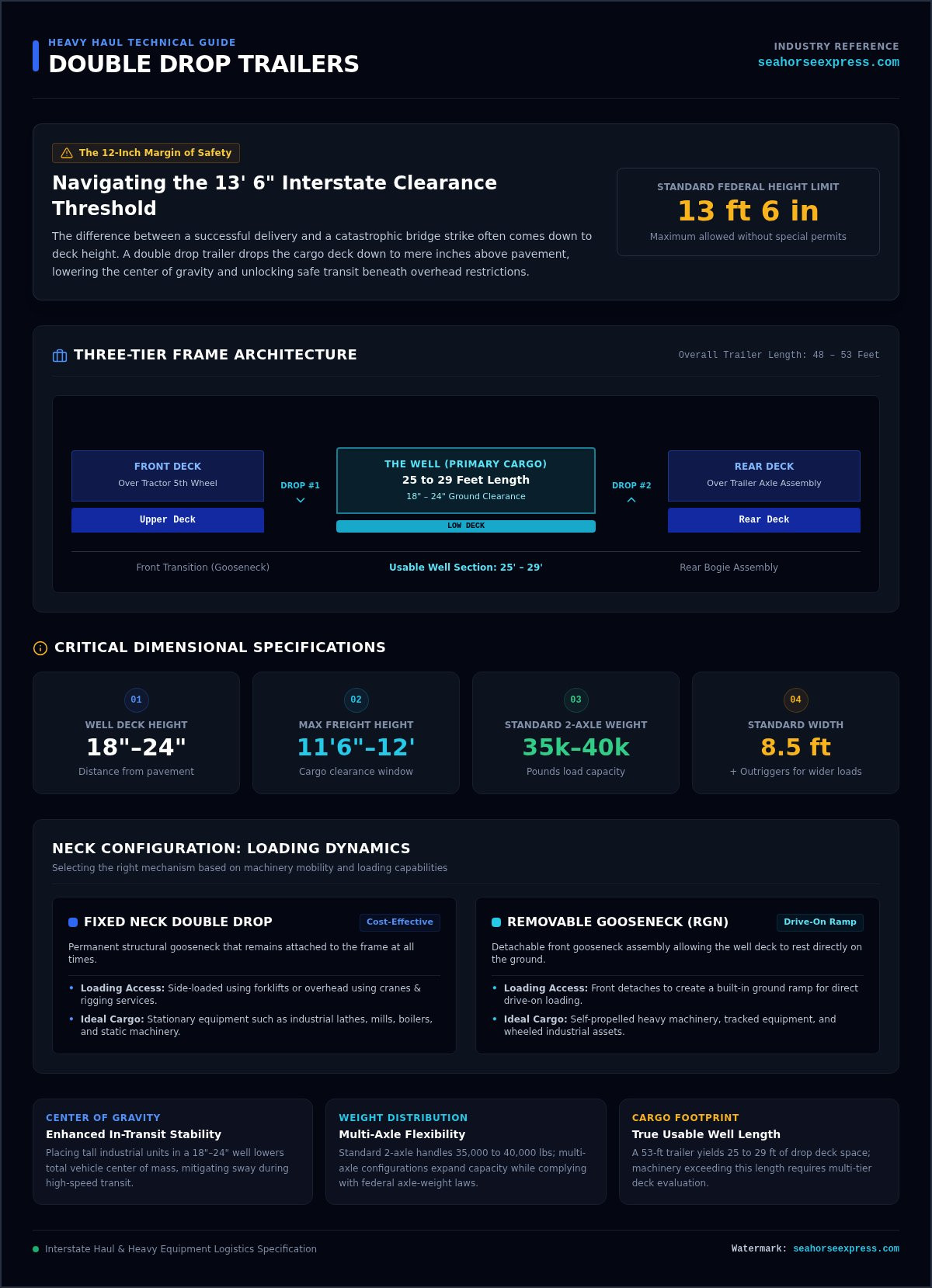
A double drop trailer is a specialized heavy-haul vehicle engineered specifically to handle freight with excessive height. Its most distinguishing feature is the "well," a lowered center section positioned between the front and rear axles. This design allows the trailer deck to sit significantly closer to the road than a standard flatbed. By lowering the cargo height, logistics teams can avoid many of the routing restrictions associated with low-clearance bridges and utility lines.
The name "double drop" refers to the specific structural transitions of the frame. The deck drops twice: once immediately after the gooseneck and once again just before the rear axle assembly. This creates a three-tier configuration:
- Front Deck: Located over the tractor's fifth wheel.
- Well: The lower middle section for primary cargo.
- Rear Deck: Positioned over the trailer axles.
The primary purpose of this equipment is to transport tall cargo that exceeds the standard interstate height limit of 13 feet, 6 inches.
The Anatomy of the Well
The well is the primary loading zone for tall freight. In a standard configuration, the deck height within the well ranges from 18 to 24 inches above the pavement. This low profile is essential for shipping industrial tanks, boilers, and large-scale manufacturing units that require every inch of available clearance. Understanding lowboy and double drop trailer mechanics helps project managers visualize how these height savings translate into safer, more efficient route planning. Beyond clearance, the lowered deck also drops the load's center of gravity, which significantly improves stability during high-speed transit.
Fixed Neck vs. Removable Gooseneck (RGN) Double Drops
Choosing between neck configurations depends largely on how the cargo will be loaded. Fixed neck double drop trailers are permanent structures where the gooseneck doesn't detach. Because the front is blocked, loading must occur from the side using forklifts or from above using machinery dismantling and rigging services. This is a common choice for stationary industrial equipment like lathes or mills.
In contrast, a Removable Gooseneck (RGN) double drop allows the front section to detach from the trailer body. Once the neck is removed, the front of the well becomes a ramp. This versatility is necessary for self-propelled machinery that needs to be driven directly onto the deck. While the RGN offers more loading options, the standard fixed-neck double drop trailer remains a cost-effective and reliable staple for cargo that doesn't require drive-on capabilities.
Technical Specifications: Dimensions and Weight Capacity
Precision in measurement is the foundation of a successful heavy haul operation. While a standard double drop trailer typically measures between 48 and 53 feet in total length, the most critical dimension for shippers is the well length. In most industry-standard configurations, the well provides a loading space of 25 to 29 feet. This distinction is vital; a 53-foot trailer doesn't equate to 53 feet of usable low-deck space. Shippers must account for the space occupied by the front and rear decks when calculating how their equipment will sit on the frame.
Weight and width also dictate the equipment configuration. Standard units are 8.5 feet wide, but they often feature outriggers, which are brackets that extend from the side of the trailer to support wider loads. Regarding weight, a standard two-axle double drop trailer handles between 35,000 and 40,000 pounds. For loads exceeding these limits, we utilize multi-axle setups that distribute the weight more effectively across the road surface. Adhering to federal commercial vehicle size regulations ensures that your shipment remains compliant with interstate safety standards while avoiding costly fines.
Standard Double Drop Dimensions Table
The following specifications represent the typical capabilities of trailers within our specialized fleet. These figures help determine if your cargo can clear standard infrastructure without requiring specialized permits.
- Deck Height: 18 to 24 inches from the ground.
- Maximum Freight Height: 11 feet 6 inches to 12 feet, depending on specific trailer clearance.
- Maximum Weight Capacity: 35,000 to 40,000 lbs for standard two-axle units.
Ground Clearance and Route Planning
The low-profile design that makes these trailers valuable also introduces specific operational risks. With a deck sitting just 18 inches off the ground, ground clearance becomes a primary concern during transit. Steep inclines, high-arched railroad crossings, and uneven industrial driveways present high-centering hazards that can stall a shipment or damage the trailer frame. Expert route surveys are mandatory for these loads to identify potential obstacles before the truck leaves the yard.
Turning radius is another factor influenced by trailer length. A 53-foot trailer requires significantly more room to maneuver in tight industrial sites than a 48-foot unit. Our team provides comprehensive heavy hauling services that account for these technical limitations during the planning phase. We analyze the physical constraints of both the pickup and delivery locations to ensure the equipment can navigate the site safely. This methodical approach to planning prevents delays and protects the integrity of your high-value assets throughout the journey.
Double Drop vs. RGN vs. Step Deck: Choosing the Right Trailer
Selecting the right trailer involves balancing vertical clearance requirements with loading logistics. While a step deck trailer offers a single drop behind the tractor, it usually maintains a deck height between 34 and 42 inches. In contrast, a double drop trailer sits significantly lower, providing an additional 12 to 24 inches of vertical space. This difference is often what allows a load to pass under standard bridge clearances without requiring an escort vehicle or specialized route adjustments.
The primary operational distinction between a standard double drop and a Removable Gooseneck (RGN) is the loading method. Standard double drops are typically fixed-neck units. Since the front doesn't detach, you must load cargo from the side or from above. This makes the double drop a more economical choice for static freight compared to multi-axle RGNs, which carry higher operational costs due to their complex hydraulic systems. Additionally, the lower deck height of the double drop provides a superior center of gravity. This stability is critical for top-heavy industrial machinery, ensuring the load remains secure according to FMCSA cargo securement rules during transit.
When to Choose a Double Drop
A double drop trailer is the optimal solution for static industrial equipment that doesn't possess its own power source. Items such as large transformers, CNC machines, and storage tanks are perfect candidates for this trailer type. These assets are usually placed into the well using cranes or heavy-duty forklifts during machinery dismantling and rigging operations. If your cargo is exceptionally long as well as tall, extendable double drop trailers can expand the well length to accommodate the footprint while keeping the height within legal limits.
When to Opt for an RGN Instead
An RGN is mandatory when the cargo must be driven onto the trailer. If you're moving self-propelled construction equipment, like excavators or pavers, the detachable front of an RGN creates the necessary ramp for loading. RGNs are also the preferred choice for extremely heavy loads that require 10 or more axles to distribute weight safely across interstate highways. Seahorse Express maintains a diverse fleet including both trailer types, allowing our logistics planners to select the equipment that maximizes safety while minimizing your total transport expenditure.
Applications: What Cargo Requires a Double Drop Trailer?
Identifying the specific freight that necessitates a double drop trailer is a critical step in avoiding unnecessary logistical delays. Most applications involve high-profile assets that cannot be dismantled into smaller components. In the industrial sector, this includes heavy-duty lathes, milling machines, and large-scale manufacturing units. These machines often feature a high vertical profile that would exceed legal limits on a standard flatbed. Similarly, the energy sector relies on these trailers to move massive transformers and small boilers. Even wind turbine components, which require extreme stability and clearance, are frequently transported using this specialized equipment.
Construction and aerospace projects also present unique challenges that only a low-profile deck can solve. Pre-fabricated steel frames or specialized tall structures often exceed 10 feet in height, leaving little room for error when passing under infrastructure. In aerospace logistics, large fuselage sections or sensitive satellite equipment require both the vertical clearance of a double drop and the smooth transit provided by its low center of gravity. These applications demonstrate that the trailer is not just a carrier but a strategic tool for high-stakes transport.
Specialized Industrial Freight
Utilizing a double drop trailer often prevents a load from being classified as a "superload," which carries significantly more regulatory oversight and higher fees. By utilizing the well to drop the cargo height, shippers can frequently keep the total height under the threshold that triggers the requirement for expensive route-clearing escorts or bucket truck crews. By lowering the deck height, double drops reduce the need for route-clearing escorts on many common industrial corridors. For high-value or sensitive assets, we integrate custom crating solutions to protect the cargo from road debris while it sits in the lower well. This combination of structural clearance and protective packaging ensures that sensitive machinery arrives at its destination without environmental or structural damage.
Permitting and Regulatory Compliance
Navigating the US Interstate system requires a deep understanding of varying state-level height restrictions. While federal standards exist, individual states often have unique bridge clearances and permit requirements that change based on the specific route. Planning a long-haul move involves complex multi-state permit coordination to ensure the truck can legally traverse every mile of the journey. Seahorse Express manages this entire process, securing the necessary oversized load permits and conducting route surveys to identify potential hazards before transit begins. If you're planning a complex move for tall equipment, contact us for expert domestic transport and permitting support.
Planning Your Heavy Haul with Seahorse Express
Successful heavy hauling is a product of meticulous planning and technical precision. We don't just provide a trailer; we manage the entire lifecycle of the shipment. This process begins with machinery dismantling and rigging services, ensuring that your assets are prepared for transport before they ever touch the deck of a double drop trailer. By centralizing these services, we eliminate the communication gaps that often lead to coordination failures at the loading site.
Safety serves as our primary metric for success. We maintain rigorous driver standards and provide 24/7 expert support for multi-state permit compliance. This constant availability ensures that even if route conditions change unexpectedly, our team is ready to coordinate adjustments immediately. Our commitment to safety protects your high-value cargo and ensures that every movement remains within the strict bounds of regulatory requirements.
The Seahorse Advantage in Specialized Transport
We operate a national fleet of specialized equipment designed to handle the most challenging industrial assets. Our capabilities extend to managing loads up to 400,000 lbs across North America, utilizing everything from standard units to extendable double drop trailer configurations. For complex industrial relocations, our project managers oversee every detail, including custom crating for sensitive components and the coordination of crane services for final placement. This comprehensive approach transforms a difficult logistics hurdle into a controlled, predictable process.
Requesting a Specialized Transport Quote
To provide an accurate logistics plan, our team requires specific data regarding your cargo. We evaluate your load based on several critical factors:
- Exact dimensions including length, width, and height.
- Total weight and specific weight distribution points.
- Physical constraints at both the origin and destination sites.
- Required delivery windows and any site-specific rigging needs.
Our engineering team analyzes this information to determine the most efficient trailer type and route. We don't rely on estimates; we use precise calculations to ensure the equipment dispatched to your site is perfectly suited for the task at hand. This level of preparation prevents site-level delays and ensures your project stays on schedule. Contact Seahorse Express for a Heavy Haul Consultation to begin your project evaluation.
Optimizing Your High-Clearance Logistics Strategy
Selecting a double drop trailer is a strategic decision that balances physical clearance with operational efficiency. You've learned that the "well" design is essential for moving tall industrial assets while avoiding the logistical delays of bridge strikes or utility interference. Success in heavy hauling requires more than just the right equipment; it demands precise measurement of well dimensions and proactive coordination of multi-state permits. By understanding these technical specifications, you can better protect your high-value cargo and ensure a smoother transit process across North America.
Seahorse Express provides the expert oversight necessary for these complex movements. We manage loads up to 400,000 lbs and offer national coverage across the US and Canada. Our team includes expert permitting and route planning in every project, ensuring your freight moves legally and safely from pickup to final placement. Whether you're relocating a single mill or an entire manufacturing facility, we have the specialized fleet and rigging expertise to execute the job correctly. Get a Specialized Heavy Haul Quote from Seahorse Express. We're ready to help you navigate your most challenging transport requirements with confidence.
Frequently Asked Questions
What is the maximum height of cargo on a double drop trailer?
The maximum height for cargo on a double drop trailer typically ranges between 11 feet 6 inches and 12 feet. This depends on the specific deck height of the well, which usually sits 18 to 24 inches above the road surface. By utilizing this lower profile, you can transport tall equipment while keeping the total height under the standard 13 foot 6 inch limit. This often prevents the need for specialized escorts.
How much weight can a standard double drop trailer carry?
A standard two-axle double drop trailer generally carries between 35,000 and 40,000 pounds. For loads that exceed these limits, we utilize specialized multi-axle configurations that can manage significantly heavier freight. Seahorse Express has the technical capability to coordinate shipments up to 400,000 pounds across North America. We analyze your cargo's weight distribution to select the specific trailer setup that ensures safety and remains compliant with all interstate bridge laws.
Can you drive a tractor onto a double drop trailer?
Driving a tractor or other self-propelled machinery onto the deck is only possible if you use a Removable Gooseneck (RGN) configuration. If the trailer has a fixed neck, the front section doesn't detach; this means you must load the equipment from the side or with a crane. We offer both fixed and RGN units to match your specific loading requirements. Our rigging experts can assist in determining which loading method is safest for your industrial assets.
What is the difference between a lowboy and a double drop trailer?
While both trailers are designed for heavy hauling, a double drop features two distinct frame transitions that create a lowered middle well. A standard lowboy often refers to a trailer with a single drop behind the gooseneck. The double drop design specifically includes a rear deck that sits higher than the well but lower than the front deck. This tiered structure is ideal for stabilizing top-heavy cargo while providing maximum vertical clearance for tall industrial components.
Do double drop trailers require oversized load permits?
Using this equipment doesn't automatically trigger the need for permits. In fact, many logistics managers choose this trailer specifically to keep their load within legal height limits and avoid permitting fees. However, if your cargo still exceeds 13 feet 6 inches even when sitting in the well, an oversized load permit is mandatory. We provide 24/7 expert support to manage the complex multi-state permitting and route planning required for these high-profile shipments.
What is the length of the 'well' in a double drop trailer?
The usable length of the well in a standard 48-foot or 53-foot double drop trailer typically measures between 25 and 29 feet. It's vital to remember that the total trailer length includes the front and rear decks, which sit higher than the well. You must ensure your cargo's footprint fits entirely within the lower section to achieve the necessary height clearance. Our team verifies these dimensions during the planning phase to confirm the equipment matches your freight.
How does ground clearance affect double drop trailer routes?
Ground clearance is a critical safety factor because the deck sits only 18 to 24 inches above the pavement. This low profile makes the trailer susceptible to high-centering on steep industrial driveways or arched railroad crossings. Our route planning process includes identifying these physical obstacles before the truck departs. We conduct thorough route surveys to ensure the path is clear of terrain that could damage the trailer frame or stall your high-value shipment.
Are double drop trailers available for transport between the US and Canada?
Yes, Seahorse Express provides comprehensive transport services between the United States and Canada. We manage the cross-border logistics, including customs coordination and regulatory compliance for both countries. Our fleet of specialized trailers is available for long-haul moves that require seamless movement across North American borders. We handle the entire project from initial machinery dismantling to final delivery, ensuring your cargo arrives safely regardless of the distance or international requirements involved.
