
A shipping container can cross five thousand miles of ocean without incident, only to sit immobilized fifty yards past the terminal berth. Treating drayage services as standard short-haul trucking is often the exact oversight that triggers supply chain disruptions. In intermodal logistics, the dray is your strategic control point, determining whether import cargo flows predictably inland or stalls at congested gates.
You already know the frustration of watching tight receiving schedules unravel while gate delays mount and free-time windows compress. Terminal bottlenecks, missing chassis pools, and surprise detention penalties quickly turn planned margins into unexpected operational losses. Discover how specialized drayage services eliminate costly terminal bottlenecks and streamline container movement nationwide, keeping both standard boxes and complex project cargo moving without interruption.
Below, you will explore official transport classifications, key accessorial charges, and the operational criteria required to select a nationwide logistics partner capable of protecting your delivery schedules.
Key Takeaways
- Understand how specialized drayage services bridge the transfer points between ocean terminals, rail ramps, and inland facilities to maintain cargo velocity.
- Identify the core transport classifications to determine whether pier moves, cross-town shuttles, or door-to-door transit match your supply chain profile.
- Differentiate between port demurrage, ocean carrier detention, and equipment per diem while deploying proactive yard staging to eliminate daily penalty fees.
- Audit potential carriers effectively by verifying active interchange agreements, clean safety compliance ratings, and access to specialized tri-axle chassis fleets.
- Discover the efficiency gains of integrating container retrieval directly with off-dock transloading, industrial staging, and heavy haul transport.
What Are Drayage Services and Why Are They Vital to Modern Supply Chains?
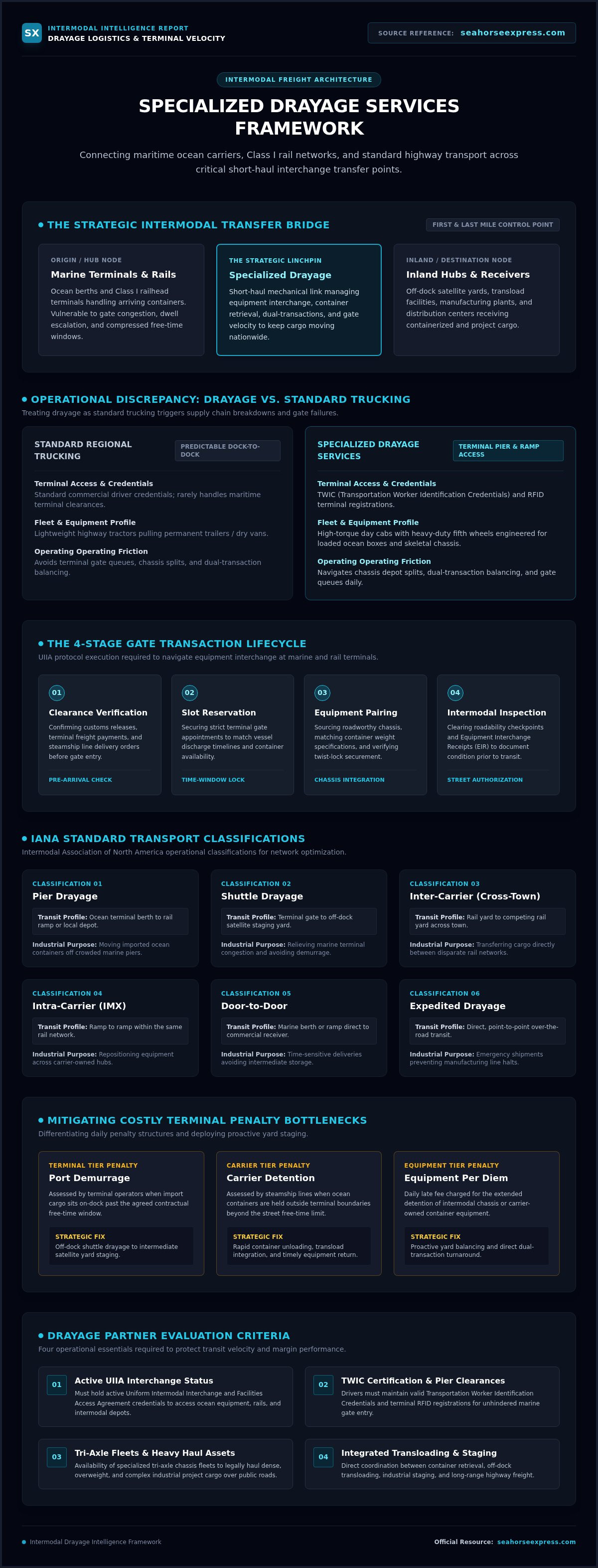
Specialized drayage services manage the transport of containerized cargo over short distances between marine terminals, inland railheads, and intermediate transfer facilities. Rather than simple point-to-point transit, drayage operates as the critical mechanical bridge connecting maritime ocean carriers, Class I rail networks, and standard highway freight. When a single link in this intermodal chain falters, dwell times escalate rapidly, triggering inventory shortfalls and compound detention penalties across nationwide commercial supply networks.
The Core Role of Drayage in Containerized Freight Logistics
Modern container movements require precise equipment interchange protocols. Drayage motor carriers must maintain an active Uniform Intermodal Interchange and Facilities Access Agreement (UIIA), granting operational access to equipment belonging to steamship lines, railroads, and intermodal equipment providers. Navigating intermodal drayage requires rigorous coordination across the gate transaction lifecycle:
- Clearance verification: Confirming customs releases, terminal freight payments, and steamship line delivery orders before gate entry.
- Slot reservation: Securing strict terminal gate appointments to match vessel discharge timelines and container availability.
- Equipment pairing: Sourcing roadworthy chassis, matching container weight specifications, and verifying twist-lock securement.
- Intermodal inspection: Clearing roadability checkpoints and equipment interchange receipts (EIR) to document unit conditions prior to street transit.
Short-Haul Trucking vs. Drayage: Understanding the Key Differences
While standard regional trucking relies on predictable dock-to-dock appointments, port drayage demands rigorous regulatory and terminal clearances. Drivers must possess Transportation Worker Identification Credentials (TWIC) and specific terminal RFID registrations to access secure maritime berths. Standard highway dry vans rarely face the complex interchange friction inherent to marine piers.
Vehicle specifications also diverge significantly. Regional trucking typically utilizes lightweight highway tractors pulling permanent trailers. In contrast, drayage fleets deploy specialized day cabs equipped with high-torque powertrains and heavy-duty fifth wheels engineered to pull loaded ocean containers mounted on separate skeletal chassis. Standard highway carriers avoid terminal gate queues, dual-transaction balancing, and off-dock chassis depot splits. Qualified drayage operators specialize exclusively in resolving these daily intermodal friction points.
The Primary Classifications of Drayage Services Across Intermodal Networks
Intermodal transport relies on distinct operational categories to move freight through regional bottlenecks. Selecting the wrong profile creates transit delays and improper equipment assignments. The Intermodal Association of North America (IANA) defines standardized classifications for drayage operations, each serving a targeted logistical function:
| Classification | Transit Profile | Primary Industrial Use Case |
|---|---|---|
| Pier Drayage | Ocean terminal berth to rail ramp or local depot | Moving imported ocean containers off marine piers |
| Shuttle Drayage | Terminal gate to off-dock satellite staging yard | Relieving marine terminal congestion and avoiding demurrage |
| Inter-Carrier (Cross-Town) | Rail yard to competing rail yard across town | Transferring cargo between disparate rail networks |
| Intra-Carrier (IMX) | Ramp to ramp within the same rail network | Repositioning equipment across carrier-owned hubs |
| Door-to-Door | Marine berth or ramp direct to commercial receiver | Time-sensitive deliveries avoiding intermediate storage |
| Expedited Drayage | Direct, point-to-point over-the-road transit | Emergency shipments preventing manufacturing line halts |
Marine Port Drayage and Rail Ramp Intermodal Transfers
Marine pier drayage transfers containers directly from vessel gantry cranes to staging lanes or local railheads. Drivers navigate security gates using credentials like the Transportation Worker Identification Credential (TWIC). Coordinated pickups are essential under current FMC demurrage and detention billing requirements, which hold cargo owners directly accountable for gate dwell. Rail-to-truck drayage mirrors this structure inland, securing containers off railcars to complete the final ground leg.
Specialized Drayage for Flat Racks, Open Tops, and Over-Dimensional Cargo
Standard container logistics cannot accommodate industrial project machinery. Out-of-gauge shipments require open-top containers or flat racks with custom securement points. Flat rack transport presents severe weight-distribution challenges, demanding heavy-duty tri-axle chassis to maintain axle compliance. High-cube open tops with top-heavy equipment require route surveys for overhead bridge clearances before leaving the marine gate. For out-of-gauge ocean shipments, partnering with a specialist in drayage and transload of flat racks and open tops ensures compliant equipment securement and specialized chassis availability.
Expedited, Cross-Town, and Door-to-Door Container Movements
Cross-town drayage bridges the gap when two railroad lines lack direct rail interchange tracks. Drivers transfer containers across metropolitan areas to keep multi-line rail bills moving. Door-to-door moves bypass intermediate yards, running straight to commercial loading docks. When assembly operations face imminent shutdown, expedited drayage prioritizes immediate gate retrieval and uninterrupted transit to keep production moving.
Managing Drayage Bottlenecks: Demurrage, Detention, and Terminal Velocity
Terminal congestion can rapidly compromise supply chain budgets when container flows stall at intermodal gates. Seaport delays and restricted gate hours compress free-time windows, causing dwell times to climb. Missed appointment slots compound these delays, stranding equipment on the docks. Securing reliable drayage services with proactive container monitoring is critical to maintaining terminal velocity and avoiding steep non-performance penalties.
Demurrage vs. Detention: Critical Differences in Container Penalties
Demurrage and detention represent distinct accessorial risks that escalate on tiered daily schedules. The Federal Maritime Commission rule on demurrage and detention billing requirements mandates strict invoice compliance and dispute windows, making it essential to identify where each charge originates:
- Port Demurrage: Storage fees billed by terminal operators or ocean carriers while a loaded container remains inside the port terminal or rail yard past the allotted free time.
- Equipment Detention: Per-day charges levied by the steamship line when the customer holds container equipment outside terminal gates beyond authorized return allowances.
- Chassis Per Diem: Daily rental assessments charged by intermodal chassis pools for equipment retained off-terminal while handling inland transit or unloading.
Chassis Availability and Terminal Gate Congestion Management
Deficits in pool chassis remain a primary driver of port congestion. When ocean terminals experience shortages, standard carriers encounter chassis splits, forcing drivers to travel to secondary depots before picking up loaded imports. Operating private chassis fleets mitigates this vulnerability by eliminating dependence on congested public pools. Private equipment streamlines dual transactions, allowing a driver to drop an empty ocean box and mount an import load in a single gate cycle, cutting gate turn time significantly.
Direct Drayage vs. Container Transloading: Mitigating Storage Traps
Transporting ocean containers directly across the country often creates severe equipment detention liability. Transloading presents an efficient alternative. Intermodal draymen pull containers directly to near-port cross-dock facilities, destuff the cargo into standard domestic trailers, and return empty marine equipment before the standard free-time clock expires.
For industrial machinery, transloading requires specialized rigging hardware and overhead crane capabilities. Riggers extract heavy assemblies from flat racks or open tops, securing them directly onto specialized trailers for domestic heavy haul. This method insulates the shipper from compounding marine equipment detention while optimizing over-the-road freight configurations.
How to Evaluate and Select a Qualified Drayage Services Partner
Choosing an intermodal carrier requires a methodical review of operational credentials, physical fleet capabilities, and interchange authority. Shippers managing industrial freight cannot rely on brokers who treat container haulage like routine dry van dispatch. A reliable provider must demonstrate technical competence across marine berths and railhead networks before you tender critical cargo.
Verifying Terminal Access, Operating Authority, and Safety Credentials
Start your evaluation by confirming the carrier's active standing within the Uniform Intermodal Interchange and Facilities Access Agreement (UIIA). Without active interchange agreements, a driver cannot pull equipment from rail lines or ocean carriers. Verify that every company driver holds valid maritime security badges, including TWIC, alongside necessary terminal-specific credentials. Finally, examine the carrier's Department of Transportation safety records and confirm cargo insurance coverage limits align with your high-value commercial freight.
Assessing Heavy Haul Capabilities for Out-of-Gauge Maritime Cargo
Transporting standard dry boxes is straightforward; handling over-dimensional project machinery is not. When vetting providers for complex moves, audit their trailing equipment and permitting infrastructure directly:
- Chassis fleet versatility: Confirm ready access to specialized tri-axle, low-profile, or extendable chassis engineered to balance high-concentration axle weights.
- Permitting and corridor routing: Validate carrier experience securing municipal and state heavy-haul permits along critical intermodal corridors.
- Securement expertise: Ensure drivers and rigging crews are formally trained in blocking, bracing, and multi-point chain binding for heavy machinery staged on open flat racks.
Technology Integration: Visibility, Milestone Alerts, and Exception Management
A capable logistics partner must provide automated container milestone tracking. Modern systems should notify dispatch the moment an ocean vessel completes discharge, instantly matching the container against active terminal holds or customs inspections. Automated free-time countdowns protect against compounding accessorial charges before appointments slip.
Gate congestion requires immediate exception management. If a terminal experiences extended queue delays or equipment shortages, your provider must redirect assets quickly to protect the delivery schedule. To secure dedicated container support with proven terminal gate execution, request a port drayage freight assessment to protect your supply chain from costly terminal disruptions.
Scaling Industrial Freight with Integrated Nationwide Drayage and Logistics
Fragmented vendor networks create friction across industrial supply chains. When one carrier manages port clearance, another handles rigging, and a third coordinates over-the-road freight, miscommunications inevitably lead to storage penalties and dropped schedules. Unifying specialized drayage services with direct transloading, custom crating, and heavy hauling creates operational cohesion that keeps complex industrial cargo moving smoothly.
Comprehensive Management for Flat Racks, Open Tops, and Project Cargo
Heavy machinery and out-of-gauge equipment require specialized handoffs the moment they clear terminal gates. Seamless project execution depends on tightly synchronized transfer operations:
- Direct rigging transitions: Staging mobile cranes and experienced rigging teams at near-dock facilities to extract heavy industrial assemblies safely from open tops and flat racks.
- Trailer transitions: Moving out-of-gauge assets off marine equipment directly onto multi-axle lowboys, step-decks, or heavy-haul trailers.
- Single-source accountability: Eliminating handover friction between separate gate draymen and inland line-haul carriers, which protects machinery warranties and keeps transit schedules intact.
Nationwide Port and Rail Coverage with Secure Intermediate Staging
Industrial supply chains often encounter site delays that prevent immediate delivery to manufacturing plants. Coordinating container recovery with secured warehousing and outdoor laydown yards solves this timing gap. Drivers retrieve loaded units across every major seaport and rail ramp nationwide, transferring them into secure staging properties where equipment can be safely stored, inspected, or repacked into engineered industrial crates for long-term domestic asset preservation.
Partner with Seahorse Express for Nationwide Specialized Drayage
Seahorse Express delivers full-service drayage and transload capabilities for flat racks and open tops at every major port nationwide. Our heavy-transport infrastructure bridges the critical gap between ocean container berths, secure warehousing, and over-the-road transit. Whether you are importing oversized machinery or coordinating complex rail ramp handoffs, our dedicated specialists manage the equipment, permits, and terminal logistics required to eliminate bottlenecks and protect project timelines.
Streamline Your Intermodal Freight Operations
Intermodal efficiency demands more than booking a tractor to clear a gate. Preventing compounding storage penalties requires aligning gate appointment windows, deploying dedicated chassis assets, and executing synchronized pickups before free time expires. When managing complex shipments, integrating specialized drayage services directly with off-dock transloading, machinery rigging, and over-the-road transport protects project budgets from costly terminal bottlenecks.
Seahorse Express provides end-to-end drayage and transload handling for standard, flat rack, and open-top containers across every major seaport and rail ramp nationwide. By combining port retrieval with on-site machinery dismantling, custom crating, and heavy-haul trucking, we ensure high-consequence cargo moves seamlessly from marine berths to final commercial destinations. Request a specialized drayage and heavy-haul consultation with Seahorse Express to eliminate dwell times and secure steady capacity for your critical freight.
Frequently Asked Questions
What is the typical distance covered by drayage services?
Drayage moves typically cover short operational distances under one hundred miles between marine terminals, railheads, and nearby industrial facilities. However, regional corridors can extend up to two hundred or three hundred miles when connecting seaports directly to inland manufacturing clusters. Because drayage services focus on completing round trips within a single operational shift, transit boundaries are generally dictated by driver hours-of-service regulations rather than long-haul highway routing.
What is the difference between demurrage and detention charges?
Demurrage penalizes cargo left inside the port or rail terminal gates, while detention applies when equipment remains outside terminal boundaries past the agreed free-time period. Terminal operators assess demurrage to clear dockside congestion and accelerate container evacuation. Conversely, ocean carriers assess detention, often referred to as per diem, when shippers don't return empty containers or specialized chassis to authorized depots before the contracted free-time window closes.
Can drayage carriers transport overweight or over-dimensional ocean containers?
Yes, specialized carriers routinely handle overweight, oversized, and out-of-gauge containers by utilizing heavy-duty trailing equipment. Hauling heavy machinery on open-top or flat-rack containers requires tri-axle chassis to distribute concentrated axle weights within federal bridge formula limits. Qualified carriers manage the entire process, including securing state overweight permits, planning approved arterial transit routes, and deploying rigging crews to ensure safe transport from terminal gates.
What documents are required to release a container for port drayage?
Releasing an import container requires an ocean Delivery Order, customs clearance validation, and a valid terminal gate appointment confirmation. Before gate entry, the ocean carrier must transmit an electronic freight release confirming all maritime bills of lading are satisfied. The motor carrier must also maintain an active equipment interchange agreement and confirm that customs holds or agriculture exams are officially cleared within the terminal operating system.
Why is a TWIC card necessary for port drayage drivers?
A Transportation Worker Identification Credential (TWIC) is mandatory for port drivers because it grants unescorted access to federally regulated maritime security areas. The Maritime Transportation Security Act requires biometric credentials to ensure that commercial personnel entering marine container yards and shipping berths have passed comprehensive security threat assessments. Without a valid TWIC, drivers can't enter secure terminal gates, causing missed pickup windows and immediate cargo dwell delays.
How does container transloading differ from direct drayage delivery?
Direct drayage delivers the original marine container straight to a customer dock, while transloading transfers cargo from the ocean container into domestic trailers at a near-port staging facility. Direct delivery works well for local facilities, but long-distance inland movements often trigger severe equipment detention. Transloading allows shippers to return the ocean container quickly to avoid per diem fees, while consolidating industrial goods into over-the-road equipment for cost-effective inland transport.
What happens if an ocean container fails terminal gate safety inspections?
When an ocean container or chassis fails an inbound or outbound gate inspection, terminal personnel reject the equipment and generate an Equipment Interchange Receipt noting the defect. Roadability violations, such as faulty brakes, bald tires, or damaged twist locks, require the driver to route the unit to an on-dock roadability repair depot. These mechanical rejections delay retrieval times and frequently cause drivers to miss designated appointment windows.
