
A crane truck can be the easiest part of a machinery move to get wrong. A machine may not be suitable for lifting and transport intact, and the right lifting equipment won’t resolve access limits, tight clearances, or the need to dismantle and secure components. Heavy machinery dismantling services can be part of a larger move, so define the full scope before arranging a lift.
Whether crane truck hire covers a job from pickup to delivery depends on the machinery’s dimensions and weight, site conditions, and how lifting, rigging, and haulage will fit together. Hiring lifting equipment covers only the tasks in the agreed arrangement. Confirm responsibilities with each provider before scheduling.
This article explains what to assess before choosing crane truck hire, what information helps plan a machinery move, and when dismantling, rigging, and transport coordination need closer attention. Seahorse Express provides machinery dismantling and rigging, along with heavy hauling and over-dimensional transportation. It doesn’t supply crane trucks, but its services may complement lifting equipment arranged separately.
Key Takeaways
- Assess the machine, lift requirements, site access, and destination before choosing lifting equipment.
- Gather verified weight, dimensions, center of gravity, lifting points, and manufacturer handling instructions to support lift planning.
- Clarify the separate responsibilities of crane truck hire, rigging, dismantling, and heavy hauling before scheduling work.
- Heavy machinery dismantling services may be needed when a machine cannot be moved intact or needs specialist preparation for transport.
- Confirm who coordinates each stage, from disconnection and lifting through transport and receiving-site placement.
When Does Crane Truck Hire Make Sense for Heavy Machinery Dismantling?
Crane truck hire may suit a machinery move when a truck-mounted crane can reach the load, lift it safely within the equipment’s capabilities, and support the planned handling sequence. It isn’t automatically the right choice for every machine or removal site. Weight, dimensions, lifting points, center of gravity, access, overhead obstructions, and destination conditions all affect equipment suitability.
Crane truck hire is an arrangement for a truck-mounted crane and operator to lift and handle a load. Transport is included only if the provider’s agreed scope covers it. Some moves use separate lifting equipment and haulage. Confirm how the proposed setup accounts for both the pickup site and the machinery’s onward journey.
What does crane truck hire typically cover?
The crane performs the lift, and the truck provides the mounted equipment. The truck may also carry the load, depending on the arrangement. Hire doesn’t automatically include machine disconnection, dismantling, rigging, loading coordination, or transport to the destination. Ask the provider to specify whether an operator, lifting equipment, setup, and site coordination are included. Confirm who supplies rigging and who manages each handoff.
Rigging prepares and secures a load for lifting. It is a separate responsibility from operating the crane. For a basic overview of the process, see Rigging (material handling).
When might machinery need dismantling before a lift?
Disassembly may be necessary if the complete machine cannot pass through an opening, fit the available lifting setup, or meet transport constraints in its current configuration. Consider how components will be separated, protected, moved, and handled at the destination. Personnel qualified for the work should address mechanical, electrical, and process connections, with responsibilities agreed before lifting begins.
For a broader planning sequence, refer to the machinery removal planning guide. Seahorse Express offers heavy machinery dismantling services and rigging, which may complement lifting equipment arranged separately. Its heavy hauling and over-dimensional transportation can also support transport planning, depending on the move’s requirements.
How to Assess Crane Truck Suitability for an Industrial Machine
Start with a clear picture of the machine and the full path it must travel, from its current position to the delivery point. Load weight alone cannot establish whether a crane truck is suitable. Lift geometry, access, setup conditions, and the destination matter too. Use this pre-assessment to identify missing information before requesting an equipment recommendation.
- 1. Identify the machine. Record its make, model, configuration, and whether it will move intact or in sections.
- 2. Document its specifications. Gather verified weight and dimensions, center of gravity, lifting points, and manufacturer handling instructions.
- 3. Inspect the access and route. Check the approach, travel path, turning clearances, doorways, floor capacity, overhead obstructions, and space for equipment setup.
- 4. Confirm the lift plan. Have qualified personnel assess the load, lifting arrangement, site conditions, and delivery position before selecting equipment.
What machine information should a project team gather?
Start with the machine nameplate, drawings, operating manuals, and available weight documentation. Check that these records match the machine’s current configuration, including detachable components that may affect its weight or dimensions. Record sensitive parts, preservation requirements, and any hazardous residues for review by the appropriate personnel.
Flag missing or conflicting information instead of relying on an estimate. Confirm the center of gravity and approved lifting points using reliable documentation or qualified technical review. If the machine may require heavy machinery dismantling services, identify which components need to be separated and how that affects lifting and transport planning.
Which site conditions can affect crane truck suitability?
Survey both pickup and delivery locations. Note travel paths, turning space, doorway dimensions, floor capacity, ground conditions, setup restrictions, and the position where the machine must be received. Identify overhead utilities, structural limits, and access-control requirements for assessment. A clear entrance isn’t enough if the equipment cannot reach a workable setup position or the destination cannot accommodate the load.
Ask qualified project and safety personnel to validate the proposed lift conditions and applicable requirements. Where the work falls within its scope, consult OSHA’s Hoisting and Rigging Standard alongside site-specific planning. Requirements depend on the work and should be confirmed by the people responsible for the operation.
Once specifications and access details are assembled, a transport partner can help assess dismantling, rigging, and hauling needs alongside lifting equipment arranged separately. Include Seahorse Express machinery dismantling and rigging in that coordination discussion.
Crane Truck Hire, Rigging, or Heavy Hauling: Compare the Scope
A machinery move may need several distinct capabilities. The right combination depends on the machine’s condition, how it must be prepared, and the lifting and transport requirements. Use the comparison below to identify responsibilities and clarify where one provider’s work ends and another’s begins.
| Service | Purpose | Typical responsibility | Information needed | Coordination boundary |
|---|---|---|---|---|
| Crane truck hire | Lift or handle a load with a truck-mounted crane; transport depends on the agreed scope. | The crane provider typically supplies the agreed equipment and operator for the lift. | Load weight, dimensions, lifting points, lift location, access, and delivery requirements. | Confirm whether transport, rigging, setup, and coordination are included or arranged separately. |
| Rigging | Prepare, attach, and control the load during handling. | Rigging personnel plan load attachment and positioning with the lifting operation. | Load configuration, center of gravity, approved lifting points, and handling instructions. | Rigging supports the lift but isn’t the same as supplying or operating the crane. |
| Machinery dismantling | Separate or prepare equipment for removal, handling, or transport. | Qualified personnel address the agreed disassembly and component preparation. | Machine documentation, connections, component details, and preservation needs. | Agree who handles disconnection, dismantling, packaging, and handoff to the lifting team. |
| Heavy hauling | Move qualifying industrial cargo between locations. | The transport provider plans and carries out the agreed haulage scope. | Final load dimensions and weight, pickup and delivery details, and route constraints. | Haulage begins at the agreed handoff point; it doesn’t automatically include the site lift. |
How is crane truck hire different from industrial rigging?
The crane provides lifting capability. Rigging prepares and connects the load, then supports controlled handling and positioning. These tasks must work together, but they are not interchangeable. Confirm who selects or supplies rigging, who directs the load-handling sequence, and how the crane and rigging teams will coordinate. For more detail, read the industrial rigging services buyer’s guide.
When does dismantling or heavy hauling become part of the scope?
Disassembly may be needed to prepare equipment for removal or meet transport constraints. After lifting, components may need packaging or staging before onward transport. Define the handoffs in advance: who prepares the machine, performs the lift, packages or stages components, and takes responsibility for the haul.
Seahorse Express provides heavy machinery dismantling services, rigging, heavy hauling, custom crating, and storage. These capabilities may complement lifting equipment arranged separately. For crane or derrick assembly and disassembly procedures, consult OSHA’s crane assembly and disassembly requirements. This reference concerns cranes and derricks, not the dismantling of industrial machines.
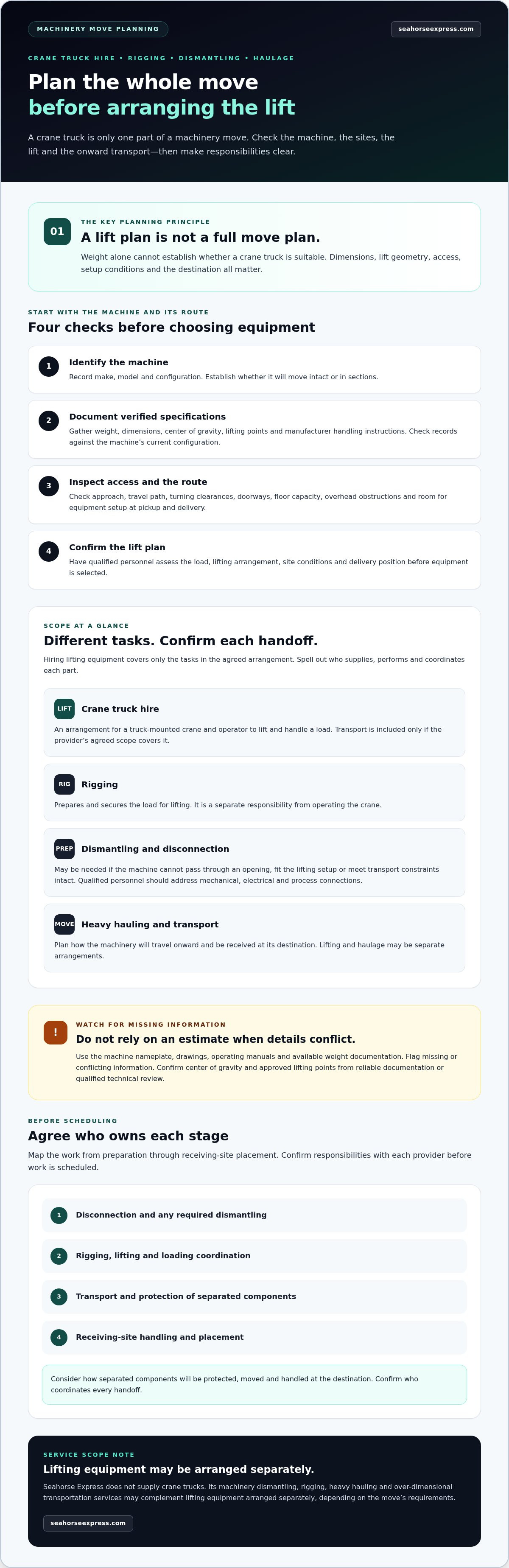
What to Confirm Before Scheduling a Machinery Lift
Before committing to a lift date, document the machine, both sites, and each provider’s responsibilities. A change in equipment configuration, access, or receiving-site readiness can affect the work sequence. If key details are uncertain, arrange a documented site review so the project team can reassess the plan before mobilization.
- Machine data: Confirm the current configuration, verified weight and dimensions, available handling documentation, and components that need separate handling.
- Site conditions: Record access routes, setup space, floor or ground conditions, obstructions, access controls, and operating restrictions.
- Scope ownership: Assign responsibility for shutdown, isolation, disconnection, dismantling, rigging, lifting, packaging, transport, and placement at the destination.
- Readiness and contacts: Identify site contacts, required approvals, receiving-site requirements, and how changes or delays will be communicated.
- Contingencies: Agree what happens if the machine differs from its documented condition or either site is not ready as planned.
Keep the checklist with the project plan and share relevant details with the site team, lifting provider, rigging personnel, and transport provider. Clear handoffs help prevent teams from arriving with different assumptions about what is included.
Which responsibilities should the project scope assign?
Name a responsible party for every stage, from preparation and lift execution to transport and receiving-site placement. Specify who approves changes, who confirms site readiness, and who must be notified if machine dimensions or access conditions differ from the plan. Record access arrangements, required approvals, and points of contact so questions have a clear route to resolution.
How can teams prepare machinery for removal and transport?
Confirm shutdown, isolation, fluid handling, and disconnection requirements with qualified site personnel. Identify parts that need separate handling or protective packaging, and decide whether custom crating is appropriate. Don’t assume one team’s scope includes another team’s preparation tasks. Document the handoff and the condition in which each component will be transferred.
If lifting and onward transport can’t happen in one sequence, plan where components will be staged and whether storage is needed. Seahorse Express offers heavy machinery dismantling services, rigging, custom crating, heavy hauling, and storage to support relevant parts of a machinery move. Discuss machinery dismantling and rigging coordination as you define the project scope.
Coordinate Machinery Dismantling and Transport Beyond the Lift
A completed lift is a transition point, not the end of a machinery move. Components may still need protection, staging, storage, or onward transport to reach their destination in the required condition. Planning these steps alongside dismantling and rigging helps define handoffs before work begins. Confirm crane truck or other lifting arrangements directly with the project team and the relevant equipment provider. Seahorse Express offers machinery dismantling, rigging, heavy hauling, custom crating, and storage, but does not provide crane truck hire.
How can integrated preparation reduce handoff uncertainty?
Align the scope for machine preparation, rigging, lifting, cargo protection, and transport. For example, if a machine will be separated into components, establish how each piece will be identified, protected, and transferred from the dismantling or lifting team to the transport provider. Agree on the condition and documentation expected at each handoff.
Custom crating may suit components that need added protection during handling or transit. Storage may also be relevant if lifting and onward transport can’t happen in one sequence. Assess these needs before arranging the move. Seahorse Express can be considered for the dismantling, rigging, crating, storage, and heavy hauling portions of a project where those services fit the required scope.
What should a project inquiry include?
Provide enough detail for the team to understand the machinery and the move, while identifying anything still unconfirmed. Useful information includes:
- Machine identification and available specifications, including weight and dimensions if verified.
- Origin and destination requirements, including delivery access and receiving-site restrictions.
- Known access limitations, site constraints, and operating requirements.
- Whether dismantling or rigging is needed, and which components may require separate handling.
- Packaging or custom crating needs, potential storage requirements, and the requested timing.
Flag missing specifications or uncertain site conditions instead of treating them as settled. The project team can then determine what needs further review and confirm lifting arrangements separately. Clear information also helps establish whether heavy machinery dismantling services, transport, crating, or storage should be considered in the agreed scope.
To discuss the machinery preparation and transport requirements for your move, discuss machinery dismantling and transport needs with Seahorse Express.
Plan the Full Move With Confidence
Choose lifting equipment only after assessing the machinery, site conditions, and complete move. Weight matters, but dimensions, lifting points, access, setup space, and delivery requirements also determine whether a crane truck is suitable. Confirm who handles dismantling, rigging, lifting, transport, and receiving-site placement so every stage has a clear owner.
Heavy machinery dismantling services may be needed to prepare equipment for removal or transport. Seahorse Express provides machinery dismantling and rigging, plus nationwide heavy hauling and over-dimensional transportation. Custom crating and commercial storage can also support industrial cargo preparation when they fit the project requirements. Crane truck hire is not a Seahorse Express offering, so confirm lifting arrangements with the relevant provider and project team.
Share machine details, site constraints, and transport requirements early to help clarify the scope and identify what needs further assessment. Discuss your machinery dismantling and transport requirements with Seahorse Express to plan the next steps for your move.
Frequently Asked Questions
What does crane truck hire include?
Crane truck hire typically provides access to a truck-mounted crane and may include an operator, but the exact scope varies by provider. Confirm the crane and vehicle arrangement, setup, operator, rigging equipment, and any site coordination included. Don’t assume hire covers machine disconnection, dismantling, load preparation, or onward transport. Request a written scope that identifies the provider’s responsibilities and any tasks your project team must arrange separately.
Can a crane truck lift and transport heavy machinery in one operation?
It may be possible, depending on the machine, lifting requirements, truck configuration, and agreed service scope. Some arrangements combine lifting and carrying; others require separate lifting equipment and haulage. Ask the provider to assess the machine’s weight and dimensions, lifting points, site access, and destination conditions. Confirm whether transport is included and whether the load and route require a different transport arrangement.
How do I know whether machinery needs dismantling before a lift?
Consider dismantling if the machine can’t pass through available access, fit the planned lifting arrangement, or meet transport constraints intact. Review its dimensions, configuration, handling instructions, and the path from its current position to the destination. Qualified personnel should assess connections and preparation requirements before work begins. Heavy machinery dismantling services may help prepare equipment for removal, but the appropriate scope depends on the specific machine and site.
Is crane truck hire the same as industrial rigging?
No. Crane truck hire concerns the lifting equipment and its agreed use, while rigging involves preparing and securing the load for handling, then supporting its controlled positioning. The services are related, but one doesn’t automatically include the other. Confirm who plans and supplies the rigging, who operates the crane, and how both teams will coordinate. This distinction helps clarify responsibilities before the lift is scheduled.
What information should I provide when requesting a machinery lift?
Share the machine’s identification, verified weight and dimensions, center of gravity, lifting points, and available manufacturer handling instructions. Include photos or drawings if available, plus pickup and delivery details, access limitations, setup space, overhead obstructions, and destination requirements. Note any dismantling, disconnection, or separate-component handling needs. Flag missing or conflicting specifications so the project team can confirm them before choosing equipment or finalizing the lift plan.
Can machinery dismantling and heavy hauling be coordinated together?
Yes, these services can be planned as connected parts of a move, depending on project requirements and provider scope. Seahorse Express offers machinery dismantling and rigging, heavy hauling, over-dimensional transportation, custom crating, and storage. Crane truck hire isn’t a listed Seahorse Express service, so confirm lifting arrangements with the project team and relevant provider. Agree on handoffs for preparation, lifting, packaging, staging, and transport.


