
A machinery move is only as well planned as the connection between lifting the equipment and transporting it afterward. When choosing industrial rigging services, look beyond lifting capability. You need a provider whose experience fits the machinery and site, plus a clear plan for coordinating dismantling, protection, and transport. Damage to valuable equipment or gaps between the rigging provider and equipment vendor are reasonable concerns. The lift is one stage of a larger move.
This guide explains how to assess a provider, prepare for the work, and reduce handoff risks between machinery handling and transportation. You’ll learn what project details to gather, how to clarify responsibilities, and what to discuss when rigging and dismantling connect with custom crating, heavy hauling, or over-dimensional transportation. You’ll also find practical questions for confirming site requirements and aligning each stage before work begins.
Key Takeaways
- Understand where rigging fits in a machinery move and how it differs from dismantling, crane rental, and freight transportation.
- Learn which load details, including weight, center of gravity, and lifting points, help inform a controlled lift plan.
- Compare industrial rigging services by scope, site coordination, equipment handling, and transportation handoffs.
- Prepare equipment, site, schedule, and destination information to help providers assess your project.
- See how rigging and machinery dismantling can connect with transport preparation, custom crating, heavy hauling, or storage.
What Industrial Rigging Services Cover in a Machinery Move
A machinery move involves more than getting a load off the floor. Rigging covers planning how heavy industrial equipment will be lifted, controlled, positioned, and handled at the origin and destination. Weight and dimensions matter, as do access routes, clearances, sensitive components, and the planned transport method.
Industrial rigging services involve the planned lifting, positioning, and handling of heavy industrial equipment as part of a machinery move. For a general overview of material-handling principles, see What is industrial rigging.
Rigging is distinct from several related scopes. Crane rental provides access to lifting equipment, while rigging covers the planning and handling needed to control a load. Machinery dismantling prepares equipment for removal, installation places or assembles it at the destination, and freight transportation moves it between locations. One provider may handle multiple related tasks, but buyers should confirm what is included and who owns each handoff.
When does machinery require professional rigging?
Consider professional rigging when equipment is heavy, awkwardly shaped, delicate, or difficult to reach using routine handling methods. Careful control may be needed when a machine contains sensitive components, has uneven load distribution, or must pass through a narrow doorway or restricted production area. These conditions affect the handling plan. The right method depends on the load and site, not on applying one standard approach to every move.
How do rigging and machinery removal work together?
Machinery dismantling can prepare an asset for lifting and removal by separating components that cannot be moved practically or safely as one unit. Plan the sequence around how each piece will be handled, protected, and transported. Clarify responsibilities among the rigging provider, equipment vendor, and carrier. Depending on the project, custom crating may protect components in transit, storage may bridge a gap between removal and delivery, and heavy hauling may be needed for the road move.
Seahorse Express provides machinery dismantling and rigging alongside custom crating, warehousing and storage, heavy hauling, and over-dimensional transportation. Confirm which services fit the equipment, site, and destination, and which tasks need coordination with another contractor. For a broader planning framework, read the machinery removal planning guide.
How Industrial Rigging Providers Plan a Safe, Controlled Lift
A sound lift plan starts with confirmed information, not assumptions. Industrial rigging services should account for the load, the route through the facility, the lift area, and what happens after the machinery is set down. Verified weight, center of gravity, and manufacturer-identified lifting points help a provider assess how the load may behave during handling. If details are missing or uncertain, flag that early so the provider can identify what needs verification.
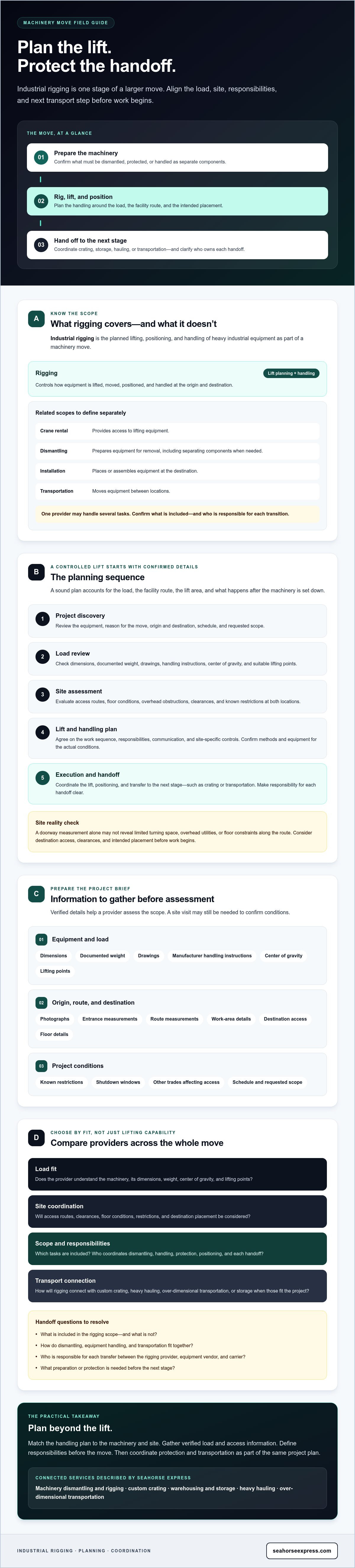
A typical planning sequence includes these stages:
- 1. Project discovery: Review the equipment, reason for the move, origin and destination, schedule, and requested scope.
- 2. Load review: Check dimensions, documented weight, drawings, handling instructions, center of gravity, and suitable lifting points.
- 3. Site assessment: Evaluate access routes, floor conditions, overhead obstructions, clearances, and known restrictions at both locations.
- 4. Lift and handling plan: Agree on the work sequence, responsibilities, communication, and site-specific controls. Confirm the methods and equipment needed for the actual conditions.
- 5. Execution and handoff: Coordinate the lift, positioning, and transfer to the next stage, such as crating or transportation. Make responsibility for each handoff clear.
Site conditions can change the scope. A machine may fit through a doorway on paper but still face limited turning space, overhead utilities, or floor constraints along the route. Consider the destination before work begins, including access, clearances, and the intended placement.
What information should buyers prepare before a site assessment?
Gather equipment dimensions, documented weight, drawings, and manufacturer handling instructions. Add photographs and measurements of entrances, routes, work areas, and destination access. Note floor details, known restrictions, shutdown windows, and other trades that could affect access. This information gives a provider a clearer basis for assessing the scope, though a site visit may still be needed to verify conditions.
Which safety and technical details need confirmation?
Ask how the provider will assess load stability, lifting points, and the handling sequence, and who will direct communication and site coordination. Applicable requirements depend on the work and location. The OSHA rigging equipment standards address construction work, so confirm whether they apply to your project and verify relevant ASME requirements with qualified project personnel. To discuss rigging and transport preparation, contact Seahorse Express.
How to Compare Industrial Rigging Services for Your Project
Compare providers against the actual work, not a broad service label. Ask about projects involving similar machinery, access constraints, and operating environments. Then establish what each provider will do, what another contractor must supply, and what remains subject to a site assessment. A clearly defined scope helps prevent gaps between dismantling, lifting, equipment protection, and transportation.
What should a rigging services comparison include?
Ask each provider the same questions so you can distinguish confirmed capabilities from items that need verification:
| Area | What to compare | What to confirm |
|---|---|---|
| Scope | Machinery dismantling, rigging, and lifting coordination | Which tasks are included and which require another contractor |
| Planning | Load information review and assessment of site conditions | How assumptions, exclusions, and unresolved details will be recorded |
| Site coordination | Access, schedule, and coordination with facility staff or other trades | Who manages site responsibilities and communicates changes |
| Handling and protection | How equipment will be handled and whether crating is in scope | Project-specific methods, equipment availability, and protection needs |
| Transport handoff | Freight coordination, heavy hauling, or storage requirements | Who arranges each stage and how the handoff is documented |
Ask providers to document dependencies and responsibilities, including schedule inputs from your facility or equipment vendor. Check that proposed crating, storage, or freight coordination fits the move instead of assuming it is part of a rigging quote. For additional industry context, the Specialized Carriers & Rigging Association offers resources on rigging industry best practices.
How do rigging services differ from crane rental?
Rigging covers planning and handling the load; crane rental concerns access to lifting equipment. These may be arranged through different providers. Confirm whether a crane is needed, who selects and supplies it, whether an operator is included, and what availability and rental terms apply. Don’t assume these arrangements are part of a rigging proposal.
Seahorse Express lists machinery dismantling and rigging, custom crating, warehousing and storage, heavy hauling, and over-dimensional transportation among its capabilities. Crane rental is not listed. For any provider, check the proposed scope against the actual equipment and site, and distinguish confirmed services from work requiring another contractor or project-specific assessment.
What to Prepare Before Hiring Industrial Rigging Services
A clear project brief gives providers a practical starting point for assessing the work. It helps identify missing information, show how rigging connects with dismantling and transportation, and distinguish confirmed requirements from details that still need review. Complete information supports a more useful assessment, but does not guarantee a particular method, schedule, or outcome. Site conditions and equipment details may still need verification.
What should a project brief include?
Gather available records before requesting an assessment. Include equipment identification and handling restrictions, then describe conditions at both ends of the move. Photos and measurements can help communicate access constraints, but identify details that are estimates rather than verified measurements.
- Equipment: Make, model, dimensions, documented weight, drawings, manufacturer handling instructions, and any known lifting or handling restrictions.
- Pickup and destination: Photos, entrance and route measurements, floor details, overhead limitations, working conditions, and access constraints.
- Schedule: Target dates, required shutdown windows, operational limits, and timing dependencies.
- Coordination: Names and roles of facility contacts, equipment vendors, other trades, and the person responsible for decisions.
- Transport needs: Intended destination, delivery access, and whether crating, storage, or heavy hauling may be part of the project scope.
Share known uncertainties directly. If weight records conflict or destination access has not been measured, identify that rather than presenting an assumption as fact.
Which questions help clarify scope and responsibility?
Before scheduling work, ask the provider to define what it handles directly and what requires another contractor. Confirm the sequence and handoffs for dismantling, rigging, crating, storage, and transportation. A written scope should also clarify which party supplies information, manages site access, coordinates other trades, and approves changes.
- Which tasks are included, and which are excluded or assigned to another provider?
- Who coordinates each transition from dismantling to rigging, protection, and transport?
- What assumptions is the assessment based on, and what details remain unverified?
- Which site conditions or schedule dependencies could affect the work sequence?
- How should changes to access, equipment information, or timing be communicated and reviewed?
Clear answers help you compare proposals by responsibility and scope, not just by the service label. If you’re assembling requirements for a move involving machinery dismantling, rigging, crating, storage, or transportation, discuss your machinery move with Seahorse Express.
Coordinate Rigging, Machinery Dismantling, and Transport with Seahorse Express
A machinery move can involve several connected stages: preparing equipment for removal, rigging it for handling, protecting it for transit, and arranging transportation to its destination. Coordinating related tasks can clarify where one stage ends and the next begins. It also helps project teams identify handoff points early, especially when a move requires dismantling, crating, storage, or heavy hauling.
Which Seahorse Express capabilities may fit a machinery move?
Seahorse Express lists industrial rigging and machinery dismantling among its services. Depending on the equipment and transport plan, other relevant capabilities may include heavy hauling, over-dimensional transportation, custom crating, and warehousing and storage. These services can support different parts of a move, but they are not automatically included in every project. Confirm which tasks fit your requirements and how responsibilities will be divided.
For example, dismantling may prepare machinery for removal, while crating may suit components that need added protection during transit. Storage may help if removal and onward transportation do not happen at the same time. Heavy hauling or over-dimensional transportation may be considered based on the load and route. Each option requires project-level review. Do not assume crane rental, equipment installation, or other unlisted services are part of Seahorse Express’s offering.
Discussing these stages together helps clarify the sequence, identify transport interfaces, and determine which details need verification before planning proceeds. It does not remove the need to confirm site conditions or equipment availability. It establishes a shared understanding of the requested scope.
How can buyers start a project conversation?
Share the information available about the machinery and the move. Useful starting details include:
- Equipment identification, dimensions, documented weight, and handling instructions.
- Pickup and destination locations, access measurements, photos, and known site restrictions.
- Target schedule, shutdown requirements, and contacts for site coordination.
- Requested services, such as dismantling, rigging, crating, storage, or heavy hauling.
- Unresolved questions about responsibilities, transport handoffs, or information that still needs verification.
With these details, Seahorse Express can assess whether its listed capabilities align with the requested scope. Specific rigging methods, equipment availability, and site requirements must be confirmed for the project. To begin that discussion, contact Seahorse Express about your project.
Plan the Move with Clear Scope and Defined Handoffs
A well-planned machinery move starts with confirmed equipment details, site access, responsibilities, and a sequence from dismantling and rigging through transportation. Comparing providers against the same scope can reveal what is included, what requires another contractor, and which project details still need verification.
Seahorse Express lists industrial rigging and machinery dismantling, with heavy hauling and over-dimensional transportation available for relevant project scopes. Custom crating and warehousing may also fit when equipment needs protection or temporary storage. The right combination depends on the machinery, site conditions, and transport requirements, so confirm scope and availability before planning proceeds.
Prepare your equipment information, pickup and destination details, schedule, and known access constraints. Discuss your industrial machinery move with Seahorse Express to review how its listed capabilities may fit your requirements. Clear information and defined responsibilities give you a practical starting point for planning.
Frequently Asked Questions
What do industrial rigging services include?
Industrial rigging services generally include planning and handling the lift, movement, or positioning of heavy machinery. The scope may involve assessing load information, access conditions, and lifting points, then coordinating how equipment will be handled. Dismantling, crating, and freight transportation are related but distinct tasks. Confirm which are included in a provider’s proposal and which require separate contractors or arrangements.
When should I hire an industrial rigging company?
Hire a rigging provider when machinery is too heavy, awkward, delicate, or difficult to access for routine handling. Tight doorways, limited floor space, overhead obstructions, or sensitive components can make planning especially important. A provider can review the load and site conditions to assess the requested scope. Share known restrictions early, and confirm whether a site assessment is needed before methods and responsibilities are finalized.
How do I choose an industrial rigging provider?
Choose a provider whose experience and listed capabilities align with your machinery, site, and project scope. Ask about comparable moves, how the provider assesses load and access information, and who coordinates site activity and transport handoffs. Review the written scope for exclusions, assumptions, and services requiring another contractor. Confirm project-specific methods, equipment availability, and safety requirements rather than relying on broad claims or assurances.
Do industrial rigging services include crane rental?
Not necessarily. Rigging involves planning and handling the load, while crane rental concerns access to lifting equipment. These may be separate services or arranged through different providers. Ask whether a crane is required, who will source it, and whether an operator and rental terms are included. Seahorse Express lists machinery dismantling and rigging, but crane rental is not among its listed services.
What information should I provide for a rigging estimate?
Provide equipment identification, dimensions, documented weight, drawings, and manufacturer handling instructions if available. Include photographs and measurements of pickup and destination access, route clearances, floor conditions, and known restrictions. Share target dates, shutdown requirements, and relevant site contacts. Note uncertain details. This information helps a provider assess the requested scope, but site conditions and equipment requirements may still need project-specific verification.
Can industrial rigging services also coordinate machinery transportation?
Some providers offer rigging alongside transportation, while others handle only the machinery at the site. Confirm who is responsible for each handoff, including protection, loading, and delivery coordination. Seahorse Express lists machinery dismantling and rigging, heavy hauling, over-dimensional transportation, custom crating, and warehousing and storage. Which capabilities fit depends on the equipment, route, destination, and requirements confirmed for the project.
What safety standards apply to industrial rigging work?
Applicable safety requirements depend on the work, equipment, and site. OSHA’s 29 CFR 1926.251 addresses rigging equipment used in construction, while relevant ASME B30 standards cover topics such as slings, below-the-hook lifting devices, and lever hoists. Don’t assume every standard applies to every move. Ask the provider and responsible site safety personnel to verify the requirements for the actual project scope.


