
Long-haul highway velocity doesn't protect an industrial supply chain; transfer precision does. Efficient intermodal trucking connects ocean ports to inland railheads and distribution centers, yet the transition from vessel discharge to domestic linehaul remains the most vulnerable operational link. Cargo owners regularly deal with mounting container demurrage fees at crowded marine terminals, severe delays caused by a lack of specialized chassis for non-standard equipment, and frustrating visibility gaps during rail yard handoffs.
You shouldn't have to absorb avoidable port penalties or risk cargo damage simply to move freight inland. By mastering the operational mechanics of intermodal trucking, transfer operations, and container logistics, you can regain control of your freight movements, lower total transportation costs across high-volume corridors, and establish predictable transit schedules. The following breakdown details the core transfer workflows, equipment management strategies, and operational controls required to synchronize port terminals, rail ramps, and industrial hubs nationwide.
Key Takeaways
- Understand the operational structure of intermodal trucking to maintain cargo integrity across ocean, rail, and highway modes without handling the product inside.
- Master gate interchange workflows and regulatory interchange agreements to eliminate terminal friction between seaports and inland railheads.
- Evaluate core mileage thresholds and operational parameters to select the most cost-effective balance between local drayage and long-haul transport.
- Mitigate equipment shortages and yard bottlenecks by implementing proactive chassis management strategies that prevent expensive dwell times.
- Implement engineered rigging, drayage, and transloading protocols designed specifically for non-standard flat rack and open-top containers.
What Is Intermodal Trucking and How Does It Operate?
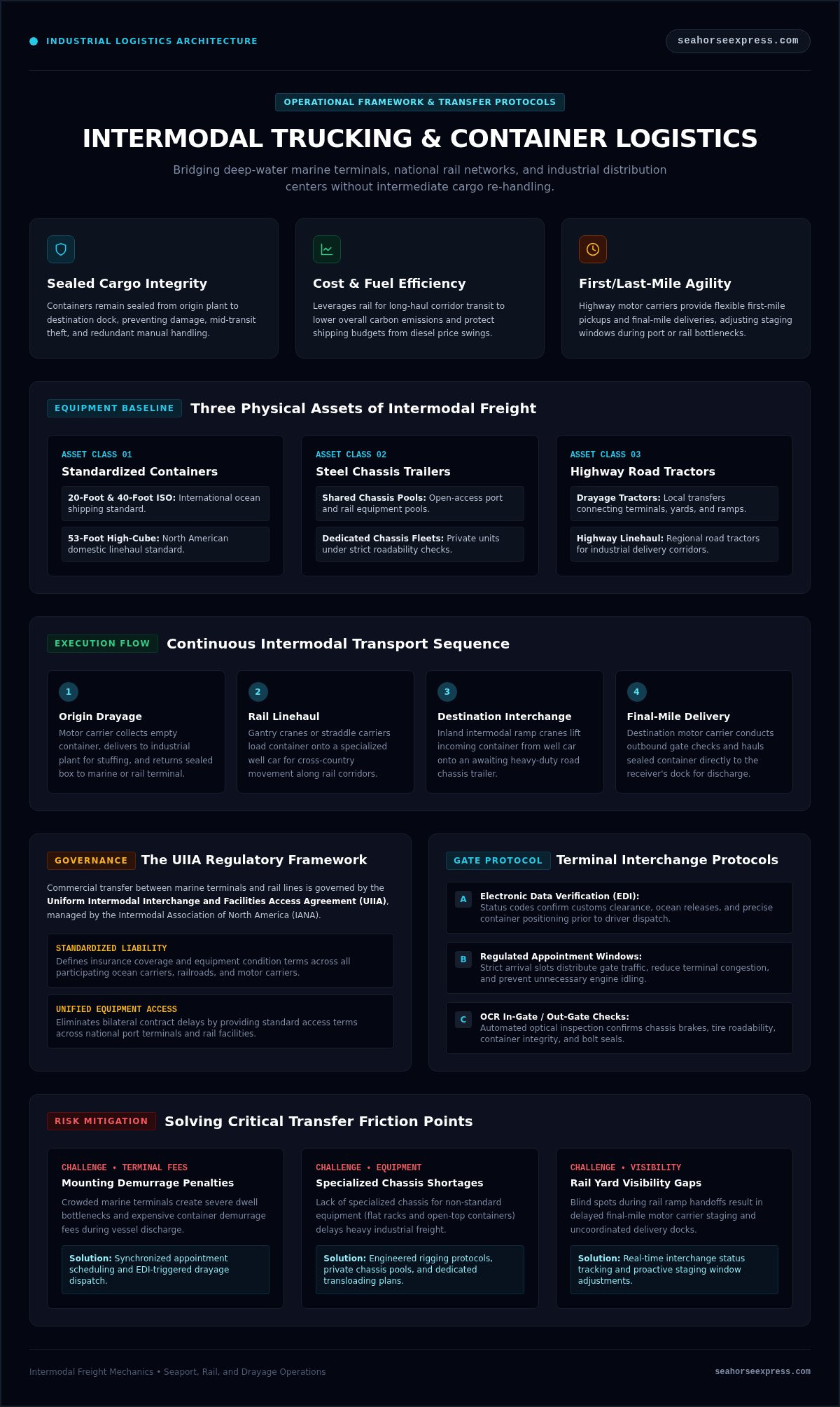
Intermodal trucking serves as the physical bridge connecting international shipping corridors to regional manufacturing and warehouse nodes. As a foundational component of intermodal freight transport, this operation moves cargo inside standardized containers across multiple transport modes without directly handling the freight during transfer. The container stays sealed from the loading dock at origin to the final receiver, reducing handling risks, cargo damage, and mid-transit theft.
This approach combines the cost structure and fuel efficiency of freight rail with highway hauling flexibility. Rail handles long-distance linehaul across high-density inland corridors, while highway motor carriers execute precise first-mile collections and final-mile deliveries. By shifting the longest segment of transit from interstate highways to rail, enterprise shippers lower overall carbon emissions and insulate logistics budgets from diesel price swings.
The Core Components of Modern Intermodal Freight
A functional intermodal move depends on three physical assets: the container, the chassis, and the road tractor. Standard international shipping relies on 20-foot and 40-foot ISO containers, while domestic North American lanes commonly use high-cube 53-foot units. Intermodal motor carriers mount these containers onto heavy-duty steel chassis trailers. Operating within shared chassis pools or using private dedicated chassis fleets, carriers pull equipment from marine terminals and rail facilities under strict roadability standards to guarantee highway safety.
The Continuous Transport Chain from Origin to Destination
The intermodal transport chain follows a planned sequence that eliminates redundant cargo handling:
- Origin Drayage: A motor carrier picks up an empty container, delivers it to an industrial plant for stuffing, and returns the sealed box to a railhead or marine terminal.
- Intermediate Rail Linehaul: Straddle carriers or rubber-tired gantry cranes lift the container onto a specialized well car, moving the unit across national rail corridors.
- Destination Interchange: Upon arrival at an inland intermodal ramp, terminal cranes lift the container from the railcar onto an awaiting road chassis.
- Final-Mile Delivery: The destination motor carrier conducts outbound gate checks and hauls the sealed box directly to the receiving industrial dock for discharge.
Throughout this chain, intermodal trucking provides essential flexibility. When ocean vessels encounter berthing delays or rail operations bottleneck at hub terminals, motor carriers adjust staging windows to keep freight moving predictably.
How Intermodal Trucking Connects Seaports to Inland Rail Ramps
Transferring shipping containers from deep-water ocean vessels to national rail networks requires precise orchestration. Intermodal trucking operates as the operational link across this interface, extracting inbound ocean boxes from crowded container yards and delivering them directly to inland rail intermodal facilities. When this transition falters, entire supply chains stall behind marine terminal gates.
Every commercial movement between ocean terminals and rail lines relies on standardized administrative and safety frameworks. Motor carriers operate under the Uniform Intermodal Interchange and Facilities Access Agreement (UIIA), managed by the Intermodal Association of North America. This standard contract governs liability, insurance coverage, and equipment usage conditions among ocean carriers, railroads, equipment leasing firms, and trucking companies across national ports.
Navigating Marine Terminal and Rail Ramp Interchanges
Executing an efficient container pickup requires strict compliance checks and systematic gate procedures:
- Electronic Data Verification: Before dispatching equipment, motor carriers monitor terminal operating systems using EDI status codes to confirm customs clearance, ocean line releases, and container physical positioning.
- Terminal Appointment Securing: Drivers enter terminal gate complexes during tightly regulated appointment windows, which distribute gate traffic and reduce engine idling across port corridors.
- Inbound/Outbound In-Gate Roadability Checks: At optical-character-recognition interchange portals, inspectors verify chassis brake mechanics, tire wear, container structural integrity, and tamper-evident bolt seal numbers before signing the Equipment Interchange Receipt.
Mitigating Demurrage, Detention, and Per Diem Costs
Operational bottlenecks generate substantial penalties if cargo or equipment sits past standard free-time thresholds. Understanding these fee structures protects shippers from avoidable accessorial charges:
- Port Demurrage: Penalties assessed by terminal operators when an import container occupies terminal ground space beyond contracted free days.
- Rail Ramp Storage: Fees charged by Class I railroads for containers lingering on rail terminal property after train discharge.
- Carrier Per Diem: Equipment rental surcharges levied by ocean lines or leasing pools when chassis and empty boxes are detained outside terminal walls past agreed terms.
To eliminate these escalating expenses, logistics planners use strategic pre-pull operations. Drivers pull loaded containers out of ocean terminals before free time expires, staging them in secure, near-dock yards. Partnering with a dedicated carrier for port drayage ensures these rapid interchanges happen smoothly, bypassing terminal gate congestion and maintaining schedule reliability for subsequent rail transfers.
Drayage vs. Long-Haul Intermodal: Key Operational Differences
Understanding freight movement requires drawing a clear line between local drayage legs and long-haul intermodal corridors. Many cargo owners conflate the two, yet they operate under distinct equipment profiles, labor structures, and cost variables. Drayage centers on short-distance terminal transfers, while long-haul intermodal leverages highway-to-rail networks for cross-country transits. Shippers navigating intermodal shipping for trucking must evaluate where these modes diverge to select the right carrier capacity for each leg.
The economic decision between direct over-the-road trucking and rail-intermodal linehaul usually hinges on transit distance. While motor carriage provides superior velocity under 500 miles, rail-intermodal becomes significantly more cost-effective as distances exceed 700 to 1,000 miles. At those longer ranges, intermodal trucking shifts into an essential feeder role, managing the local pick-and-drop connections at both terminal endpoints while double-stack trains handle the transcontinental haul.
Operating Radius and Turn Times Across National Corridors
Local port drayage operates within a localized perimeter, typically covering a 50- to 150-mile radius around marine terminals and railheads. Drivers on these routes generally complete their shifts within standard daily duty periods, returning to their home base each night. Operating efficiency improves dramatically when dispatchers arrange dual transactions, where a driver delivers an export or empty container and immediately picks up an import load on the same gate pass. Regional and long-haul moves, by contrast, cross multiple state borders, requiring coordinated driver relays and compliance with overnight sleeper-berth hours-of-service mandates.
Equipment Requirements: Standard Dry Vans vs. Intermodal Chassis
Hauling intermodal containers introduces distinct mechanical demands compared to pulling standard over-the-road dry vans:
- Integral Body vs. Two-Piece Assemblies: A traditional dry van utilizes an integrated monocoque trailer. Intermodal operations secure an ISO steel container onto a separate structural skeleton chassis using corner twist locks.
- Axle Weight Distribution: Ocean containers often carry dense, concentrated freight. Drivers must adjust slider tandems to avoid violating federal bridge gross weight formulas and state axle limits.
- Roadability Standards: Under Federal Motor Carrier Safety Administration (FMCSA) rules, Intermodal Equipment Providers (IEPs) must systematically maintain chassis fleets. Drivers and dispatchers must inspect twist locks, air brake lines, and lighting rigs before moving equipment over public highways.
Whether utilizing shared neutral chassis pools at public rail ramps or dedicated private fleet chassis, selecting verified equipment prevents roadside mechanical violations and guarantees seamless cargo transfer.
Critical Challenges in Container Hauling and How to Solve Them
Intermodal transfer velocity breaks down when physical equipment bottlenecks collide with strict highway safety regulations. In high-volume freight environments, motor carriers face persistent chassis deficits, mechanical gate rejections, and severe axle-weight imbalances. Solving these challenges requires disciplined pre-dispatch workflows and engineering-driven loading standards rather than reactive firefighting.
Overcoming Chassis Deficits and Equipment Quality Issues
Marine terminal pool chassis frequently suffer from neglect. When a driver encounters a bad-order unit with flat-spotted tires, damaged wiring, or bent twist locks, terminal mechanics must inspect and repair the equipment before gate-out clearance. This process drains driver hours-of-service clocks and risks missed rail cutoffs. Securing dedicated private chassis or long-term lease equipment bypasses terminal roadability lines entirely. For heavy ocean freight, utilizing tri-axle chassis distributes concentrated weight across three physical axles, preventing structural frame sagging and road-level enforcement shutdowns.
Weight Distribution and Rail Load Securing Regulations
Heavy container freight creates distinct compliance and safety risks across highway and rail networks:
- Bridge Formula Compliance: Dense freight packed into standard 20-foot containers often concentrates tonnage over too short a wheelbase. Even if the total payload remains under 80,000 pounds gross vehicle weight, it can easily violate federal bridge formula limits for tandem axles.
- Rail Impact Forces: Railcars endure extreme longitudinal G-forces during train assembly and classification switching, commonly known as rail humping. Shippers must follow Association of American Railroads (AAR) loading rules, using heavy-duty blocking, bracing, and void fillers to prevent internal load shifts.
- Strategic Transloading: Shippers often transload heavy import ocean containers into larger 53-foot domestic trailers near the port. Consolidating the contents of three 40-foot ocean containers into two 53-foot domestic units eliminates road-weight violations while reducing linehaul transportation costs.
Operating reliable intermodal trucking across major freight arteries requires proactive coordination. If your supply chain struggles with container congestion or equipment compliance issues, coordinate your domestic transport with Seahorse Express to secure verified capacity and protect transit timelines.
Specialized Intermodal Solutions for Industrial and Over-Dimensional Cargo
Standard enclosed dry containers handle the vast majority of consumer goods, but heavy industrial machinery and project cargo require non-standard configurations. When freight exceeds standard dimensions or requires overhead crane loading, international supply chains rely on flat racks and open-top containers. Transporting these out-of-gauge units across highway networks demands engineered securement, specialized equipment, and precise execution rather than standard intermodal trucking operations.
Managing Flat Rack and Open-Top Container Transport
Draying and transloading out-of-gauge containers introduces complex technical challenges immediately upon vessel discharge:
- Engineered Cargo Rigging: Machinery secured to flat racks lacks protective container walls. Crews must execute precise industrial rigging, machinery dismantling, and custom crating to protect precision components against heavy weather and transport vibrations.
- Heavy-Haul Trailer Configuration: Over-dimensional open-top and flat rack loads frequently exceed standard chassis weight and height ratings. Moving these units requires specialized multi-axle lowboys, step-decks, or heavy-duty flatbed trailers capable of handling concentrated center-of-gravity loads.
- Route Engineering and Permitting: Highway movements exceeding statutory width, height, or weight thresholds require state-level oversized permits, route surveys, and coordinated escort vehicles before clearing marine terminal security gates.
Selecting a Capable National Intermodal Logistics Partner
General motor carriers rarely maintain the equipment, facilities, or rigging credentials necessary to manage non-standard container movements. Freight managers need strategic providers with verifiable capabilities across all transfer touchpoints. Essential qualifications include verified Transportation Worker Identification Credential (TWIC) clearance for port terminal access, comprehensive industrial cargo insurance policies, and specialized equipment fleets capable of heavy hauling.
Experienced carriers also provide secure near-dock storage yards equipped with heavy-lift cranes and forklifts. This infrastructure enables swift container stripping and cargo transloading, releasing expensive ocean carrier equipment before per diem penalties accrue. Discover how Seahorse Express coordinates nationwide heavy haul and port drayage to keep complex project cargo moving efficiently from ocean ports to industrial destinations across the country.
Executing Seamless Port-to-Inland Freight Velocity
Balancing transit speed with rigorous terminal compliance defines successful modern logistics. Intermodal trucking bridges the critical divide between ocean berths and inland rail corridors, safeguarding cargo owners against compounding demurrage fees, chassis deficits, and unexpected handoff bottlenecks. Establishing predictable transit timelines requires disciplined appointment management, strict highway weight compliance, and engineered securement protocols that withstand rail switching forces.
When moving heavy industrial machinery and out-of-gauge shipments, standard dry van networks don't offer the necessary capabilities. Specialized cargo demands an engineered logistics approach across every transfer point. Partner with Seahorse Express for reliable national port drayage, container transloading, and specialized heavy haul solutions. Backed by nationwide capabilities coordinating flat racks and open-top containers across major seaports, combined with integrated rigging, custom crating, and heavy haul transport, you gain the operational control required to maintain an efficient, damage-free supply chain.
Frequently Asked Questions
What is the main difference between intermodal trucking and standard freight trucking?
Intermodal trucking moves freight inside standardized ISO shipping containers that transfer between ocean vessels, railcars, and highway chassis without handling the internal cargo. Standard freight trucking typically utilizes dedicated dry van or refrigerated trailers that carry goods exclusively over the highway from origin to destination. This fundamental difference allows intermodal transport to blend rail and marine efficiencies with highway pickup and delivery flexibility across regional routes.
How does an intermodal ramp function within the domestic freight network?
An intermodal ramp operates as a specialized inland rail terminal designed to transfer containers between trains and highway transport equipment. High-capacity gantry cranes and mobile reach stackers lift containers directly off railcars onto waiting motor carrier chassis or staging tracks. These facilities act as intermediate distribution hubs, enabling regional drayage carriers to complete first-mile pickups and final-mile deliveries without requiring long-distance highway linehauls across national freight corridors.
Can specialized or oversized equipment move via intermodal transportation?
Yes, out-of-gauge and heavy industrial cargo moves regularly using specialized non-enclosed equipment such as flat racks and open-top containers. Transporting these units requires engineered logistics support, including certified industrial rigging, custom export crating, and heavy-haul trailers capable of handling concentrated weights. Specialized carriers coordinate port drayage, machinery transloading, and domestic permits to move these non-standard loads smoothly from marine docks to inland industrial manufacturing facilities nationwide.
What is the role of a chassis in intermodal container transport?
A chassis provides the wheeled structural steel frame required to transport ISO ocean containers over public highways safely. Standard dry containers don't have built-in running gear, so motor carriers must lock the container corners onto a matching skeletal trailer using locking pins and twist locks. Carriers select tandem-axle or tri-axle chassis configurations depending on total weight to comply with federal bridge formula mandates and state axle regulations.
How do motor carriers prevent rail damage during intermodal container moves?
Preventing cargo damage requires strict adherence to Association of American Railroads securement rules before a container ever enters a rail ramp. Railcars experience massive longitudinal impact forces during switching operations. Motor carriers and shippers prevent load shifting by installing heavy-duty wood blocking, perimeter bracing, and certified void-filling systems inside the container. Proper weight distribution across the floor deck ensures cargo remains perfectly stable across rough rail transitions.
What causes terminal demurrage fees during intermodal container transfers?
Terminal demurrage charges accumulate when an import container sits inside a marine terminal or railhead past agreed free-time allowances. Common causes include customs clearance holds, documentation errors, missing gate appointments, and severe chassis deficits that prevent prompt container retrieval. Managing appointments proactively and utilizing near-dock transload yards for rapid container pre-pulls protects shippers from these steep, daily storage penalties assessed by terminal operators.
Why do shippers choose intermodal rail over long-haul over-the-road trucking?
Shippers choose rail-intermodal linehaul combined with intermodal trucking primarily to cut overall freight costs and stabilize capacity on long-haul routes. Moving high-volume freight by rail is significantly more fuel-efficient than solo highway hauling, offering substantial financial savings on distances exceeding 700 miles. Additionally, intermodal networks reduce reliance on long-haul driver availability, simplify carbon footprint tracking, and provide predictable door-to-door transit timelines across core commercial lanes.

