
A crate can protect a machine well and the shipment can still face delays if destination-country wood rules or the next freight handoff weren’t planned. Export crating services need to account for more than the cargo itself. Crate design, route conditions, packaging requirements, and transport coordination all affect whether industrial equipment is ready to move.
Protecting valuable machinery from impact, moisture, and handling damage is a sensible first priority. A complete export plan also considers where the cargo will be stored, how it will be moved and transferred, and which wood-packaging requirements and documents apply at the destination.
Use this checklist to prepare industrial cargo for export, review destination requirements such as applicable ISPM 15 rules, and organize shipment documentation. You’ll also learn how to connect custom crating with storage and the next logistics steps, including port handling and drayage or transloading for flat-rack and open-top containers. Planning these details together helps prevent gaps between the crate and the freight that carries it.
Key Takeaways
- Use cargo dimensions, weight, center of gravity, lifting points, and access constraints to guide crate planning.
- Match internal blocking, bracing, cushioning, and restraint to the equipment and expected handling conditions.
- Plan cargo protection alongside destination-country wood-packaging requirements and transport needs.
- Review current ISPM 15 requirements for the shipment’s wood packaging and destination. A mark addresses wood-packaging compliance, not overall cargo protection.
- Coordinate crating completion with storage, scheduled transport, and port drayage or transloading handoffs.
Why export crating services matter for industrial cargo
Industrial cargo can pass through several transport legs and handling points before reaching its destination. Depending on the route and handling, each transfer can expose equipment to vibration, impact, stacking pressure, or moisture. A crate designed with those conditions in mind helps protect the cargo, but no single design suits every shipment.
Export crating is packaging designed around specific cargo, its protection and handling needs, and its planned international route. The crate’s purpose is to secure the equipment and reduce exposure to foreseeable transit hazards. It doesn’t replace export documentation, customs processes, or freight arrangements. Those are separate parts of shipment planning and should be coordinated with the packaging plan.
What makes export crating different from domestic packaging?
An international shipment may involve more handoffs or transport modes than a domestic move. Cargo could be loaded at a facility, transferred between inland transport and port handling, and then secured for an ocean journey. The sequence varies, so route, handling method, expected exposure, and destination conditions should inform packaging decisions from the outset.
For example, equipment lifted at designated points needs a crate and internal supports that work with those access points. Cargo exposed to outdoor staging may need protection from moisture. Destination requirements can also affect the choice of wood packaging. ISPM 15 rules address pest-related requirements for wood packaging used in international trade. They don’t establish whether a crate adequately protects the machine. Applicable requirements depend on the packaging material, destination, and current rules.
Which industrial cargo needs a tailored crate?
Machinery, high-value equipment, and irregularly shaped industrial assets often have features that standard packaging can’t safely accommodate. Protruding controls, exposed fittings, delicate surfaces, or uneven weight distribution can affect where supports and protective barriers belong. Crate planning also needs to account for cargo dimensions and weight, center of gravity, lifting points, and access for loading and unloading.
These details help determine how to restrain cargo and limit unwanted movement without putting pressure on vulnerable components. Internal blocking, bracing, cushioning, and restraint can be incorporated to suit the equipment and shipment. Start by documenting the machine’s measurements, weight, fragile areas, and handling points. Then consider those details alongside the route and planned freight handoffs. This gives custom crating a clear role in the export plan while keeping transport coordination and shipment compliance in view as separate tasks.
How export crate design protects equipment across the route
A crate has to do more than enclose equipment. It must keep the cargo stable and allow it to be lifted, transferred, and secured using the planned handling methods. Consider the full route, including storage, inland transport, port handling, and the international leg. Export crating services are most effective when cargo characteristics and transport handoffs shape the packaging plan from the start.
| Planning factor | What to assess | Design consideration |
|---|---|---|
| Cargo needs | Dimensions, weight, center of gravity, fragile areas, and exposed components | Position supports and restraint to limit movement without loading delicate parts. |
| Exposure risks | Moisture, vibration, impact, and storage conditions along the route | Consider cushioning or moisture protection where the cargo and conditions call for it. |
| Handling method | Forklift access, lifting points, and transfer locations | Provide practical access for the equipment and handling method planned at each handoff. |
| Transport interface | How the crate will be loaded, secured, and moved between transport stages | Plan the crate’s structure and access around the shipment’s actual handling sequence. |
How do cargo dimensions and handling affect crate construction?
Start with accurate measurements and weight, then identify the center of gravity and accessible lifting points. A crate that simply surrounds a machine may still allow it to shift or put pressure on a vulnerable surface. Internal blocking and bracing can help hold the load in position; cushioning can absorb some movement, while restraint helps limit shifting. The placement and use of each should suit the specific cargo.
Forklift pockets, lifting access, and crate tie-down points should align with the planned equipment and transfer locations. That matters as cargo moves from storage to a vehicle, through port handling, or onto another transport mode. A considered design supports both cargo protection and practical handling.
When should a shipment use moisture or corrosion protection?
Assess exposure across the whole journey, including staging and storage, rather than assuming every export shipment needs the same barrier. Protective films may shield surfaces, barriers may limit moisture exposure, and desiccants may help manage moisture within an enclosure. The right approach depends on the equipment, its surface sensitivity, packaging arrangement, and expected conditions. No single method is universal.
Wood-packaging requirements are separate from moisture and corrosion protection. For current U.S. guidance, consult USDA APHIS’s Wood Packaging Material regulations. For broader cargo-protection principles, see custom crating guidance for industrial equipment. Seahorse Express provides custom crating for industrial cargo and can coordinate it with storage and transport planning.
ISPM 15 and export rules: what a crate mark does and does not prove
A mark on wooden packaging addresses a specific compliance question. It doesn’t confirm that the cargo is properly protected, that export paperwork is complete, or that the shipment is ready for every transport handoff. Treat wood-packaging compliance and overall export readiness as related but separate parts of the shipment plan.
When can ISPM 15 apply to export wood packaging?
ISPM 15 is an international standard developed under the International Plant Protection Convention (IPPC). It addresses wood packaging material used in international trade to help manage the risk of spreading plant pests. Whether a particular crate or other wood packaging is subject to requirements depends on its materials and the destination’s current rules.
Before shipping, verify whether treatment and marking requirements apply and whether any exemptions are relevant to the packaging being used. Don’t assume the same requirements apply to every destination or packaging material. For U.S. guidance, USDA APHIS explains ISPM 15 wood packaging material requirements. For other destinations, consult current guidance from the relevant plant-health or customs authority.
A wood-packaging mark indicates information associated with the treatment and handling of regulated wood packaging. It doesn’t certify the crate’s structural suitability, prove that the equipment is adequately restrained, or replace destination-specific checks. Export crating services need to account for these considerations separately rather than treating a visible mark as all-purpose approval.
What else should be aligned beyond the wood packaging mark?
Packaging compliance is distinct from commercial and transport documentation. Depending on the shipment, records may include a commercial invoice and transport documents such as a bill of lading or air waybill. Requirements vary with the commodity, route, and transaction, so verify which documents and details apply rather than assuming there is one universal export document set.
Keep cargo descriptions and shipment records consistent. Compare the equipment description, package count, weights, and other shipment details across the documents being prepared. Discrepancies can prompt questions at handoffs or during customs processing, even when the wood packaging meets applicable rules.
U.S. Customs and Border Protection (CBP) provides customs guidance for shipments involving the United States. Incoterms can clarify how parties allocate certain delivery responsibilities, costs, and risks, but they don’t replace customs requirements or determine whether wood packaging complies with ISPM 15. Treat each layer separately: confirm applicable wood-packaging rules, prepare accurate shipment information, and coordinate documents and freight arrangements for the specific route.
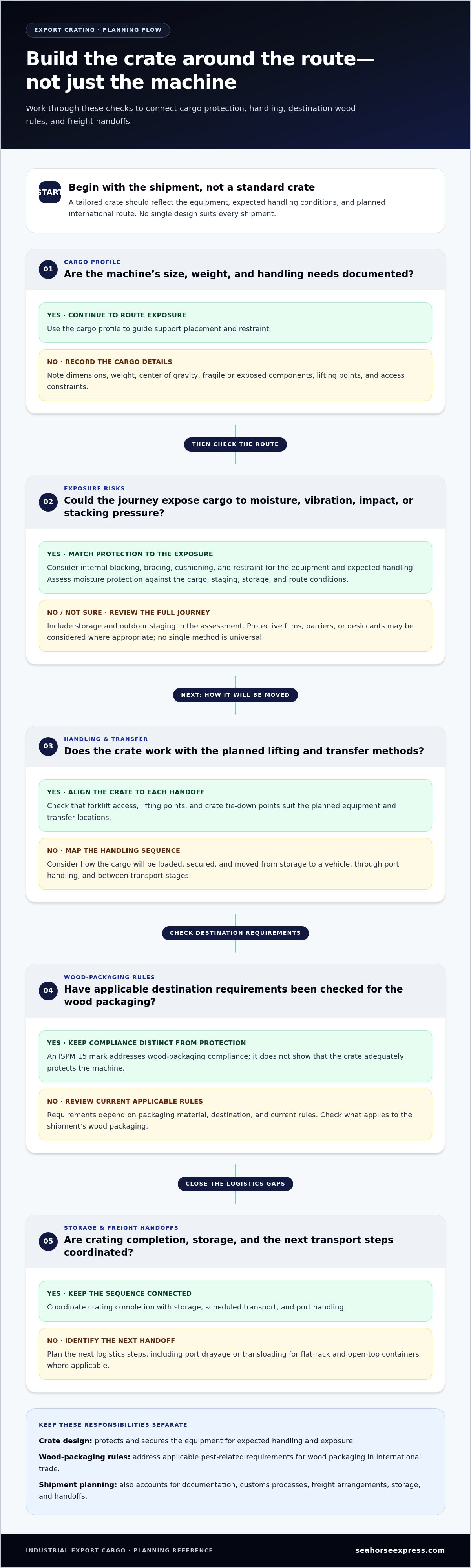
Export crating services checklist: prepare cargo before shipment
A clear sequence connects cargo-protection needs with the shipment route and final handoff. Use this checklist to gather the necessary details before crating, then review the packed cargo and records before release.
What cargo and route information belongs in the initial brief?
Start with a complete cargo profile. Accurate information helps shape the crate and can reduce avoidable changes during preparation.
- Identify the cargo: Record the machine or equipment description, identifying numbers, operating condition, and clear photos from multiple angles.
- Measure and weigh it: Provide overall dimensions and weight, including any components packed separately. Note the center of gravity if known.
- Map handling needs: Mark fragile or exposed areas, accessible lifting points, required lifting methods, and instructions for handling or positioning the equipment.
- Note access constraints: Record doorway, loading-area, forklift, and other equipment limits that could affect crate dimensions or movement.
- Outline the route: Include origin, destination, planned transport modes, known transfer points, and expected storage or staging needs.
- Flag packaging considerations: Identify likely exposure to moisture or outdoor staging, and check whether wood-packaging requirements apply to the destination and materials used.
Specifics matter. A machine with low clearance or lifting points on only one side needs different handling considerations from compact equipment with accessible lifting points. The route informs planning too. For example, storage before port delivery adds a staging step to the schedule and packaging discussion.
What should the final pre-shipment inspection cover?
Before the crate moves to the next transport leg, inspect its overall condition and confirm that the planned handling is practical. Check closures, visible internal restraint, lifting access, and any visible handling or orientation markings. Look for damage that could affect safe movement or cargo protection.
Then compare cargo identifiers and package details against the shipment records. Confirm that descriptions, package counts, and recorded weights align across the applicable documents. Verify current destination-specific wood-packaging rules rather than assuming one standard applies to every shipment. Documentation and customs requirements depend on the shipment, so coordinate the relevant records without treating the crate mark as proof of complete export readiness.
If the route includes a port handoff, align the crate’s release with the planned drayage or transfer sequence. Review professional drayage and port-transfer planning as part of that coordination. Seahorse Express provides custom crating and connected shipment planning through industrial cargo crating.
Coordinate export crating with storage, port handling, and transport
Crating is one stage in an export move, not a handoff to plan in isolation. Align crate completion with where the cargo will be staged, how it will travel inland, and how it will reach the port. This sequence helps identify timing or handling mismatches before they disrupt the next leg. Seahorse Express coordinates custom crating with storage and industrial freight logistics as connected shipment stages.
How can storage and port transfers fit into an export plan?
Staging can help when crating finishes before transport is scheduled or when cargo needs to be assembled with other shipment components. Planned storage can connect crate completion to inland movement and port delivery while keeping the expected handling and release sequence clear to the teams coordinating the freight.
Port needs depend on the cargo and loading plan. Dimensions, weight, shape, lifting access, and how the load will be secured all inform whether a flat-rack or open-top container is appropriate and how the transfer should be coordinated. These options aren’t interchangeable by default. Unusually shaped cargo may need a different loading approach from crated cargo that fits a standard container plan. When port transfer is part of the route, integrated logistics planning connects drayage and transfer details with the wider move.
What information helps coordinate a crating and freight project?
Bring the main project details together before setting the sequence. A concise coordination brief should include:
- Cargo profile: Description, dimensions, weight, center of gravity if known, fragile areas, photos, and lifting points.
- Route: Origin, destination, planned transport modes, port or other transfer points, and expected storage or staging.
- Handling constraints: Access limits, available lifting or loading equipment, and special positioning instructions.
- Packaging needs: Protection concerns, crate access requirements, and any destination-specific wood-packaging rules that apply.
- Schedule: Target dates for crating, storage, inland transport, and port handoff, with dependencies between stages noted.
With these details, crating can be planned alongside storage, port drayage, and transport rather than treated as a separate task. For shipments using flat-rack or open-top containers, early coordination also connects the crate’s dimensions and handling plan with the intended port transfer. Seahorse Express coordinates these stages for industrial freight projects. Find out more about export crating and logistics.
Set Your Export Shipment Up for a Confident Handoff
Export readiness begins with cargo-specific protection and continues throughout the route. Effective export crating services account for equipment dimensions, weight, vulnerable components, lifting access, and expected handling. Check destination wood-packaging requirements separately, since a crate mark doesn’t confirm that the cargo, documents, and freight plan are ready.
Keep the stages connected. Coordinate crate completion with any needed storage, inland movement, and port transfer so the shipment can move from preparation to its next handoff with fewer planning gaps. Port drayage and transloading for flat-rack or open-top containers can be coordinated as part of the broader logistics sequence.
Seahorse Express provides custom crating for industrial equipment, along with warehousing, storage, export logistics coordination, and nationwide port drayage and transloading for flat-rack and open-top containers. Share your cargo details and route to discuss your export crating and industrial logistics project.
With the right information and connected planning, your team can prepare cargo carefully and move toward the next shipping stage with greater clarity.
Frequently Asked Questions
What are export crating services?
Export crating services prepare cargo for international transport with packaging designed around the equipment, its handling needs, and the planned route. For industrial machinery, this can include a custom-built wooden crate with internal supports to limit movement and protect vulnerable areas. Crating is one part of shipment preparation. It doesn’t replace export documentation, customs processes, freight coordination, or destination-specific packaging checks.
Does every export wood crate need to meet ISPM 15?
No. Whether ISPM 15 applies depends on the wood-packaging material, destination, and current entry requirements. Some manufactured wood materials may be treated differently from solid wood, and exemptions can apply. Don’t assume every crate is covered or exempt based on its appearance. Verify current requirements for the destination and packaging materials before shipment, using guidance from the relevant plant-health authority.
What does an ISPM 15 mark on a crate mean?
An ISPM 15 mark identifies wood packaging treated and marked under the standard’s requirements. It relates to pest-risk controls for regulated wood-packaging material in international trade. The mark doesn’t show that machinery is securely restrained, protected from moisture, or suitable for the route. It also doesn’t confirm that export records, customs data, or freight arrangements are complete. Check the mark and shipment readiness separately.
How do I prepare industrial equipment for export crating?
Begin by documenting the equipment’s dimensions, weight, operating condition, and clear photographs. Identify the center of gravity if known, fragile or exposed components, accessible lifting points, and any handling or access constraints. Include instructions for positioning and loading. Share the planned route, destination, transport modes, and expected storage needs too. This information helps tailor the crate and coordinate movement through each planned handoff.
Can export crating protect machinery from moisture during transit?
Packaging can include moisture or corrosion protection when the equipment and expected conditions call for it. The approach may involve protective films, barriers, or desiccants, but no single method suits every machine or route. Consider exposure during storage and transport, along with surface sensitivity and crate arrangement. Moisture protection should be planned as part of cargo protection, not assumed from the presence of a wooden crate.
What information is needed to plan an export crate?
Provide the cargo description, accurate dimensions, weight, photographs, and details about fragile areas, lifting points, and handling limits. Include the origin, destination, route, planned transport modes, transfer points, and expected storage or staging. Note packaging concerns such as moisture exposure and check whether destination-specific wood-packaging requirements apply. A clear project brief helps connect crate design with loading, transport, and the shipment schedule.
Can crating be coordinated with port drayage and storage?
Yes. Crating can be planned alongside warehousing, storage, export logistics, and port drayage so cargo preparation and transport handoffs fit together. Seahorse Express coordinates custom crating for industrial equipment with storage and freight logistics, including drayage and transloading for flat-rack and open-top containers. Share the cargo profile, route, handling needs, and target schedule to help organize the stages.


