
A factory relocation can fall behind before the first machine moves. When plant, equipment, and logistics teams work from separate schedules, a late decision about site readiness, dismantling, or transport can put production milestones at risk. Industrial plant relocation services are one part of the effort. The project plan must connect each workstream to shared milestones and clear handoffs.
That coordination challenge is familiar to teams managing a facility move. A useful plan does more than list tasks. It identifies who owns each decision, what must happen first, and how machinery preparation, route planning, permits, and delivery fit into the sequence.
This 2026 guide provides a practical project plan structure you can tailor to your facility. Learn how to map relocation phases, assign owners, record dependencies, set decision gates, and coordinate the logistics workstream for oversized machinery. The result is a clearer view of what must happen before equipment moves and how each handoff supports the transition to the new site.
Key Takeaways
- Define whether the move covers a single machine, production line, facility, or multiple sites before assigning scope and responsibilities.
- Build the plan in phases, giving each phase an owner, due date, dependency, deliverable, and approval gate.
- Compare coordination models to identify where accountability, schedule visibility, and change control need closer attention.
- Use a readiness checklist and risk register to track preparation, access, transport, receiving, and escalation actions.
- Connect industrial plant relocation services to the wider project schedule by sequencing machinery handling, route planning, permits, and delivery handoffs.
What a Factory Relocation Project Plan Must Coordinate
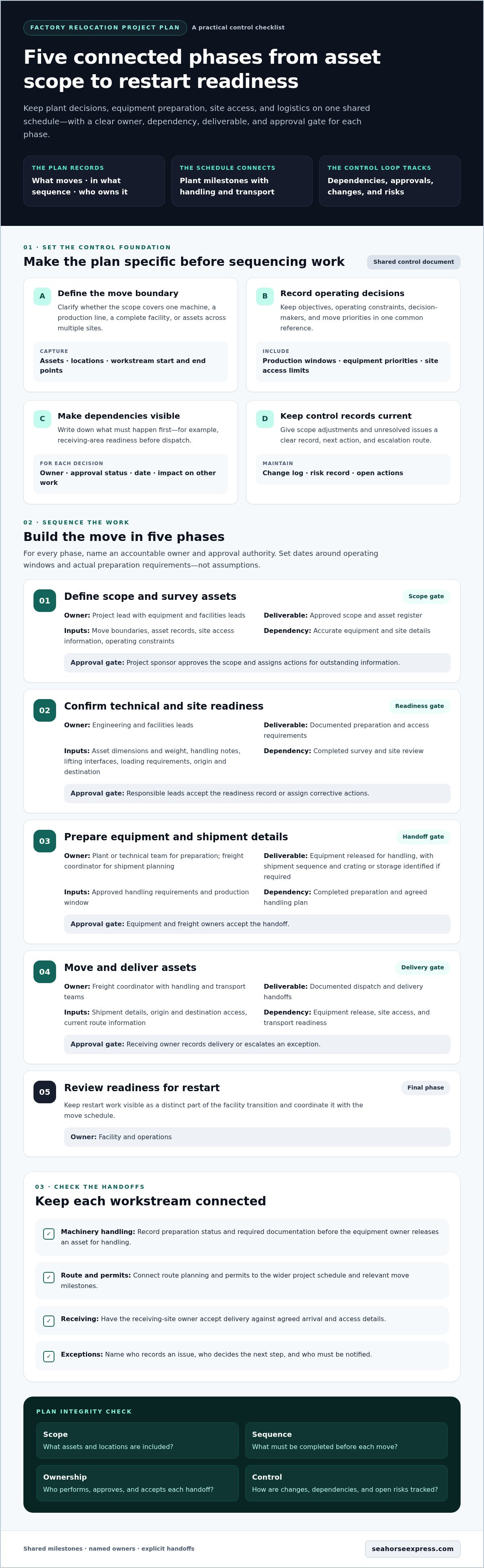
A factory relocation project plan is a shared control document, not just a task list. It records what is moving, in what sequence, who owns each activity, what must happen first, and who approves decisions. A clear structure helps plant teams coordinate operational needs with equipment preparation, site readiness, transport, and restart work. It also gives everyone a common reference when the date, scope, or conditions change.
Set the project boundary first. A move might cover one machine, a production line, a complete facility, or assets across multiple sites. That boundary affects the asset register, schedule, coordination needs, and handoffs. Show where each workstream begins and ends, including how equipment preparation connects to rigging, shipment, receiving, and the plant’s separate restart activities. Project management principles such as defined scope, sequencing, and control of constraints provide a useful foundation for a Factory Relocation Project Plan.
Which decisions belong in the relocation plan?
Record the objectives, move boundaries, operating constraints, and decision-makers in one place. Include production windows, equipment priorities, site access limits, and dependencies, such as receiving-area readiness before dispatch. For each decision, document the owner, approval status, date, and impact on other work. Maintain a change log for scope adjustments and a risk record for unresolved issues, with the next action and escalation route clearly identified.
Who should own each project workstream?
Assign one accountable owner to each workstream, even when several teams contribute. Operations can own production windows and priorities; engineering can manage technical asset information; facilities can coordinate site readiness; and equipment leads can organize preparation. A freight coordination owner aligns handling and transportation milestones. Define internal plant responsibilities separately from specialist activities such as machinery dismantling and rigging, crating, or heavy and over-dimensional transport.
Make every handoff explicit. For example, the equipment owner can release an asset for handling once its preparation status and required documentation are recorded. The receiving-site owner then accepts delivery against the agreed arrival and access details. If either party identifies an exception, the plan should name who records it, who decides the next step, and who must be notified.
- Scope: What assets and locations are included?
- Sequence: What must be completed before each move?
- Ownership: Who performs, approves, and accepts each handoff?
- Control: How are changes, dependencies, and open risks tracked?
A missed handoff can leave equipment unready, transport out of sync with site access, or production waiting on an unresolved decision. A strong plan makes these interfaces visible early. Teams coordinating industrial plant relocation services can then connect freight milestones to plant decisions instead of managing machinery movement as a separate schedule.
Build the Factory Relocation Plan in Phases
Sequence the move so each milestone has a clear owner, required inputs, deliverable, due date, dependency, and approval gate. Set dates around the facility’s operating windows and actual preparation requirements, not assumptions. Treat industrial plant relocation services as a connected logistics workstream within the broader project schedule, tying handling and transport milestones to plant and site decisions.
Use this phase structure as a working template. Add a named owner and approval authority to every line in the project schedule.
- Define scope and survey assets. Owner: project lead with equipment and facilities leads. Inputs: move boundaries, asset records, site access information, and operating constraints. Deliverable: approved scope and asset register. Due: before sequencing work. Dependency: access to accurate equipment and site details. Gate: project sponsor approves the scope and assigns actions for outstanding information.
- Confirm technical and site readiness. Owner: engineering and facilities leads. Inputs: asset dimensions and weight, handling notes, origin and destination, lifting interfaces, loading requirements, and receiving-site conditions. Deliverable: documented preparation and access requirements. Due: before equipment preparation is scheduled. Dependency: completed survey and site review. Gate: responsible leads accept the readiness record or assign corrective actions.
- Prepare equipment and shipment details. Owner: plant or technical team for equipment preparation; freight coordinator for shipment planning. Inputs: approved handling requirements and production window. Deliverable: equipment released for handling, with shipment sequence and any required crating or storage identified. Due: ahead of the planned load date. Dependency: completed preparation and agreed handling plan. Gate: equipment and freight owners accept the handoff.
- Move and deliver assets. Owner: freight coordinator, working with handling and transport teams. Inputs: shipment details, origin and destination access, and current route information. Deliverable: documented dispatch and delivery handoffs. Due: against the approved move sequence. Dependency: equipment release, site access, and transport readiness. Gate: receiving owner records delivery or escalates an exception.
- Review readiness for restart. Owner: facility and operations leads. Inputs: received-asset records, site-readiness status, and operational criteria. Deliverable: acceptance record and open-action list. Due: before the planned restart decision. Dependency: delivery and facility readiness. Gate: designated plant leaders approve the next operational step.
Adjust the sequence for complex shipments
Oversized machinery can add equipment selection, route planning, permits, and escort logistics as dependencies before dispatch. Verify route-specific requirements with current applicable authorities. Port transfers may require drayage and transloading milestones; temporary storage adds arrival, custody, and release handoffs. Include each in the schedule rather than leaving it implicit.
For machinery dismantling and rigging, crating, or heavy and over-dimensional transport, Seahorse Express coordinates specialized machinery logistics as part of the shipment sequence.
Compare Relocation Delivery Models and Control the Handoffs
A relocation can use one central coordination structure, separately managed specialists, or a hybrid model. The right choice depends on the move’s scope, the plant’s internal capacity, and how closely technical and transport activities depend on one another. Whichever structure you choose, distinguish coordination from execution: a project coordinator tracks interfaces but does not automatically own every technical task.
| Model | Accountability | Interfaces | Schedule visibility | Change-control needs |
|---|---|---|---|---|
| Centralized coordination | One coordination lead maintains the integrated plan and escalation path. | Teams still define and accept their own technical handoffs. | Shared milestones make dependencies easier to see. | Changes should be logged centrally, with impact and approval recorded. |
| Separately managed specialists | Each internal team or specialist owns its assigned scope. | The plant must actively manage boundaries between work packages. | Schedule visibility depends on timely updates from each owner. | Teams need a clear process for resolving scope or timing conflicts. |
| Hybrid workstreams | A project lead coordinates the overall schedule; workstream leads own delivery. | Named owners connect plant, equipment, and freight activities. | Integrated milestones show overall progress and workstream status. | Set rules for who assesses, approves, and communicates changes. |
When does centralized coordination help?
Central coordination can make milestone ownership and escalation paths easier to track, particularly when multiple teams share a move window. It does not replace direct agreement between plant personnel and technical specialists. Equipment preparation and release, for example, must be agreed by the responsible plant team, while handling and transportation activities need their own defined owners. Keep installation and production restart explicitly assigned to the facility’s designated teams.
How should the plan manage specialist and freight handoffs?
Record each transfer as a checkpoint: equipment release, loading, transport dispatch, receipt, and condition acceptance. Name both the party handing over the asset and the person accepting it, along with the required documentation and escalation process for exceptions. Assign rigging and heavy hauling their place in the sequence; include crating, port drayage, transloading, or temporary storage where the move requires them.
Preparation details shape these handoffs. Use this machinery removal planning guide to consider equipment information and removal planning before setting dispatch milestones. For industrial plant relocation services, clearly dividing coordination, specialist responsibilities, and plant-owned restart work helps teams track interfaces without confusing oversight with execution.
Use a Relocation Checklist to Protect Schedule and Production
A readiness checklist turns open tasks into verifiable conditions for moving equipment. For each item, record its owner, due date, status, and the evidence needed to close it. “Site ready” is difficult to act on; a completed access review or documented receiving-team acceptance gives the project team a clear basis for a decision.
What belongs on a pre-move readiness checklist?
Organize checks around the asset’s path from preparation through receipt. Tailor the list to each machine or shipment, and keep incomplete information visible as an assigned action.
- Documentation: Asset records, available dimensions and weight, handling instructions, photographs, origin and destination, and transport details.
- Equipment preparation: Preparation status, lifting interfaces, handling requirements, and release approval from the responsible plant or technical owner.
- Access and loading: Origin and destination access conditions, lifting arrangements, loading sequence, and site-readiness dependencies.
- Transport: Shipment sequence, equipment needs, and route, permit, or escort requirements. Verify route-specific requirements against current applicable authorities.
- Receiving and approvals: Receiving-team readiness, delivery and condition-acceptance records, and named approvers for each decision gate.
Set explicit gates before equipment release, transport dispatch, delivery acceptance, and production restart. Each gate should identify the decision-maker, required evidence, and next step if a condition is unmet. Restart approval belongs to the designated plant or facility team, not the freight handoff.
How can teams reduce downtime and schedule surprises?
Mark production-critical assets and dependencies so the move sequence reflects what the operation needs first. Maintain a risk register with five fields: probability, consequence, mitigation owner, trigger, and escalation route. For example, a route change could trigger a review of the transport milestone, receiving access, and any related permit or escort arrangements. A storage or transloading need should also appear as a planned contingency, with release and onward-delivery handoffs recorded.
For specialized transport considerations, consult the heavy hauling and oversized-load guide. During active move periods, use a consistent daily status update covering completed work, blockers, decisions required, and next milestones. This helps teams coordinating industrial plant relocation services surface schedule conflicts while there is still time to assign an owner and respond.
Use a documented checklist to coordinate heavy hauling, route planning, and related freight handoffs with Seahorse Express heavy-haul logistics.
Coordinate Industrial Relocation Logistics from Planning to Delivery
A project schedule becomes useful to freight teams when it translates into a shipment sequence. Group assets by priority, origin, destination, preparation status, and receiving needs. For each shipment, document who releases the equipment, who handles loading, who tracks transport progress, and who accepts delivery. This connects machinery movement to plant milestones without leaving freight as a separate, last-minute task.
What freight details should the plan capture?
Build a shipment record for every asset or coordinated load. Capture available cargo dimensions and weight, pickup and delivery requirements, handling constraints, priority, and required equipment. Track route-planning status alongside applicable permit actions or escort dependencies that affect an oversized move. Verify route-specific requirements with current applicable authorities. Record milestone owners and status so changes in readiness or access are visible to affected teams.
- Before pickup: Confirm equipment release, handling arrangements, loading order, and origin access.
- During transit planning: Track transport equipment needs, route review, and applicable permit or escort actions.
- At delivery: Document receiving access, delivery handoff, and condition acceptance.
- For port-connected cargo: Add drayage, container transfer, and the next delivery leg to the sequence. The professional drayage services guide offers context for planning a port connection or container transfer.
Not every shipment follows the same path. A machine may move directly by heavy haul, require custom crating for protection, or need temporary storage if the receiving site is not ready. Cargo moving through a port may need drayage and transloading from a flat-rack or open-top container. Add each required transfer as a scheduled handoff, with an owner, location, and acceptance record.
How can Seahorse Express support the logistics workstream?
Seahorse Express coordinates relevant logistics activities within the relocation plan, including machinery dismantling and rigging, heavy and over-dimensional hauling, domestic freight transport, custom crating, and warehousing or storage. For cargo moving through a port, port drayage and flat-rack or open-top container transloading can be incorporated into the shipment sequence. These logistics workstreams do not replace plant-owned decisions about equipment preparation, installation, or production restart.
Once the move scope, cargo details, and key milestones are defined, review logistics for an industrial relocation with Seahorse Express. A clear plan gives the freight workstream a practical basis for coordinating machinery handling, transport, and delivery handoffs.
Put Your Relocation Plan Into Motion
A well-built factory relocation plan makes scope, owners, dependencies, and approval gates visible before equipment moves. Phasing the work and tracking readiness helps teams connect plant decisions with machinery preparation, freight milestones, and delivery handoffs. A clear risk process also gives the team a path to respond when access, routing, or timing changes.
Industrial plant relocation services work best as a coordinated logistics workstream within the facility’s broader plan. Seahorse Express provides nationwide heavy-haul and over-dimensional transportation, machinery dismantling and rigging, custom crating, and warehousing. For port-connected moves, port drayage and flat-rack or open-top container transloading are available at every major US seaport.
With your scope, cargo details, and milestones defined, discuss logistics for your industrial relocation with Seahorse Express. A clear plan gives every team a stronger starting point for the move ahead.
Frequently Asked Questions
What should a factory relocation project plan include?
A factory relocation project plan should define the move scope, phases, owners, dependencies, schedule milestones, approvals, and risk controls. It should connect plant operations and site readiness with equipment preparation and freight activities. Include a readiness checklist and record who accepts each handoff, from equipment release through delivery. For industrial plant relocation services, documenting route planning, applicable permits, and specialized transport needs helps teams coordinate logistics within the larger project.
How do you create a factory relocation plan?
Start by defining what is moving, such as one machine, a production line, or an entire facility. Survey the assets and both sites, then list activities in sequence, assign an accountable owner and due date to each, and record dependencies and approval gates. Track unknown dimensions or missing documents as assigned actions. Connect equipment preparation to handling, transport, receiving, and facility-owned restart decisions so no critical handoff is assumed.
How long does an industrial plant relocation take?
The timeline depends on the scope, equipment, site readiness, transport requirements, and planned production windows. A broad planning range is 12 to 24 months from the initial decision to full production, but a particular move may differ. Build the schedule backward from key operating milestones, allowing time for asset surveys, preparation, route planning, applicable permits, delivery, and readiness reviews. Avoid setting dates before dependencies are understood.
How can a factory relocation minimize production downtime?
Reduce downtime risk by identifying production-critical assets and sequencing their preparation, movement, and receiving around agreed operating windows. Set decision gates before release, dispatch, delivery acceptance, and restart, with clear owners and evidence for each. Track blockers and risks in regular status updates, and plan responses to delayed readiness, route changes, or storage needs. Keep facility readiness and restart criteria explicit, since freight delivery alone does not mean production can resume.
Who is responsible for planning a factory relocation?
A designated project lead should maintain the integrated plan, schedule, and escalation process, while accountable workstream owners manage their own activities. Operations, engineering, facilities, equipment, and freight coordination each have distinct responsibilities. Specialist teams may handle machinery dismantling and rigging or transportation, while plant teams retain ownership of operating decisions, facility readiness, installation, and production restart. Name who accepts each handoff so accountability remains clear across internal and external workstreams.
What information is needed to plan heavy machinery transport?
Gather the cargo’s dimensions, weight, pickup and delivery locations, handling constraints, shipment priority, and available equipment records. Include loading and receiving access details, lifting or crating needs, and the planned shipment sequence. For oversized machinery, route planning, permit actions, and escort logistics may affect the schedule; verify route-specific requirements with current applicable authorities. If cargo moves through a port, include drayage, container type, transloading, and onward delivery handoffs as relevant.


