
A complex industrial move should be managed as one coordinated project, not as a series of disconnected freight bookings. Industrial project logistics management brings transport, handling, storage, and transfer points into a single plan. When each stage is arranged separately, unclear responsibilities and handoffs can put schedules and sensitive equipment at risk.
Choosing a logistics partner and service approach can be difficult when a move involves oversized machinery, port transfers, warehousing, or multiple transport modes. A clear scope helps you compare proposals and understand what support the cargo needs, from preparation at origin through delivery readiness.
This guide explains how to compare integrated and separate logistics approaches, define the services a project may need, and reduce handoff risk through coordinated planning. It also shows how heavy hauling, over-dimensional transportation, port drayage and transloading, machinery dismantling and rigging, custom crating, and storage can fit into an industrial cargo plan.
Key Takeaways
- Use cargo dimensions, weight, handling needs, route, and transfer points to define the scope before comparing proposals.
- Structure industrial project logistics management around the cargo’s actual needs, from preparation through delivery readiness.
- Compare logistics models by how clearly they assign responsibilities, manage communications, and connect service interfaces.
- Build a written project scope that captures cargo details, site conditions, timing, assumptions, and transfer requirements.
- Match services such as heavy hauling, port transloading, rigging, crating, and storage to the specific demands of the move.
What Industrial Project Logistics Management Covers, and Why Coordination Matters
Industrial project logistics management is the planning and coordination of the services, decisions, and handoffs needed to move industrial cargo through a project. Unlike booking a single freight shipment, it considers how each stage connects, from preparing equipment at origin to making it ready for delivery. The scope depends on cargo dimensions and weight, handling requirements, route, and transfer points. A broad overview of logistics provides useful context, but project moves need plans shaped around the cargo and its specific journey.
In practical terms, project logistics management coordinates the connected steps required to move industrial assets, while a freight booking arranges one shipment within that larger movement. The distinction matters when transport depends on prior work, such as dismantling or crating, or on a later port transfer, storage period, or site delivery window.
Which industrial projects need coordinated logistics?
A machinery relocation, plant equipment movement, or shipment of imported industrial cargo may involve several connected stages. Oversized or heavy assets can require specialized transport planning. Fragile equipment may need protective packaging and careful handling. Dismantled machinery requires coordination between disassembly, packing, and onward movement. A straightforward one-time shipment may need fewer interfaces. A project involving multiple assets, transport modes, or transfer points benefits from a plan that clearly identifies dependencies and responsibilities.
What does a project logistics plan coordinate?
The plan maps the stages that apply to the move: cargo preparation, packaging, handling, transport, transfers, staging, and delivery readiness. It also identifies decision points. Is the cargo ready to load? When can a transfer take place? Can the origin and destination sites accommodate the planned handling and transport? Answering these questions helps teams align activities instead of treating each booking as a separate task.
A useful scope separates known requirements from assumptions that still need assessment. Record available cargo details, route information, transfer points, and site conditions as confirmed inputs. Flag missing measurements, uncertain readiness dates, and unassessed access conditions as open items. This gives project teams a shared basis for planning and helps prevent one stage from proceeding on information that another stage has yet to validate.
How an Industrial Project Move Connects Handling, Transport, and Transfers
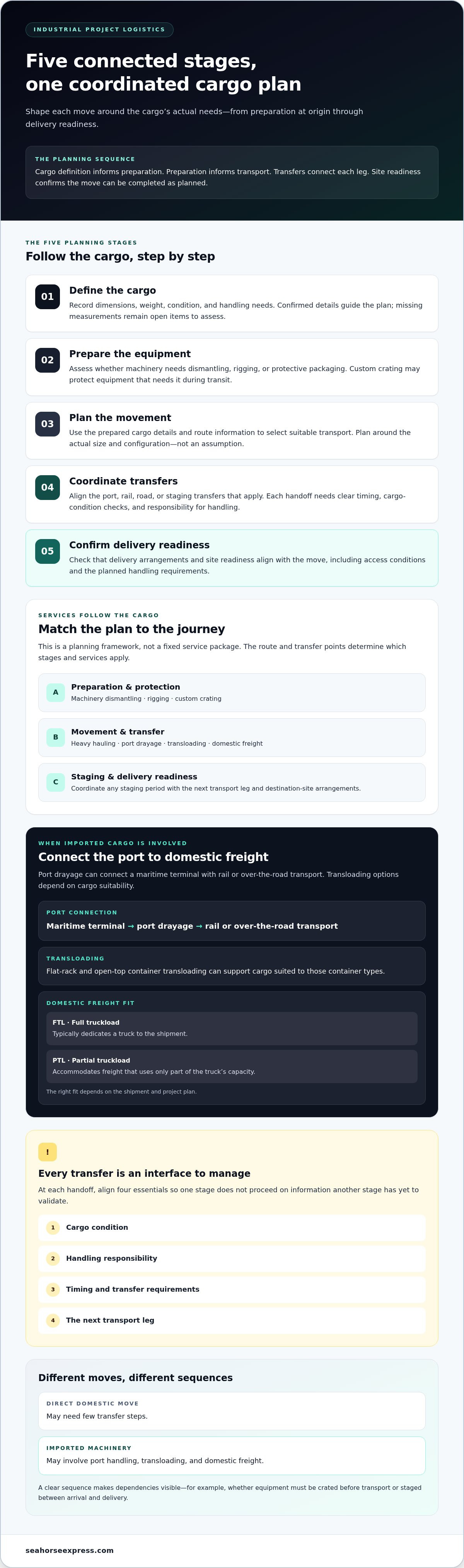
A project move is easier to coordinate when each activity follows from the cargo’s requirements. Industrial project logistics management connects five planning stages: define the cargo, prepare it, plan its movement, coordinate transfers, and confirm delivery readiness. This is a framework, not a fixed service package. A direct domestic move may need few transfer steps, while imported machinery may involve port handling, transloading, and domestic freight.
- Define: Record cargo dimensions, weight, condition, and handling needs.
- Prepare: Determine whether equipment needs dismantling, rigging, or protective packaging.
- Plan: Match the cargo and route to suitable transport.
- Coordinate: Align port, rail, road, or staging transfers that apply.
- Confirm: Check that delivery arrangements and site readiness align with the move.
Connect cargo preparation to transport requirements. Decisions made before loading can affect how equipment is handled and moved at every later stage.
From machinery preparation to transport-ready cargo
Machinery dismantling and rigging may be needed when equipment must be separated or carefully moved from its installed position. Custom crating can protect equipment that needs it during transit. These choices depend on the cargo’s condition and handling requirements. Measurements and load details inform transport selection and route planning, so the movement plan reflects the prepared cargo rather than an assumed size or configuration.
Connecting ports, transloading, and domestic freight
For imported cargo, port drayage can connect a maritime terminal with rail or over-the-road transport. Flat-rack and open-top container transloading can support cargo suited to those container types. Once cargo is ready for domestic movement, full truckload (FTL) typically dedicates a truck to the shipment, while partial truckload (PTL) accommodates freight that uses only part of the truck’s capacity. The right fit depends on the shipment and project plan.
Each transfer creates an interface to coordinate: cargo condition, handling responsibility, timing, and the next transport leg. The Global Project Logistics Network reflects the specialist focus of this field, where distinct logistics capabilities must connect around a project’s cargo. A clear sequence helps teams identify dependencies, such as whether equipment must be crated before transport or needs staging between arrival and delivery.
For a move involving heavy hauling, port drayage, transloading, or domestic freight, industrial cargo transport services can form part of a coordinated plan built around the cargo and its required stages.
Integrated Provider or Separate Vendors? Compare Industrial Logistics Models
There’s no single logistics model that fits every industrial move. The right structure depends on how many stages must connect, how specialized the cargo is, and how much coordination your internal team can manage. Compare industrial project logistics management approaches by looking beyond the number of vendors. Assess who owns the scope, communicates changes, and coordinates each handoff.
| Model | Strengths | Trade-offs | Best fit |
|---|---|---|---|
| Separate specialist vendors | Direct engagement with providers for distinct services. | The buyer coordinates schedules, records, updates, and handoffs across vendors. | Clearly divided scopes and an experienced internal logistics team. |
| Lead coordinator with specialists | A central point coordinates providers while retaining specialist capabilities for individual tasks. | Responsibilities between the coordinator and specialists need clear definition. | Moves requiring several capabilities with a buyer who wants a central coordination role. |
| Provider offering multiple relevant services | Related activities can be scoped and communicated through one provider. | The buyer still needs to understand the service interfaces, responsibilities, and project assumptions. | Moves combining services such as handling, crating, transport, port transfer, or storage. |
When separate specialist bookings may fit
Separate bookings can suit a project with distinct work packages and an internal team equipped to manage coordination. The buyer aligns schedules and records, shares cargo information, and tracks each handoff. If vendors make different assumptions about readiness, packaging, or what a transfer includes, accountability and status updates can become harder to follow. A shared scope helps keep those interfaces visible.
When coordinated multi-service logistics may fit
A move that combines machinery handling, custom crating, heavy or over-dimensional transport, port drayage, transloading, or storage may benefit from connecting related services under a coordinated plan. This can simplify communication between stages, but a longer service list alone doesn’t demonstrate project fit. Compare the defined scope: which tasks are covered, where responsibilities pass between activities, and how the plan accounts for cargo and timing requirements.
Flexibility matters, too. Separate specialists may suit a project with well-defined tasks and strong in-house coordination. A lead coordinator or a provider with multiple relevant services may better fit a move with interdependent stages or limited internal resources. In every model, assess cargo expertise, scope visibility, communication responsibilities, and handoff ownership. The strongest proposal makes these points clear for your project rather than simply listing the most services.
A Buyer’s Checklist for Evaluating Industrial Project Logistics Management
A useful proposal starts with a clear picture of the cargo and the move. Give each provider the same project information and use the same evaluation criteria to compare scope, coordination, and assumptions. Look at which services are included, how they connect, and who is responsible at each interface.
Information to assemble before comparing proposals
Gather the details available for each asset, then identify gaps that may affect planning. Include:
- Cargo: Dimensions, weight, condition, lifting points, packaging status, and handling constraints.
- Origin and destination: Site access conditions, loading and unloading considerations, and any known restrictions that could affect movement.
- Timing: Readiness dates, delivery targets, transfer windows, and dependencies on other project work.
- Movement stages: Potential needs for specialized transport, port or rail transfers, storage, and import-export logistics.
Distinguish confirmed details from estimates. For example, note whether cargo measurements are final or preliminary, and whether a delivery window is fixed or subject to change. Clear qualifications help prevent assumptions from being treated as settled requirements.
How to assess planning, safety, and communication
Review how the proposed plan addresses the cargo and its route. For a move that may involve specialized transport, look for an explanation of route planning and how permitting or escort coordination would be handled when applicable. Don’t rely on broad assurances alone. Check statements about regulatory requirements against current official guidance relevant to the route and cargo.
Then assess the coordination method. A written scope should identify responsibilities, service interfaces, assumptions, and project communications. It should also explain how the team will track milestones, handoffs, and cargo status, and how changes to readiness, access, or timing will be communicated. This helps you see where a delay or revised condition could affect the next stage.
Compare proposals on scope completeness and coordination, not price alone. A lower figure may reflect a narrower scope, while two proposals with similar totals may assign handoffs or responsibilities differently. Before comparing them, check whether each addresses the same cargo, stages, assumptions, and communication needs. Strong industrial project logistics management makes the planned work and its interfaces visible, so your team can judge project fit with fewer unknowns.
Prepare a clear cargo brief to plan your industrial cargo move around its transport, handling, and transfer needs.
How Seahorse Express Can Support a Coordinated Industrial Logistics Plan
A well-scoped move connects cargo requirements to the services needed at each stage. Seahorse Express provides industrial cargo services including heavy hauling and over-dimensional transportation, port drayage and transloading, domestic FTL and PTL, machinery handling, packaging, and storage. The right combination depends on the cargo, route, transfer points, and project requirements. This keeps industrial project logistics management grounded in the actual work rather than a preset service package.
Match Seahorse Express services to the project scope
For oversized or heavy cargo, Seahorse Express provides nationwide heavy-haul and over-dimensional transportation planned around cargo dimensions and route requirements. Imported cargo in applicable flat-rack or open-top containers can connect with port drayage and transloading at every major U.S. seaport, followed by domestic transport. Depending on the scope, machinery dismantling and rigging, custom crating, warehousing, or storage can support preparation and staging. FTL or PTL serves domestic transport needs, while import-export logistics connects international movement with U.S. transport operations.
Not every move needs every service. A project may need only specialized transport, or it may require several connected stages, such as machinery preparation, crating, a port transfer, and storage before domestic delivery. Defining the cargo, interfaces, and responsibilities helps determine which combination fits without adding unnecessary steps.
Prepare a clear project brief and next steps
To start scoping the move, assemble the cargo dimensions, weight, condition, packaging status, handling requirements, and known lifting constraints. Add origin and destination access conditions, likely movement stages, timing dependencies, transfer needs, and known route or site constraints. Mark estimates and open questions clearly. This gives project planning a practical basis and helps align the proposed services with the information available.
Seahorse Express can tailor the relevant service combination to the project, whether the need centers on heavy hauling, port drayage, domestic transport, equipment handling, or storage alongside other stages. A scoped plan should make the included work, responsibilities, and service interfaces clear while distinguishing confirmed details from assumptions that need assessment.
Have an industrial cargo move to plan? Discuss your project requirements with Seahorse Express and request a scoped logistics plan built around your cargo, route, and required services.
Build Your Next Industrial Move Around a Clear Plan
Industrial project logistics management works best when cargo requirements, transport choices, and transfer responsibilities are planned as connected parts of the same move. A well-defined scope makes it easier to compare logistics models, identify missing information, and understand how each stage supports delivery readiness.
Seahorse Express provides nationwide heavy-haul and over-dimensional transportation, plus port drayage and flat-rack or open-top container transloading at every major U.S. seaport. Depending on the project, machinery handling, custom crating, warehousing, and storage can also support the cargo plan. The right service combination depends on your equipment, route, and required movement stages.
Start with the cargo details, origin and destination conditions, timing dependencies, and transfer needs. Then use that brief to shape a practical, clearly scoped approach. Discuss your industrial logistics project with Seahorse Express and take the next step toward a coordinated move built around your requirements.
Frequently Asked Questions
What is industrial project logistics management?
Industrial project logistics management is the planning and coordination of the services and handoffs required to move industrial cargo through a project. It considers cargo details, preparation, transport, transfers, staging, and delivery readiness as connected activities. For example, a machinery move may involve rigging before transport and storage before final delivery. The scope varies by cargo, route, handling needs, and project requirements. Not every move requires every service.
What services can be part of an industrial logistics project?
Services may include heavy hauling, over-dimensional transportation, domestic FTL or PTL freight, port drayage, and container transloading. Depending on the equipment and move, the plan may also include machinery dismantling and rigging, custom crating, warehousing, storage, or import-export logistics. These services address different stages, from preparing cargo to moving it between transport modes. A project scope should identify which services are needed and how their responsibilities connect.
How do I choose an industrial project logistics provider?
Choose a provider based on how clearly its plan fits the cargo and project scope. Compare relevant cargo experience, included services, assigned responsibilities, handoff coordination, communications, and how assumptions or changing conditions will be handled. Review proposals against the same cargo information and movement stages, not just their service lists. Seahorse Express connects services such as heavy hauling, port drayage, transloading, domestic transport, machinery handling, crating, and storage to project requirements.
When should I use one coordinated logistics provider instead of separate vendors?
A coordinated provider may suit a move with connected stages, such as machinery preparation, crating, specialized transport, port transfer, or storage, particularly when your team has limited capacity to coordinate multiple vendors. Separate vendors can fit clearly divided scopes and an experienced internal logistics team. Compare both approaches by scope visibility, communications, cargo expertise, handoff responsibilities, and flexibility. The best fit depends on project complexity and your available coordination resources.
What information is needed to plan an industrial equipment move?
Start with cargo dimensions, weight, condition, packaging status, lifting points, and handling constraints. Add origin and destination access details, the route and transfer points under consideration, timing dependencies, and known storage or staging needs. Note whether measurements and dates are confirmed or estimated. This brief helps connect preparation to transport requirements and highlights open questions that may affect the plan, such as cargo readiness or access conditions.
Can industrial project logistics include port drayage and transloading?
Yes. Port drayage can connect a maritime terminal with rail or over-the-road transport, while transloading moves cargo between containers or transport equipment when the shipment calls for it. Seahorse Express provides drayage and transloading for applicable flat-rack and open-top containers at every major U.S. seaport. These services can form part of a broader plan that also includes import-export logistics and domestic transport, depending on the cargo’s route and project scope.
How can project logistics reduce delays during an industrial move?
A coordinated plan can help reduce avoidable delays by making dependencies and handoffs visible before cargo moves. Teams can align cargo readiness, packaging, transport arrangements, transfer windows, and destination access, then track milestones and communicate changes. For example, identifying that equipment needs crating before loading connects preparation with transport planning. Coordination can’t remove every source of disruption, but a clear scope helps teams identify issues earlier and respond with shared information.


