
A shipment that’s too large for a straightforward LTL plan doesn’t automatically need a dedicated truck. Partial truckload shipping may be a better fit, but providers don’t all use the term the same way. The right option depends on the cargo, the service plan, and how the shipment needs to be handled.
If you’re unsure how PTL differs from LTL or FTL, start by comparing how each provider will move your specific freight. Capacity, dimensions, packaging, handling needs, site access, and timing all affect the plan.
This guide explains how partial truckload shipping works and compares it with LTL and FTL using practical selection criteria. It also outlines what to prepare before requesting a quote, including accurate weights and dimensions, piece count, pickup and delivery requirements, and handling considerations. With those details ready, you can ask providers focused questions and compare their proposed services more clearly.
Key Takeaways
- Partial truckload shipping uses part of a truck’s capacity, but terminology and acceptance criteria can vary by provider.
- Assess dimensions, weight, packaging, handling needs, and site access before choosing a freight mode.
- Compare LTL, PTL, and FTL by capacity, cargo handling, and coordination needs, not by labels alone.
- Accurate shipment details help providers assess service suitability and reduce avoidable plan changes.
- When comparing providers, confirm equipment fit, communication expectations, and what each quote includes.
What Is Partial Truckload Shipping, and How Does It Work?
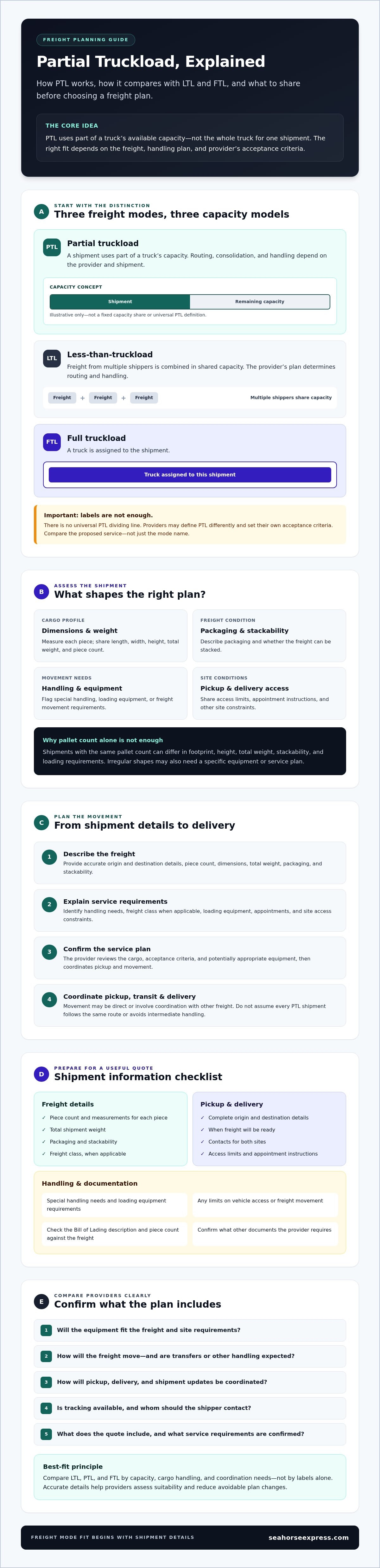
Partial truckload (PTL) shipping moves freight using part of a truck’s available capacity, rather than reserving the entire truck for one shipment. PTL may suit freight that needs more room or a different handling plan than a typical less-than-truckload shipment, but doesn’t require a full truck. There is no universal dividing line: providers may define “PTL” differently and set their own acceptance criteria.
For comparison, Less-than-truckload (LTL) shipping combines freight from multiple shippers in shared capacity. PTL also uses less than a full truck, but the routing, consolidation, and handling model depends on the provider and shipment. FTL assigns a truck to the shipment. PTL does not mean that one shipment occupies an entire truck.
What happens to a shipment during partial truckload transport?
The process starts with shipment details and service requirements. The provider reviews the cargo, checks whether it can be accepted, and determines what equipment may be appropriate. After service is confirmed, the provider coordinates pickup and plans the movement to the destination.
The shipment may move directly between locations or require additional coordination, such as combining loads or planning around other freight. Don’t assume every PTL shipment follows the same route or avoids intermediate handling. Ask how the freight will move, whether transfers or other handling are expected, and how pickup and delivery will be coordinated. A point-to-point service may follow a different plan from one that coordinates the load with other freight.
What freight can be considered for PTL?
Providers can assess commercial and industrial freight for PTL based on its dimensions, weight, packaging, and handling requirements. For example, palletized machinery components may need more space than a routine LTL plan accommodates. Packaging and handling requirements may also affect which service is appropriate. Volume is one consideration, but it is not the only one.
Pallet count alone doesn’t determine suitability. Two shipments with the same number of pallets can differ in footprint, height, total weight, stackability, and loading requirements. Unusually shaped freight or cargo that needs particular handling may also require an equipment or service plan that a pallet count cannot describe.
Before booking, provide accurate cargo details and explain any handling concerns or access constraints at pickup and delivery. Then confirm that the provider accepts the freight and can meet its equipment and service requirements. Seahorse Express provides domestic PTL and FTL transportation for commercial and industrial cargo. Suitability depends on the shipment details and operational requirements.
How Partial Truckload Shipping Is Planned and Coordinated
A sound PTL plan starts with accurate shipment information, then addresses handling requirements, service confirmation, and pickup coordination. These details help a provider assess whether the freight, equipment, and movement plan are compatible. Partial truckload shipping isn’t arranged on size alone. Pickup and delivery access and any special handling can also affect the plan.
For a useful freight assessment, provide origin and destination details, piece count, dimensions, total weight, packaging, stackability, handling needs, and pickup and delivery access conditions. Include freight class when applicable, and identify any loading equipment, appointment, or site constraints. This gives the provider a clearer basis for assessing the shipment than a brief description alone.
Which shipment details should a shipper provide?
Measure each piece and provide its length, width, and height, along with the total shipment weight and piece count. Describe how the freight is packaged and whether it can be stacked. Pallet count may not show the full footprint or loading requirements, especially for machinery or irregularly shaped cargo.
Also share complete origin and destination information, when the freight will be ready, and contacts for both sites. Flag special handling needs, loading equipment requirements, appointment instructions, and any limits on vehicle access or freight movement. If freight class applies, confirm the classification details with your provider.
How are pickup, movement, and delivery coordinated?
Before dispatch, the shipper and provider should confirm when the freight will be ready, how the driver can access and load it, and what delivery conditions apply. The provider should also explain the proposed route and handling plan. For background on how shared-capacity and dedicated-truck options differ, see the NMFTA’s overview of LTL and FTL shipping methods.
A Bill of Lading (BOL) records key shipment and transportation details. Check that its description and piece count match the freight being tendered, and confirm what other documents the provider requires. Before dispatch, ask how updates will be shared, whether tracking is available, and whom to contact if readiness, access, or delivery plans change. Tracking and exception procedures vary by provider, so confirm them rather than assume they’re included.
Clear details support a more informed service assessment. Seahorse Express provides domestic PTL and FTL transportation for commercial and industrial cargo. Review its domestic freight services as part of planning a shipment.
Partial Truckload vs. LTL vs. FTL: Which Mode Fits?
Choosing a freight mode means weighing capacity against cargo needs and coordination. LTL uses shared freight capacity, PTL uses part of a truck’s capacity, and FTL provides a full truck for the shipment. These labels don’t guarantee a standard shipment size or handling process. Provider thresholds, routing, and service models vary, so compare the details behind each quote.
| Mode | Typical shipment fit | Capacity use | Handling and planning considerations |
|---|---|---|---|
| LTL | Freight suited to movement with other shippers’ shipments | Shared freight capacity | Ask about transfers, consolidation, handling practices, and shipment details required. |
| PTL | Freight that may need more space or a different handling plan than an LTL service provides | Part of a truck’s available capacity | Confirm how the provider plans routing, coordination, and cargo handling. |
| FTL | A shipment whose volume or operational needs warrant evaluating a full truck | Full-truck service | Confirm equipment, movement plan, schedule, and service scope. Point-to-point transport may be relevant, but should not be assumed. |
For added context on full-truck service, see this truckload freight shipping guide. The right option depends on the freight and the provider’s operating model, not just the name on a quote.
When should a shipper compare PTL with LTL?
Compare PTL with LTL when the shipment’s dimensions or volume seem poorly suited to the LTL plan, or when fragility, packaging, or handling needs call for closer attention. LTL networks may involve terminal transfers or additional handling, but practices differ. Ask each provider how the freight will move and be handled. Then compare those details rather than assuming every LTL or PTL service follows the same process.
When might FTL be the more suitable option?
Evaluate FTL if the shipment uses enough capacity, needs dedicated truck space, or has operational requirements that favor assigning a truck to the load. A direct point-to-point movement may be useful to consider, but it isn’t guaranteed by the FTL label. Compare quotes based on the same shipment information and requested services, including equipment, handling, schedule, routing, and communication arrangements.
Partial truckload shipping can be a middle option when neither shared LTL capacity nor a full truck clearly matches the shipment. Before deciding, confirm each provider’s criteria and compare the movement plan, equipment fit, and handling requirements.
How to Prepare a Shipment for Partial Truckload Service
A clear shipment description gives a provider a sound basis for assessing equipment, handling, and pickup arrangements. Inaccurate dimensions or missing access details can require plan changes once the freight is ready. Before requesting partial truckload shipping, gather the information below and check for provider-specific requirements.
- Measurements and weight: Record the dimensions of each handling unit and the total shipment weight.
- Packaging: Describe how the freight is packaged, whether it is palletized or stackable, and any cargo protection needs.
- Access: Note site access conditions, loading equipment, and pickup or delivery restrictions.
- Contacts: Provide current contacts for both locations and identify who can answer questions about the freight.
- Documentation: Confirm which shipping documents and cargo details the provider needs.
Photographs can help clarify unusual shapes, packaging, or loading conditions, especially when a written description doesn’t show how the freight is arranged. Ask the provider whether images are useful and how to submit them. Don’t assume one packaging method suits every item. Confirm preparation and protection requirements for the cargo and planned handling.
How should cargo be measured, packaged, and documented?
Measure each handling unit rather than estimating from the overall load. Report individual dimensions as well as the shipment’s total dimensions and weight, and describe palletization and stackability. If a piece is irregularly shaped or needs particular protection, explain that clearly. Confirm required documents with the provider, including the Bill of Lading if applicable, and check that the cargo details match the freight being tendered.
What should be confirmed before pickup?
Check that the pickup and delivery sites can accommodate the planned vehicle and that the freight will be accessible and ready. Confirm operating hours, appointment requirements, loading equipment, and who is responsible for loading and unloading. A mismatch between site equipment and freight requirements can disrupt the plan, so settle those details before dispatch.
Also verify contact names and numbers, expected freight readiness, how shipment updates will be shared, and whom to reach if plans change. Tracking availability and exception procedures depend on the provider. Ask what communication to expect instead of assuming it is included.
Preparing these details can make a service review more precise. Discuss your commercial freight requirements with Seahorse Express when assessing domestic PTL or FTL transportation.
Choosing a Partial Truckload Provider and Planning Next Steps
A suitable provider should be able to assess the freight, explain how it will be handled, and clarify what the quoted service includes. Use the same shipment details and requested services when comparing options. Otherwise, quotes may describe different equipment, handling, or coordination, making them difficult to compare fairly.
What questions should a shipper ask a PTL provider?
Ask how the provider evaluates dimensions, total weight, packaging, and special handling needs. Clarify how pickup and delivery will be coordinated, what tracking or shipment updates are available, and how exceptions or schedule changes are communicated. These questions help turn a mode label into a practical service plan.
- Equipment fit: What equipment is available for this freight, and which cargo details determine suitability?
- Handling: How will the shipment be handled, and are transfers or additional coordination expected?
- Communication: Who provides shipment updates, and whom should the shipper contact if plans change?
- Service scope: Which pickup, transportation, and delivery arrangements are included in the quote?
Confirm service eligibility and availability with the provider before booking. Partial truckload shipping can be useful, but the cargo requirements and operating details determine whether it fits a specific move.
How can Seahorse Express help assess freight needs?
For freight with more complex requirements, its wider capabilities include heavy hauling, machinery dismantling and rigging, and custom crating. These services may be relevant to a broader logistics plan, depending on the cargo and requested work.
Before requesting an assessment, have the origin and destination, piece count, dimensions, total weight, packaging description, handling needs, and site access information ready. Identify any equipment or schedule requirements as well. Confirm coverage, equipment availability, shipment acceptance, and operational arrangements directly, as these depend on the specific move.
For a shipment-specific discussion, contact Seahorse Express about your freight requirements.
Plan Your Next Freight Move with Confidence
The right freight mode depends on the shipment, not the label alone. Partial truckload shipping uses part of a truck’s capacity, while LTL and FTL use different capacity and coordination models. Compare the actual service details, including equipment, cargo handling, routing, and pickup and delivery arrangements.
Accurate dimensions, weight, packaging, and access information help a provider assess the shipment and plan the movement. Before booking, confirm cargo eligibility, equipment availability, communication expectations, and service scope. These checks help set clear expectations before the freight is ready to move.
Its broader capabilities include heavy hauling, port drayage, transloading, and machinery handling, which may be relevant when a shipment has additional logistics requirements. Service suitability and operational details depend on the freight and should be confirmed with the provider.
Discuss your commercial or industrial freight requirements with Seahorse Express. Share the shipment details and ask about the service plan for your move.
Frequently Asked Questions
What is partial truckload shipping?
Partial truckload shipping uses part of a truck’s available capacity for a shipment rather than assigning the entire truck to one load. It may suit commercial freight that doesn’t fit a typical LTL plan but doesn’t require a full truck. PTL definitions, acceptance criteria, routing, and handling practices vary by provider. Share cargo dimensions, weight, packaging, and handling needs to help the provider assess the shipment.
What is the difference between LTL and partial truckload shipping?
LTL generally combines freight from multiple shippers in shared capacity, while PTL uses a portion of a truck’s capacity for a shipment. Operating details vary by carrier: routing, consolidation, transfers, and handling can differ. Ask how each provider plans to move and handle your freight. Compare those service details, equipment, and pickup and delivery arrangements instead of relying on mode names alone.
Is partial truckload shipping faster than LTL?
Not necessarily. Transit time depends on the provider’s route, schedule, consolidation plan, and handling process, so PTL doesn’t automatically move faster than LTL. Before booking, request expected transit details for your shipment and ask whether the route includes transfers or other coordination. Compare the proposed schedules and service terms, and confirm how the provider will communicate changes or exceptions during transport.
When should I use partial truckload instead of FTL?
Consider PTL when your shipment needs only part of a truck’s capacity and a full-truck service may not be necessary. Cargo dimensions, handling needs, and site requirements can also affect the decision. Compare PTL and FTL using the same shipment description, equipment needs, schedule, and service scope. If dedicated capacity or particular operational requirements matter, ask the provider whether FTL is a better fit for the move.
What information is needed for a partial truckload quote?
Provide origin and destination details, piece count, each handling unit’s dimensions, total weight, packaging, and whether the freight can be stacked. Include freight class if applicable, plus handling needs, loading equipment, pickup readiness, and access or appointment constraints at both sites. Accurate information helps the provider assess equipment and service suitability. Confirm any additional details or documents the provider requires before comparing quotes.
Does partial truckload shipping include residential delivery?
Not by definition. PTL describes how truck capacity is used, not whether delivery to a residential address is included. Service scope depends on the provider, destination, and site access. Confirm whether the requested address and delivery arrangements can be accommodated before booking. Seahorse Express does not offer last-mile residential delivery, so shippers who need that service should verify options with a provider that does.
How should I prepare freight for partial truckload pickup?
Measure each handling unit, record its weight, and describe its packaging, palletization, stackability, and protection needs. Follow packaging instructions confirmed with the provider rather than assuming one standard suits every shipment. Check pickup access, loading equipment, freight readiness, and who will load the cargo. Confirm required documents and site contacts. Photos of unusual cargo or loading conditions may help, but ask the provider what information it needs.


