
When industrial cargo moves from a maritime terminal to rail and then over the road, every handoff needs to fit the next leg. Industrial transloading services coordinate the transfer between modes, including the timing, staging, equipment, and cargo handling needed to keep the shipment moving.
If you’re coordinating machinery or containerized freight, each transfer point adds decisions. A flat rack or open-top container may need specialized handling, and rail or truck schedules must align with terminal operations and the next leg. To plan the handoff, start with the cargo’s dimensions, weight, packaging, and destination, then match those details to the route and equipment.
This article explains what industrial transloading includes, when it can fit a shipment, and which details shape the handling plan. You’ll also see how port drayage connects maritime cargo with onward domestic transportation. Seahorse Express coordinates port drayage and transloading for flat rack and open-top containers at every major U.S. port, connecting maritime terminals with rail and over-the-road transport.
Key Takeaways
- Understand when industrial transloading services can connect cargo moving between vessel, rail, and road.
- See how shipment dimensions, weight, packaging, and destination shape a practical transfer plan.
- Learn the difference between transloading, drayage, cross-docking, and storage so you can identify the role each plays in a shipment.
- Use a preparation checklist to organize cargo details and inform equipment and handling decisions.
- Explore how coordinated port drayage and onward domestic transportation can simplify complex industrial freight handoffs.
What Are Industrial Transloading Services, and When Do Shippers Use Them?
Industrial transloading is the transfer of cargo from one transportation mode or piece of equipment to another for its next journey. A shipment might arrive by vessel, move through a terminal or transloading facility, and continue by rail or truck. The transfer is the defining activity. It does not automatically include extended storage.
Industrial transloading services connect transport legs when a shipment’s route, equipment, or handling needs change. Cargo may need to move from a maritime container to a railcar, or from a container to an over-the-road trailer. The receiving equipment, cargo characteristics, and onward route all affect how the transfer is planned.
This is especially relevant for machinery and project cargo, where dimensions, weight, and configuration shape the handling approach. Flat rack and open-top containers accommodate some cargo that does not fit within the enclosed dimensions of a standard container. A flat rack has an open structure suited to certain oversized loads, while an open-top container allows cargo to be loaded from above. The appropriate container and transfer plan depend on the shipment and its route.
Which industrial shipments can benefit from transloading?
Transloading may suit cargo that arrives by vessel and continues by rail or road, or freight that must shift between equipment types to reach its destination. Machinery, project cargo, and freight in flat rack or open-top containers are examples where a planned transfer can connect transport modes. Not every shipment needs this step. Consider whether the arriving equipment can continue to the destination and whether the route requires a change of mode or equipment.
Seahorse Express coordinates port drayage and transloading for flat rack and open-top containers at every major U.S. port, connecting maritime handling with onward domestic transportation. For a foundational overview of the term and its uses, see Transloading.
How is transloading different from cross-docking or warehousing?
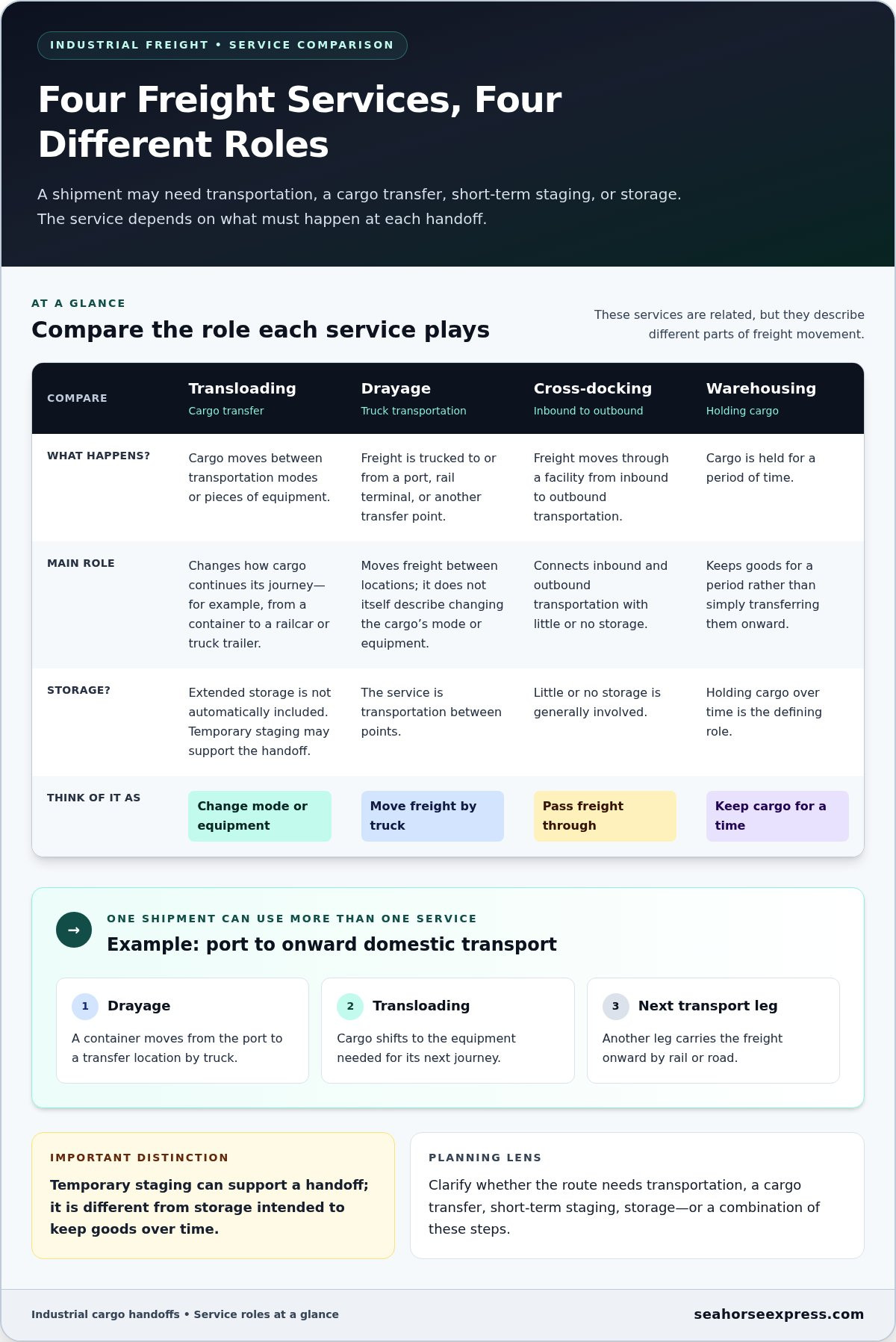
These terms describe related but distinct parts of freight movement. Transloading means transferring cargo between modes or equipment. Cross-docking generally describes freight moving through a facility from inbound to outbound transportation with little or no storage. Warehousing holds cargo for a period of time. Temporary staging can support a handoff, but it is different from storage intended to keep goods over time.
Drayage is truck transportation to or from a port, rail terminal, or another transfer point. It moves freight between locations; transloading changes the cargo’s mode or equipment. A shipment can use both: drayage brings a container from a port to a transfer location, transloading shifts the cargo to its next equipment, and another transport leg carries it onward. Distinguishing these services helps clarify which steps the route requires: transportation, cargo transfer, short-term staging, or storage.
How the Industrial Transloading Process Coordinates Each Cargo Handoff
A workable transfer starts before cargo reaches the facility. Industrial transloading services depend on accurate shipment details and a shared plan for how cargo will arrive, move between equipment, and depart. Dimensions and weight inform equipment decisions. Packaging, lifting points, container type, and destination help determine how freight can be handled and what the next leg requires.
The basic sequence is to gather shipment details, plan the transfer, coordinate receipt, move the cargo between modes or equipment, and dispatch it onward.
Each handoff needs clear responsibilities and aligned arrival and departure information. Terminal operations, the transloading facility, and the next carrier need to know when cargo is expected and what equipment is required. If a rail connection or truck pickup changes, share the update promptly so the team can adjust staging and avoid planning each leg in isolation. Commtrex’s overview of Transloading Services also describes how transloading connects freight with rail and other transportation options.
What shipment information supports a workable transfer plan?
Start with the details that affect handling and onward transport. A general shipment description may not show whether cargo can be lifted as packaged or needs a different arrangement. Share available information early, and flag project work that could affect the transfer sequence.
- Cargo profile: dimensions, weight, packaging, visible handling points, and cargo condition.
- Equipment: container type, including whether freight arrives on a flat rack or in an open-top container.
- Route: origin, destination, modes involved, and the planned order of terminal, rail, facility, and road handoffs.
- Handling needs: planned lifting, rigging, dismantling, custom crating, or staging requirements.
Clear measurements help determine how cargo can be accessed, positioned, and transferred. Weight information supports equipment planning. If cargo is secured to a base, has designated lifting points, or needs protection during handling, document those details. That gives the team a more useful planning basis than a broad description such as “heavy machinery.”
What happens during receipt, transfer, and dispatch?
Before arrival, the receiving team coordinates the expected delivery and confirms that the transfer plan reflects the shipment details. On receipt, the team can compare the cargo’s observed condition and configuration with the information provided, noting any differences that could affect handling. The transfer method and equipment should suit the cargo, its packaging, and its next mode of transport.
After the transfer, cargo is positioned and prepared for onward loading according to the route plan. The next carrier’s equipment and destination guide that step. Updates about arrival, receipt, handling progress, and dispatch help connect terminal, facility, and carrier responsibilities. For connected port drayage and transloading, Seahorse Express coordinates flat rack and open-top container transfers at every major U.S. port.
Industrial Transloading vs. Drayage, Cross-Docking, and Storage
These services can appear in the same freight plan, but they solve different problems. Transloading transfers cargo between containers, trailers, railcars, or other equipment. Drayage transports freight between a port or terminal and another location. Cross-docking and warehousing describe how cargo moves through or is held at a facility.
| Service | Main function | Typical shipment need |
|---|---|---|
| Transloading | Transfers cargo between transport modes or equipment | A shipment must move from a container to a railcar or truck for its next leg |
| Drayage | Moves freight by truck over a short connection between facilities or transfer points | A container needs to travel from a maritime terminal to a transload location |
| Cross-docking | Moves inbound cargo through a facility to outbound transport, usually with limited staging | Freight is ready to continue without a planned holding period |
| Warehousing or storage | Holds cargo at a facility for a planned period | Freight needs to wait before the next transport leg or be staged for a later movement |
When does transloading solve a different problem than drayage?
Think of drayage as movement between points and transloading as a change in how cargo is carried. A container may be trucked from a port to a transfer location by drayage, then unloaded or otherwise transferred so its contents can continue by rail or in different road equipment. The shipment uses both functions, but the terms are not interchangeable. Industrial transloading services handle the cargo handoff; drayage connects locations along the route.
This distinction clarifies responsibilities in a shipment plan. The transfer plan addresses how cargo changes equipment, while the transportation plan addresses how it reaches the next facility or terminal. Coordinating both aligns the handoff with the connecting movement.
When do cross-docking or storage enter the plan?
Cross-docking may suit freight that can move from inbound to outbound transport with little time at the facility. Some staging may still be needed to organize the handoff, but that is not the same as long-term storage. Warehousing is a separate requirement when cargo must be held for a planned period, such as while a later transport leg is arranged or freight is staged for a project.
Include storage as a deliberate part of the shipment plan, rather than assuming it comes with transloading. Cargo condition, handling requirements, and expected onward movement help determine whether temporary staging is enough or warehousing is needed. For more detail on planning a holding period and organizing industrial cargo, see the warehouse storage planning guide.
How to Prepare Industrial Cargo for a Transloading Move
Preparation gives the handling team a clear picture of the cargo and its route. For industrial transloading services, incomplete measurements or unclear lifting instructions can make it harder to choose a transfer method and onward equipment. Share shipment information early and keep it consistent across the terminal, transloading location, and next carrier.
Use this checklist to organize the details before cargo arrives:
- Shipment identity and route: Describe the cargo, origin, destination, intended transport modes, container type, and planned sequence of handoffs.
- Dimensions and weight: Provide the cargo’s length, width, height, and weight. Include overall dimensions with packaging or supports in place.
- Handling points: Identify designated lifting points and the center of gravity when known. Note handling restrictions or areas that must not bear pressure.
- Condition and packaging: Record the condition of the packaging and cargo. Point out exposed, fragile, or sensitive components that need particular care.
- Project requirements: Flag anticipated rigging, machinery dismantling, protective crating, or staging needs.
- Handoff coordination: Share expected arrival windows, transfer locations, onward mode, and the next carrier’s planned pickup or connection.
What should the shipper document before cargo arrives?
Be specific rather than relying on broad labels such as “oversized equipment” or “machinery.” Clear measurements and weight help the team assess access, handling, and equipment needs. Lift points and center of gravity add useful context for positioning the load. Container type also matters because it affects how cargo is accessed. For example, specify whether freight is arriving on a flat rack or in an open-top container.
Describe the packaging as it will arrive, including any areas that are open or vulnerable. If actual cargo details differ from the initial plan, update the shipment information before the handoff so the transfer can be adjusted and the relevant parties informed.
How can packaging and handling requirements reduce transfer risk?
Packaging helps protect cargo during lifting, movement, and the transition to the next mode. Secure packaging can support stable handling, while a crate may provide added protection or a defined structure for industrial equipment in transit. Choose packaging that accounts for the item’s shape and sensitive components, not just one that covers the outside.
Seahorse Express provides custom crating alongside industrial logistics services. For practical guidance on protective packaging, see the custom crating guide for industrial equipment.
Clear coordination ties preparation details to the actual move. Align the expected arrival window with the transfer point and onward transportation plan, then communicate changes that could affect staging or pickup. If cargo requires rigging or dismantling, include those steps in the handling sequence. Information about the cargo, route, and supporting services also helps Seahorse Express coordinate specialized freight movements. Learn more about industrial transloading.
Coordinating Industrial Transloading with a Nationwide Logistics Partner
A complex shipment can involve several distinct movements: cargo leaves a maritime terminal, reaches a transfer location, changes equipment, then continues inland by road or rail. A coordinated plan connects these steps around the shipment’s route and handling needs. Align port drayage, the cargo transfer, and onward domestic transportation instead of planning each handoff in isolation.
How can transloading connect port cargo with inland transport?
Drayage can move a container from the terminal to a transload location. There, cargo can be transferred to equipment suited to its next leg and dispatched toward its inland destination. Coordination between the terminal, facility, and carrier helps clarify handoff expectations and responsibilities. For more on connecting port movements with inland transport, consult this drayage services guide.
Seahorse Express coordinates port drayage and transloading for flat rack and open-top containers at every major U.S. port. These container types can support specialized cargo through port handling and onward domestic transportation. The wider plan can also account for rail and over-the-road connections, treating cargo transfer and physical transportation as linked but distinct parts of the route.
When should a shipment use coordinated industrial logistics services?
Coordination matters when a transfer involves more than a standard container handoff. Machinery dimensions, container type, lifting needs, and the intended route all influence how cargo moves between modes. Bringing these details into one plan helps align equipment, handling, staging, and onward transport around the shipment.
Supporting services may also be part of the move. Rigging can address lifting or positioning needs, while machinery dismantling may prepare equipment for transport. Custom crating can provide protective packaging, and warehousing can support a planned holding period when cargo cannot proceed directly to its next leg. These services complement transloading when the cargo or schedule requires them; they are not automatic steps in every transfer.
Seahorse Express brings port drayage, container transloading, and industrial logistics capabilities together for complex freight movements. A clear shipment profile and route help shape the coordination plan, including how specialized cargo will move from port handling to its next domestic transport leg. Learn more about Seahorse Express’s industrial logistics services.
Turn Your Shipment Plan Into the Next Move
Turn the route and cargo requirements into a shared working plan. Gather the shipment’s dimensions, weight, handling instructions, packaging details, and intended transport sequence in one place. Use that information to align the people responsible for each handoff. A clear, consistent brief gives the team a practical starting point for planning industrial transloading services around the actual shipment.
Identify any remaining decisions: how cargo will be handled, whether supporting services are needed, and how the transfer fits with onward transportation. Addressing these points early helps align the route, equipment, and handling plan before the shipment reaches its transfer point.
For complex industrial freight, a coordinated discussion can turn cargo requirements into a clear movement plan. Discuss your industrial transloading requirements with Seahorse Express.
Frequently Asked Questions
What are industrial transloading services?
Industrial transloading services move industrial cargo between transportation equipment or modes as part of its journey. For example, machinery arriving in a maritime container may need to be transferred for onward rail or truck movement. The handling plan depends on the cargo and route. Transloading describes the transfer, drayage or other trucking covers movement between locations, and warehousing addresses cargo held for a period.
When should a shipper use transloading instead of direct shipping?
Use transloading when the planned route requires cargo to change modes or equipment, or when the receiving location cannot take the arriving equipment as it is. For example, a shipment may arrive by vessel but need to continue inland by rail or in a different trailer. Direct shipping may suit cargo that can continue on the same equipment along its route. Compare the origin, destination, cargo requirements, and available transport modes.
How does industrial transloading work for flat rack containers?
For a flat rack shipment, the transfer plan accounts for the cargo’s shape, how it is secured, and how it can be accessed. The team considers dimensions, weight, lifting points, and the equipment needed for the next leg. For instance, machinery arriving on a flat rack may need a transfer arrangement compatible with onward road or rail movement. Accurate cargo information supports planning for each handoff.
Can industrial machinery be transloaded between a ship, rail, and truck?
Yes. A shipment can connect maritime, rail, and road transportation when those modes fit its route and handling requirements. The plan must account for the machinery’s size and weight, lifting and securing needs, and positioning for each leg. Some projects may also call for rigging, dismantling, crating, or heavy hauling as part of the wider move. Consider those needs alongside the route, not as isolated tasks.
What is the difference between transloading and cross-docking?
Transloading focuses on cargo changing equipment or transportation modes. Cross-docking focuses on freight passing through a facility from an inbound movement to an outbound one, often with limited staging. An operation can involve both, but each term describes a different part of the work. If the key requirement is changing from one mode to another, transloading describes that transfer; cross-docking describes the facility flow.
What information is needed to plan an industrial transload?
Share the cargo description, dimensions, weight, packaging, container type, route, and planned transport modes. Include lifting points, center of gravity, and handling restrictions when relevant. A cargo identification list or available handling drawings can clarify what each item requires, especially when a shipment includes multiple pieces of equipment. Also outline the transfer points and any project-specific rigging, crating, or staging needs so the movement can be planned around the load.
Does transloading include warehousing or storage?
No. Storage is a separate service need, even if it forms part of the same shipment plan. If cargo cannot proceed directly to its next transport leg, specify how it should be staged, how it must remain protected, and what conditions trigger its release. Those instructions distinguish a brief transfer-related pause from a planned holding period. Seahorse Express offers warehousing and storage for industrial cargo when a shipment requires that additional step.


