
Does your freight need to fill an entire trailer to make truckload the right choice? Not necessarily. The better question is whether your shipment’s size, handling needs, and delivery requirements fit a full truckload move. Truckload freight shipping gives commercial and industrial cargo dedicated truck capacity for the journey, but choosing it confidently starts with accurate cargo details, not simply reserving trailer space.
Trailer space is only one factor. Equipment, pickup and delivery coordination, and special handling can also affect which service fits. Gathering the right information before requesting a quote helps you compare options and address potential issues before the shipment is dispatched.
This guide explains how truckload transport works, when full truckload may suit your cargo, and what details to prepare before requesting a quote. You’ll also learn what to clarify about equipment, handling, and service terms, and when related capabilities such as heavy hauling or over-dimensional transportation may be relevant. With a clear picture of the process, you can evaluate providers and plan your shipment with greater confidence.
Key Takeaways
- Assess whether dedicated trailer capacity suits your shipment. The cargo does not have to fill the trailer.
- Confirm key details before dispatch, including cargo readiness, pickup arrangements, and site access.
- Compare truckload, partial truckload, and intermodal options based on your freight and coordination needs.
- Prepare an accurate cargo description, measurements, packaging details, and receiving plan to support shipment planning.
- For truckload freight shipping involving complex industrial cargo, assess whether capabilities such as heavy hauling, custom crating, or warehousing may be relevant.
What Is Truckload Freight Shipping and How Does It Work?
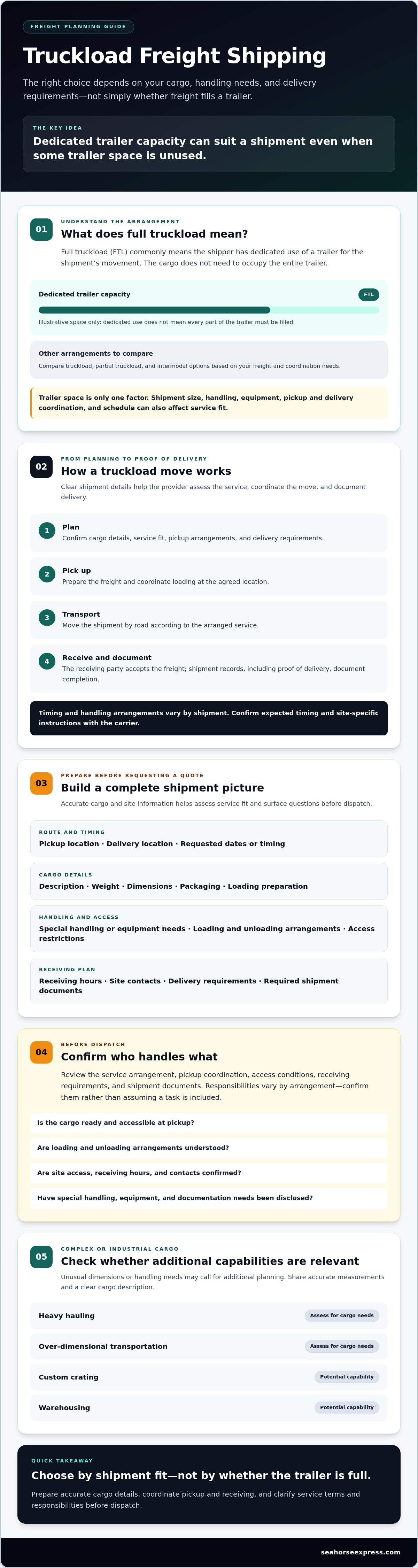
Truckload freight shipping is a road-freight arrangement in which a shipment moves by truck or trailer, often with dedicated trailer capacity. The freight does not have to fill every part of the trailer. The right arrangement depends on factors such as shipment size, handling requirements, and schedule. After the shipper provides the cargo and route details, the provider assesses the service, coordinates pickup and transportation, and documents delivery.
What does full truckload mean in freight shipping?
Full truckload (FTL) commonly means that a shipper has dedicated use of a trailer for the shipment’s movement. This differs from sharing trailer space with other shipments, but it does not mean the cargo must physically occupy the whole trailer. A shipment may suit FTL because of its size, handling needs, or schedule, even when it leaves some trailer space unused.
Terms and available equipment depend on the cargo and the carrier’s capabilities. For a foundational overview of how the service differs from less-than-truckload shipping, see Truckload shipping.
What happens during a truckload shipment?
Planning starts with shipment information. The shipper provides the origin and destination, cargo description, dimensions, weight, and requested timing. Packaging, loading conditions, site access, and delivery requirements also help the provider assess whether the proposed service fits.
The carrier reviews those details and confirms the service arrangement, pickup coordination, and receiving requirements. Before dispatch, make sure both sides understand who is responsible for each part of the move.
- Plan: Confirm cargo details, service fit, pickup arrangements, and delivery requirements.
- Pick up: Prepare the freight and coordinate loading at the agreed location.
- Transport: Move the shipment by road according to the arranged service.
- Receive and document: The receiving party accepts the freight, and shipment records, including proof of delivery, document completion.
Schedules and handling arrangements vary by shipment. Confirm expected timing and site-specific instructions with the carrier instead of assuming a fixed transit period. For commercial and industrial cargo, accurate measurements and a clear description are particularly useful when specialized handling or equipment may be needed. A straightforward shipment may fit standard domestic truckload service; cargo with unusual dimensions or handling needs may call for additional planning.
How Truckload Freight Shipping Moves from Booking to Delivery
A truckload move is easier to coordinate when the shipper provides complete cargo and site information and the carrier confirms how pickup and delivery will work. For a quote, provide the locations, requested timing, cargo description, weight, dimensions, handling needs, access conditions, and site contacts.
What information should a shipper provide for a truckload quote?
Start with the pickup and delivery locations and the dates or timing you are requesting. Describe the freight, including its weight and dimensions, and explain how it is packaged and prepared for loading. This information helps the carrier assess service fit and identify questions to resolve before dispatch.
Describe the conditions at both ends of the move, too. Note loading and unloading arrangements, access restrictions, receiving hours, and a contact person at each site. Disclose special handling, equipment, or documentation needs early. If shipment-specific regulatory questions arise, consult the Federal Motor Carrier Safety Administration (FMCSA) regulations rather than relying on assumptions.
What should happen at pickup and delivery?
The shipper prepares the cargo and makes it accessible at the agreed pickup point. The carrier coordinates transportation and confirms the planned pickup and delivery requirements with the parties involved. Responsibilities vary by arrangement, so confirm who handles each task rather than assuming it is included.
- 1. Request a quote: Submit locations, requested dates, cargo details, dimensions, weight, and handling needs.
- 2. Confirm the plan: Review service fit, pickup coordination, access conditions, receiving hours, contacts, and any required shipment documents.
- 3. Prepare and load: Have the freight packaged, ready, and accessible. Confirm the loading plan and site-specific instructions.
- 4. Transport and receive: The carrier moves the freight while the shipper and receiver remain reachable for coordination. The receiver should have an agreed plan for accepting and unloading the delivery.
- 5. Close out the shipment: Retain the relevant shipment paperwork and confirm delivery. Proof of delivery records that the freight was received and helps close the move.
Before dispatch, check that the cargo is ready, the pickup site can accommodate the planned visit, and the receiving contact knows when and how to accept the shipment. Changes to dimensions, packaging, access, or timing can affect coordination, so share updates promptly. For commercial and industrial freight, Seahorse Express domestic transport includes full truckload and partial truckload options. Confirm your shipment details and service fit during planning.
Which Truckload Shipping Arrangement Fits Your Freight?
The right arrangement depends on what the freight needs during the move, not just how much trailer space it occupies. Consider shipment dimensions, handling requirements, route, requested timing, transfer points, and the equipment available for the load. Truckload freight shipping may suit cargo that needs dedicated trailer capacity. Partial truckload or intermodal may be worth discussing when the shipment and schedule allow other arrangements.
| Arrangement | At a glance | What to assess |
|---|---|---|
| Truckload (FTL) | Dedicated trailer capacity for the shipment’s movement. | Whether cargo dimensions, loading conditions, handling needs, and schedule suit the available equipment. |
| Partial truckload (PTL) | A possible option when a shipment doesn’t require a full truckload arrangement. | How the freight will be handled and coordinated, and whether the proposed schedule meets delivery needs. |
| Intermodal | Freight moves through connected transport modes during its journey. | Transfer points, handling between modes, route, timing, and final delivery requirements. |
When is truckload shipping a practical fit?
Truckload can be a practical arrangement for larger commercial loads or industrial cargo that needs dedicated trailer capacity, specific pickup coordination, or particular handling. A machine component, for example, may need careful consideration of its dimensions and loading method even if it does not fill a trailer.
Share verified measurements, weight, packaging, and loading conditions with the carrier. Ask the carrier to confirm whether available equipment can accommodate the shipment. The Truckload Carriers Association (TCA) offers truckload-sector information, but a provider still needs to assess the requirements of your specific move.
When might partial truckload or intermodal be considered?
Partial truckload may be worth considering if the freight does not need a dedicated truckload arrangement and its handling and schedule fit the service offered. Intermodal may be relevant when a route uses connected modes, but each transfer point brings coordination and handling considerations. Neither option is automatically a better fit. Compare the full movement, not just the linehaul portion.
Before choosing, ask how the freight will be handled, where transfers occur, what delivery arrangements are needed, and how scheduling will be coordinated. Seahorse Express provides domestic full truckload and partial truckload transportation for commercial and industrial freight. Confirm shipment-specific service and equipment availability with the provider.
How to Prepare Cargo for Reliable Truckload Freight Shipping
Good preparation gives the carrier a clearer basis for planning equipment, loading, and the route. A general description such as “machinery” may not show whether a shipment is compact, unusually shaped, sensitive to handling, or made up of separate components. Record what is moving and how it will be presented for pickup.
How should freight be measured and described?
Use verified information for the cargo’s weight and overall dimensions. Include its length, width, and height, accounting for packaging or projections that affect the space it occupies. Accurate measurements help the carrier assess equipment suitability and plan the route. Avoid estimates when reliable figures are available.
Describe the cargo’s shape, packaging, handling sensitivities, and any parts traveling separately. For machinery, identify whether disassembly, rigging, or custom crating may be needed. These steps are not necessary for every load, but raising them early helps determine whether standard preparation is sufficient or more coordination should be assessed.
How can pickup and receiving sites be made ready?
Confirm that both locations can accommodate the planned pickup or delivery. Share access restrictions, operating hours, site contacts, and details about loading or unloading equipment. Agree on who is responsible for each task, and make sure the cargo is accessible when pickup is scheduled. At the destination, plan for receiving equipment and enough space to unload and position the freight.
- Cargo: Confirm the description, verified weight and dimensions, packaging, and any separate components.
- Handling: Flag sensitivities and assess whether machinery disassembly, rigging, or custom crating is relevant.
- Pickup: Check vehicle access, loading arrangements, operating hours, and the responsible site contact.
- Delivery: Confirm receiving hours, unloading resources, access, space, and the delivery contact.
- Route considerations: Identify cargo that may be over-dimensional and ask the provider to assess route-specific requirements. Applicable permits or other requirements may depend on the move, so verify current rules before dispatch.
Standard freight may need only clear packaging, accurate measurements, and coordinated loading. Oversize or complex industrial cargo can require further planning, including checks on equipment suitability and route requirements. Share changes to the shipment or site conditions promptly, since outdated details can undermine the plan.
If your commercial or industrial shipment may need custom crating, machinery dismantling and rigging, heavy hauling, or over-dimensional transportation, review Seahorse Express freight preparation capabilities and confirm which services fit the shipment.
When to Use an Integrated Truckload and Industrial Logistics Partner
A standard domestic truckload move may be sufficient when commercial freight is ready for pickup, fits an available service arrangement, and can be loaded and received without additional handling coordination. More complex cargo can call for a broader plan. Before selecting a provider, consider whether the shipment needs specialized equipment, preparation, or coordination between transport stages.
When does freight require specialized handling?
Over-dimensional, overweight, or heavy industrial cargo may need specialized transport planning. Dimensions, weight, loading method, and destination access can affect equipment suitability and route planning. Depending on the shipment and route, permits or escort coordination may also need to be assessed. Requirements vary, so confirm current rules with the appropriate authorities and verify shipment-specific arrangements before dispatch.
Machinery moves may involve preparation beyond standard loading. Disassembly, rigging, or custom crating could be relevant, depending on the equipment and how it must be handled. For more on planning that work, see the machinery removal planning guide.
What can an integrated freight provider coordinate?
For a straightforward move, domestic truckload service may meet the need without additional logistics capabilities. Seahorse Express provides domestic full truckload and partial truckload transportation for commercial and industrial freight. When cargo or its movement calls for more coordination, related capabilities may be relevant, but they are not necessary for every load.
- Heavy or over-dimensional cargo: Heavy hauling and over-dimensional transportation may fit shipments that require specialized transport planning.
- Machinery preparation: Machinery dismantling and rigging or custom crating may be worth assessing when equipment needs preparation or particular handling.
- Port-related moves: Port drayage and transloading of flat-rack or open-top containers may be relevant for freight moving through ports.
- Additional logistics needs: Warehousing and storage or import and export logistics may suit shipments that involve those requirements.
Assess service fit by sharing the cargo description, verified dimensions and weight, handling needs, route, timing, and pickup and receiving conditions. Ask which capabilities apply to the specific move and confirm availability and requirements rather than assuming every service is needed.
Plan Your Next Freight Move with Confidence
Dependable truckload freight shipping starts with a clear understanding of the cargo, its handling needs, and pickup and delivery conditions. Full truckload means dedicated trailer capacity, not necessarily a trailer filled to capacity. Sharing accurate dimensions, weight, packaging, and site details helps a provider assess the service arrangement and plan the move.
For straightforward commercial freight, domestic FTL or PTL may fit. More complex shipments may call for additional capabilities, depending on the cargo and route. Seahorse Express provides domestic FTL and PTL for commercial and industrial freight, along with nationwide heavy-haul and over-dimensional transportation. Its services also include port drayage and flat-rack or open-top container transloading at major U.S. ports.
Start with your shipment details and the requirements at each end of the move. With accurate information, a provider can assess which available services may suit your cargo and help clarify the plan.
Frequently Asked Questions
What is truckload freight shipping?
Truckload freight shipping is a road-freight arrangement where a shipment moves by truck or trailer, commonly with dedicated trailer capacity. The cargo does not have to fill the entire trailer. The right setup depends on shipment dimensions, weight, handling needs, route, timing, and available equipment. Commercial and industrial shippers use truckload arrangements for a range of cargo, from packaged goods to machinery, provided the service and equipment suit the shipment.
How does full truckload shipping work from pickup to delivery?
Full truckload shipping begins with the shipper sharing pickup and delivery locations, cargo details, dimensions, weight, and requested timing. The provider reviews the information and confirms the service arrangement and coordination requirements. The shipper prepares the freight and pickup site, then the carrier collects and transports the load. At delivery, the receiving party accepts the shipment and delivery is documented, often with proof of delivery.
When should I choose truckload instead of less-than-truckload shipping?
Consider truckload when dedicated trailer capacity, shipment handling needs, or scheduling make it a suitable fit. Less-than-truckload typically combines shipments from different shippers in shared trailer space. There is no single size threshold that determines the right option. Compare cargo dimensions, packaging, handling requirements, route, and requested timing with a provider. For industrial freight, confirm that the proposed service and available equipment can accommodate the way the cargo must be loaded.
What information is needed to get a truckload freight quote?
Provide the pickup and delivery locations, requested dates or timing, cargo description, verified weight, and overall dimensions. Include packaging details, loading and unloading arrangements, site access restrictions, operating hours, and contacts at both locations. Disclose special handling, equipment, or documentation needs before service is arranged. Complete information helps the provider assess service fit and resolve planning questions before dispatch, rather than discovering important requirements at pickup.
Can truckload freight include oversized or heavy equipment?
Yes. Oversized or heavy industrial equipment may move by truck, but it can require specialized transport planning. Dimensions, weight, loading conditions, route, and destination access all affect equipment suitability. Over-dimensional shipments may also require route-specific permits or escort coordination, depending on applicable requirements. Seahorse Express provides heavy hauling and over-dimensional transportation capabilities. Confirm current rules, shipment-specific equipment availability, and handling arrangements with the provider before planning the move.
How should cargo be prepared for truckload shipping?
Confirm the cargo description, weight, dimensions, packaging, and any components that travel separately. Protect and secure freight appropriately for its handling needs, and tell the provider about sensitivities or machinery preparation needs such as disassembly, rigging, or custom crating. Check pickup and delivery access, loading and unloading resources, operating hours, and site contacts. Accurate details help the provider assess equipment fit and coordinate the shipment.
Does truckload shipping include residential delivery?
Not necessarily. Truckload describes a freight transport arrangement, and the delivery location and included services should be confirmed with the provider. Seahorse Express provides domestic full truckload and partial truckload transportation for commercial and industrial cargo, but does not offer last-mile residential delivery. If a shipment must reach a residence, confirm who will handle that final delivery before booking and make sure the receiving arrangements match the freight and site requirements.


