
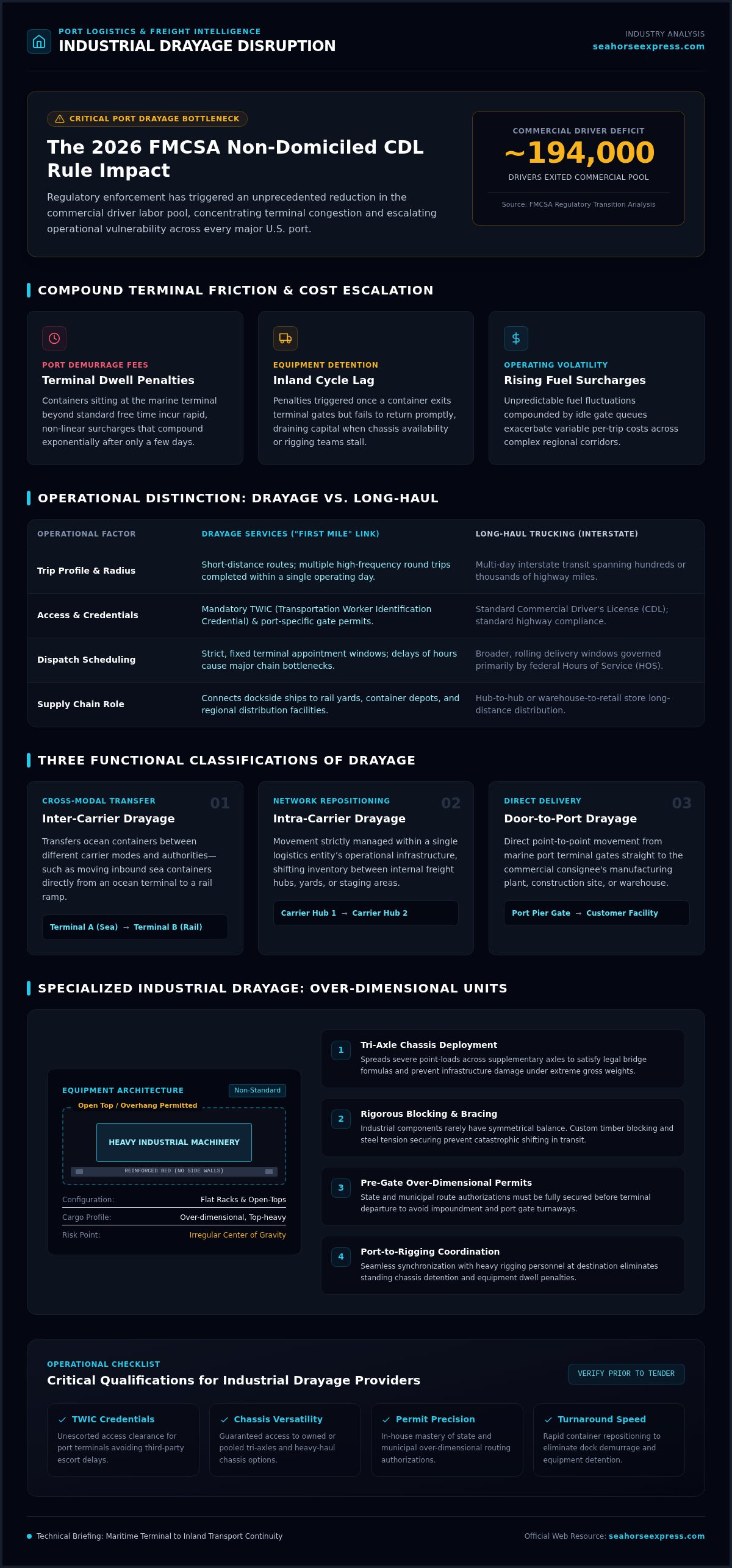
Nearly 194,000 drivers have exited the U.S. commercial pool following the 2026 FMCSA Non-Domiciled CDL rule, creating a critical bottleneck for drayage services at every major port. You've likely felt the impact through rising fuel surcharges and the constant threat of demurrage fees that escalate rapidly after just a few days of dwell time. It's frustrating when specialized industrial cargo, like flat racks or open-tops, sits idle because a carrier lacks the specific equipment or permits required for heavy hauling. Seahorse Express understands that a container left on the dock is a mounting financial liability that threatens your entire project timeline.
This guide helps you master these logistical complexities and shows how specialized providers bridge the gap between maritime terminals and inland success. We'll outline how to reduce port dwell times, manage the seamless transition to road transport, and ensure reliable handling for your most complex industrial equipment. You'll gain a clear understanding of the current regulatory landscape and the technical requirements for over-dimensional freight. By the end of this article, you'll have a practical roadmap to maintain a steady, predictable flow of goods in an increasingly volatile market.
Key Takeaways
- Understand the critical role of drayage services as the "first mile" connection between maritime terminals and inland warehouses or rail yards.
- Learn why specialized equipment is mandatory for moving non-standard containers like flat racks and open-tops to avoid unnecessary port delays.
- Evaluate the strategic differences between direct drayage, transloading, and intermodal shipping to choose the most efficient path for your specific cargo.
- Identify key carrier requirements, including TWIC credentials and equipment versatility, to ensure your provider can safely handle over-dimensional industrial loads.
- Discover how to integrate port logistics with heavy hauling and rigging to create a seamless, end-to-end solution for complex machinery transport.
What are Drayage Services? The Critical Link in Port Logistics
Drayage acts as the vital connective tissue in global trade. It is the specialized trucking service that moves freight over short distances, typically connecting seaports to rail yards, warehouses, or inland distribution centers. While it may only represent a small fraction of the total miles a container travels, it's often the most complex segment of the journey. In industrial logistics, drayage services represent the "first mile" of inland distribution. Without this link, international cargo remains stranded at the terminal, unable to reach the manufacturing plants or construction sites where it's needed.
Drayage is distinct from long-haul trucking in several key ways. While a long-haul driver might spend days on the interstate, a drayage driver performs multiple high-frequency trips within a single day. These operations require specific port permits and credentials, such as the Transportation Worker Identification Credential (TWIC). The work is governed by the strict appointment windows of port terminals. Precision is mandatory. A delay of even a few hours can result in missed appointments, leading to significant bottlenecks in the broader supply chain.
Efficiency in this sector directly impacts your bottom line. When containers sit at the port beyond their allotted free time, carriers face demurrage fees. Once the container leaves the port but isn't returned promptly, detention fees accrue. Specialized providers focus on rapid equipment turnaround to mitigate these costs. By maintaining a steady flow of equipment, they ensure that your capital isn't tied up in avoidable terminal penalties.
The Classifications of Drayage
Understanding the different types of movement helps project managers select the right logistical path for their freight:
- Inter-carrier drayage: This involves moving units between different types of carriers, such as transporting a container from a rail terminal to a sea port.
- Intra-carrier drayage: This refers to movement within a single carrier's own network, often between different hubs or facilities.
- Door-to-port drayage: This is the direct transport of a container from a port terminal to a customer's specific facility.
Why Specialized Drayage Matters for Industrial Cargo
Standard 20-foot or 40-foot containers are common, but industrial projects often require specialized equipment like flat racks and open-tops. These units carry over-dimensional machinery that cannot fit in a standard box. Handling these at a port terminal requires specialized chassis and experienced rigging teams. Improper handling doesn't just cause delays; it risks catastrophic damage to high-value industrial assets. Professional drayage services provide the essential logistical bridge that moves heavy industrial cargo from the ship's side to the final inland destination with precision and safety.
Specialized Drayage: Handling Flat Racks and Open-Top Containers
Standard drayage services often focus on the high-volume movement of dry van containers. However, industrial shippers frequently encounter cargo that exceeds the dimensions of a standard box. Moving non-standard units like flat racks and open-top containers out of port terminals presents a unique set of challenges that require specialized expertise. These units aren't just larger; they often carry high-value machinery that is top-heavy, wide, or exceptionally heavy. Success in this niche depends on having the correct heavy-duty chassis and a deep understanding of terminal operations.
Flat racks are essential for over-dimensional machinery because they lack side walls, allowing for cargo to overhang the edges. This flexibility is vital for transporting large industrial components, yet it demands rigorous safety protocols. Securing these loads requires specialized blocking and bracing to prevent shifting during transport. Because these loads often exceed standard weight limits, they require tri-axle chassis to distribute the load across more axles, ensuring compliance with road safety regulations and preventing damage to the equipment or the road surface.
Flat Rack Drayage Challenges
Weight distribution is a primary concern. The center of gravity for industrial machinery is rarely perfectly centered, which complicates axle load calculations. Carriers must secure over-dimensional permits before the truck leaves the terminal gates. This process requires precise coordination with port cranes, as specialized equipment often needs to be "stripped" or handled at a specific area of the terminal. According to the Intermodal Association of North America (IANA), maintaining equipment standards is critical for safety in these high-stakes environments. Professional planning ensures that the right permits are in hand before the driver arrives at the gate, preventing costly detention at the terminal.
Managing Open-Top Containers
Open-top containers are the preferred choice for tall machinery that can be loaded through the top but still fits within the width of a standard container. Weather protection is a major logistical hurdle here. Tarping requirements must be strictly followed to protect industrial assets from moisture and debris during transit. Height restrictions also play a significant role in route planning. A load that is only a few inches over-height can be blocked by low bridges or utility lines. Specialized rigging is often required to secure the cargo within the open-top unit before it leaves the port. If you need a partner to manage these complexities, consider a provider experienced in over-dimensional transportation to ensure a safe inland move.
Safety remains the priority when handling these units. Every strap and chain must be inspected, and the driver must be trained in the specific handling characteristics of wide-load containers. By choosing a carrier that owns its specialized chassis and maintains port-specific credentials, you reduce the risk of equipment failure and regulatory delays.
Drayage vs. Transloading vs. Intermodal: Choosing Your Strategy
Selecting the right logistical model requires a clear understanding of three distinct yet related services. While many providers treat these terms as interchangeable, they represent different operational strategies. Drayage is a specialized short-haul trucking service that moves containers between a port and a nearby facility. Transloading involves transferring cargo from one piece of equipment to another, such as moving machinery from an international container to a domestic trailer. Intermodal refers to the use of multiple modes of transport, typically combining ocean, rail, and truck to move a single unit across long distances. For industrial shippers, choosing the wrong path can lead to thousands of dollars in unnecessary equipment fees.
Direct drayage services are often the best choice for facilities located within 50 to 100 miles of the port. This method maintains the integrity of the container's seal and minimizes handling. However, as distances increase, transloading becomes a powerful cost-saving tool. By transferring cargo to a domestic trailer near the port, you can return the ocean carrier's container immediately. This strategy avoids escalating per diem fees, which in 2026 can reach $150 to $350 per day per container. It also allows for consolidation, where the contents of multiple international containers are combined into fewer domestic loads to optimize inland freight costs.
The Transloading Advantage
Transloading is particularly effective for heavy industrial assets. When machinery arrives on a flat rack or in an open-top container, it often requires specialized rigging to move it onto a heavy-haul trailer for final delivery. This process allows for custom crating or dismantling if the cargo needs to meet specific inland weight or height restrictions. By handling these transfers at a facility equipped for industrial logistics, you ensure the transition from maritime to road transport is handled by experts who understand the safety requirements of over-dimensional freight. It's a reliable way to manage complex equipment moves.
When Intermodal is the Right Call
For long-distance inland distribution, intermodal trucking offers the best balance of speed and cost. This strategy integrates port drayage with national rail networks, allowing containers to move hundreds of miles with lower fuel consumption than traditional long-haul trucking. It's a steady solution for high-volume containerized freight that isn't time-sensitive. The key is coordinating the initial drayage move from the ship to the rail ramp with precision. Successful intermodal strategies rely on a carrier that understands the scheduling demands of both port terminals and rail hubs, ensuring that equipment dwell time remains at a minimum throughout the entire journey.
5 Factors to Consider When Evaluating Drayage Companies
Selecting a partner for drayage services involves more than comparing base rates. In a high-stakes industrial environment, the right provider acts as a strategic extension of your supply chain. You need a carrier that understands the specific regulatory hurdles of 2026, including the recent tightening of driver eligibility and fluctuating fuel surcharges. A failure at the port gate doesn't just delay one truck; it creates a ripple effect that can stall an entire production line.
When you evaluate potential partners, prioritize these five operational pillars:
- Port Access and Certification: Confirm that every driver holds a valid Transportation Worker Identification Credential (TWIC). Without these permits, your cargo stays on the dock while fees accumulate.
- Equipment Versatility: Confirm their drayage services include access to tri-axle chassis and heavy-duty equipment designed for over-dimensional loads. Don't assume a carrier has the right gear without verification.
- Technological Integration: Real-time tracking is mandatory. Your provider should offer digital documentation to streamline port clearance and provide instant visibility into container status.
- Safety Record and Compliance: Review their FMCSA safety scores. Ensure they carry industrial-grade insurance that covers the full value of specialized machinery and heavy hauling operations.
- National Reach: For large-scale projects, choose a carrier with a presence at multiple seaports. This consistency simplifies coordination across different regions and ensures a steady hand at every major port.
Vetting for Specialized Capability
Industrial cargo requires more than a standard truck. You must ask potential drayage companies about their specific experience with flat racks and open-top containers. A provider that only handles standard dry vans won't have the necessary expertise to manage over-dimensional permits or coordinate the complex rigging required for machinery transfers. It's also beneficial to look for integrated services, such as custom crating or dismantling, which can resolve logistical issues before the cargo even leaves the port area.
Communication and Transparency
Reliable carriers provide proactive alerts regarding terminal congestion or equipment shortages. They don't wait for you to call when a container is approaching its free-time limit. Instead, they provide regular reports on demurrage status to help you avoid penalties. The number one red flag to look for in a drayage quote is the absence of clearly defined port fees, which often reappear as surprise surcharges on the final invoice. If you need a partner that prioritizes clear communication and safety, you can request an industrial logistics consultation to discuss your specific port requirements.
Integrated Solutions: Beyond the Port Terminal
Drayage services are not an isolated event in a successful industrial supply chain. For large-scale projects, the move from the terminal is just one phase of a complex deployment that requires careful synchronization. Successful logistics managers view the port exit as the pivot point where maritime handling transitions into specialized inland transport. This integration is vital for over-dimensional freight that requires more than a standard chassis to reach its final site. It's about ensuring that the momentum gained at the port isn't lost during the transition to the open road.
The synergy between port drayage and heavy-haul trucking ensures that specialized equipment moves seamlessly to a transload facility or project site. When a provider handles both the drayage and the subsequent machinery dismantling or rigging, it eliminates communication gaps between different vendors. This unified approach reduces the risk of equipment mismatching and ensures that safety protocols remain consistent throughout the move. Whether you're dismantling a manufacturing line for export or rigging new turbines for an inland power plant, the transition from the port must be handled with technical precision to avoid costly delays.
From Port to Foundation
Coordinating drayage with on-site rigging and installation is a hallmark of a sophisticated industrial strategy. For high-value exports, custom crating at the port of origin protects sensitive machinery from the rigors of ocean transit. When importing, the process is reversed. A single partner manages the container retrieval, the specialized transport, and the final placement on the factory floor. This end-to-end oversight simplifies the management of over-dimensional assets and provides a clear point of accountability. Managing the entire lifecycle of an over-dimensional move ensures that every permit and specialized chassis is ready long before the vessel arrives.
Nationwide Reach for Every Major U.S. Port
Operating across multiple seaports requires a partner with a nationwide footprint. Managing separate vendors at different coasts often leads to inconsistent service standards and fragmented reporting. By utilizing a single strategic partner, you ensure that every move, regardless of the port, adheres to the same safety and compliance benchmarks. This consistency is especially critical when dealing with the current regulatory environment, where port-specific rules and driver availability vary by region. A nationwide reach ensures that your drayage services remain reliable whether you're moving cargo through the Atlantic, Gulf, or Pacific coasts.
Seahorse Express positions itself as the steady hand for these complex operations. Since 2008, the focus has remained on bridging the gap between maritime terminals and inland success through specialized expertise. We provide drayage and transload services for flat racks and open-top containers at every major port in the USA, integrating these moves with custom crating and warehousing. You can contact Seahorse Express for a comprehensive drayage and transload consultation to secure your industrial supply chain at every major U.S. port.
Securing Your Industrial Supply Chain for 2026 and Beyond
Precision at the port terminal is the foundation of a resilient industrial supply chain. We've explored how professional drayage services act as the critical link between maritime transport and inland success, especially when handling complex assets like flat racks and open-top containers. By selecting a strategy that balances speed and cost through transloading or intermodal moves, you protect your bottom line from escalating port fees and regulatory bottlenecks. A proactive approach to port logistics isn't just a preference; it's a necessity in a volatile market.
Seahorse Express provides the steady hand required for these high-stakes operations. With national coverage at every major U.S. port and deep expertise in over-dimensional industrial freight, we ensure your cargo moves safely from the ship's side to its final foundation. Our specialized flat rack and open top transloading capabilities provide the technical reliability your project demands. You don't have to navigate these complexities alone. Request a Specialized Drayage Quote from Seahorse Express today to ensure your next industrial move is handled with the precision and safety it requires.
Frequently Asked Questions
What is the difference between drayage and cartage?
Drayage refers specifically to the short-distance transport of freight between a port terminal and a nearby rail yard or warehouse. Cartage is a broader term for moving goods within a limited commercial zone, often involving smaller trucks for local distribution. While both are short-haul, drayage services are defined by their connection to international trade hubs and specialized port equipment requirements. Seahorse Express focuses on the industrial drayage segment, ensuring heavy machinery moves efficiently through maritime gates.
How much does port drayage typically cost?
The total cost of port drayage is determined by several variables, including fuel surcharges, chassis rental fees, and the distance from the terminal. As of 2026, fuel surcharges remain a significant factor in overall rates due to market volatility. Shippers should also account for accessorial charges like pre-pull fees or yard storage. Because every move has unique requirements, it's best to request a detailed quote that accounts for your specific cargo dimensions and destination requirements.
What are demurrage and detention fees in drayage?
Demurrage fees are penalties charged by terminal operators when a container remains at the port beyond its allotted free time. Detention fees, often called per diem, apply when the container is kept outside the port for too long before being returned to the carrier. Both fees can escalate quickly, sometimes reaching hundreds of dollars per day. Efficient coordination between the port and the final destination is the primary way to avoid these mounting operational costs and keep projects on budget.
Do I need specialized equipment for flat rack drayage?
Moving flat rack containers requires specialized equipment such as tri-axle chassis to distribute the weight of heavy machinery safely. Standard drayage chassis often lack the weight capacity or structural design to handle over-dimensional loads. You also need heavy-duty straps, chains, and blocking materials to secure the cargo for road transport. Using a provider that owns its specialized fleet ensures that the correct equipment is available when your vessel arrives at the terminal, preventing equipment mismatch delays.
Can drayage services handle over-dimensional or oversized machinery?
Specialized drayage services are equipped to handle over-dimensional and oversized machinery that exceeds standard container footprints. This process involves securing over-dimensional permits and coordinating with port cranes for non-standard retrieval. These moves often require specific route planning to avoid low clearances or weight-restricted bridges. Seahorse Express integrates these port moves with heavy hauling and rigging to provide a seamless transition from the ship to the final project site, ensuring every safety protocol is followed.
What documents are required for port drayage services?
Port drayage requires several critical documents to ensure a smooth terminal exit. The primary requirements include the Delivery Order (DO), the Bill of Lading (BOL), and any applicable customs clearance paperwork. Drivers must also possess a valid Transportation Worker Identification Credential (TWIC) to enter the terminal. Providing these documents to your carrier in advance allows for the scheduling of terminal appointments and helps prevent unnecessary delays at the gate, which can lead to additional storage fees.
How can I reduce port wait times for my containers?
You can reduce port wait times by utilizing digital tracking tools and scheduling terminal appointments during off-peak hours. Early submission of all required documentation allows your carrier to clear hurdles before the driver reaches the gate. Transloading cargo near the port is another effective strategy, as it permits the immediate return of ocean containers to the carrier. This proactive planning minimizes dwell time and ensures that your industrial equipment remains in motion toward its final inland destination.
Does Seahorse Express provide drayage at all U.S. seaports?
Seahorse Express provides comprehensive drayage and transload services at every major seaport across the United States. This nationwide reach allows industrial shippers to maintain consistent service standards for multi-port operations. Whether you're moving cargo through the Atlantic, Gulf, or Pacific coasts, our team handles everything from specialized flat rack transport to heavy hauling. This national footprint ensures a steady hand is available to manage your most complex logistical challenges regardless of which port your cargo enters.


