
The lowest initial quote on a container move often becomes the most expensive line item on an import ledger. Selecting drayage companies based solely on base rates ignores the operational realities of modern marine terminals, where a single missing interchange agreement or delayed pickup triggers severe demurrage and detention penalties. Standard dry van carriers routinely accept port assignments without the specialized chassis needed for out-of-gauge flat racks or open-top cargo, leaving high-value shipments stranded while storage fees accumulate.
Managing containerized freight requires precise coordination, yet scattered communication between terminal gates, drivers, and receiving facilities frequently leaves supply chain managers blindsided by preventable charges. You shouldn't have to absorb budget-breaking penalties because a carrier arrived without valid terminal credentials or proper equipment. This guide provides an objective framework to evaluate top drayage companies, verify operational readiness, and select dependable logistics partners. We'll examine the core criteria needed to eliminate port delays, protect your margins, and streamline your container movements nationwide.
Key Takeaways
- Standard long-haul carriers often fail at maritime gates due to strict terminal credentialing rules and complex interchange agreements.
- Leading drayage companies maintain dedicated equipment assets, including private chassis pools and heavy tri-axles, to prevent equipment bottlenecks.
- Evaluating carrier models reveals significant operational differences between digital brokerages, generic container fleets, and specialized industrial haulers.
- A rigorous screening process verifying active UIIA compliance and direct port access reliably eliminates unexpected demurrage and detention charges.
- Moving specialized open-top containers and flat racks requires nationwide drayage capabilities paired with industrial transloading and heavy hauling infrastructure.
Understanding Port Drayage: Why Standard Freight Carriers Fall Short at Maritime Terminals
At its core, Drayage involves the specialized transport of shipping containers over short distances between maritime container terminals, inland rail yards, and distribution facilities. While standard over-the-road trucking focuses on highway mileage, port logistics requires navigating highly regulated, congested maritime gates where administrative friction is constant. Missed gate appointments rapidly increase container dwell times, leaving importers vulnerable to severe storage penalties and compounding schedule disruptions.
Standard freight carriers often treat port pickups like typical warehouse dock appointments, leading to immediate operational failure. Marine terminals enforce strict operating windows, rigid queue protocols, and distinct equipment interchange guidelines. When motor carriers don't understand these complex gate requirements, containers get trapped on terminal pads while demurrage clocks run continuously.
The Crucial Role of Drayage in Intermodal Supply Chains
Maritime drayage serves as the critical link connecting international ocean vessels to domestic transport corridors. Once container cranes discharge freight, shipments must move promptly to off-dock yards or transload warehouses to maintain port fluidity. Professional drayage companies manage these moves against strict vessel schedules, ensuring cargo transitions seamlessly into domestic pipelines. Efficient intermodal trucking connects seaport complexes directly to national rail networks, allowing industrial goods to clear congested maritime corridors and enter long-haul transit without delay.
Regulatory and Security Credentials Required for Marine Terminal Access
Entering a commercial maritime terminal demands administrative credentials that general freight carriers simply don't possess. To enter terminal gates, drivers and fleets must maintain several rigorous qualifications:
- Federal Security Clearances: Drivers must carry active Transportation Worker Identification Credentials (TWIC) to gain unescorted access to secure port facilities.
- UIIA Compliance: Motor carriers must maintain active, good-standing agreements under the Uniform Intermodal Interchange and Facilities Access Agreement (UIIA), satisfying equipment liability standards with ocean carriers and rail lines.
- Terminal Registrations: Fleets must register with port-specific clean-truck databases, radio-frequency identification systems, and local gate appointment registries.
When shippers hire general dry van carriers lacking these prerequisites, drivers face immediate turnaways at the inbound terminal bobtail gates. Vetted drayage companies hold active interchange contracts and required security clearances, ensuring immediate terminal access that keeps your container moves on schedule.
Core Operational Capabilities Separating Industry-Leading Drayage Companies
Generic carrier directories often treat all transport providers equally, but operational reliability hinges on physical hardware and digital connectivity. Evaluating prospective drayage companies requires looking past sales claims to examine physical fleet assets, chassis reserves, and terminal integration tools. Resolving the everyday challenges of drayage, including terminal gate congestion and sudden equipment imbalances, demands carriers that maintain direct control over their operational resources.
Dedicated Chassis Fleets and Specialized Container Equipment
Public chassis pool shortages routinely paralyze import deliveries during volume surges. When carriers rely entirely on common chassis pools, their drivers often wait for hours or face turnaways if the terminal pool runs empty. Elite drayage providers maintain private equipment assets to bypass these bottlenecks, deploying specialized hardware designed for complex cargo:
- Tri-Axle Chassis: Vital for properly distributing the weight of dense industrial materials and heavy machinery to comply with federal bridge formula limits.
- Specialized Configurations: Purpose-built chassis engineered to haul out-of-gauge flat racks and open-top containers safely.
- Rigorous Fleet Maintenance: Proactive roadability inspections that eliminate equipment failures, tire blowouts, and mid-transit breakdowns.
Private equipment ownership ensures that when a vessel discharges, your carrier has the precise running gear ready to mount and pull your container immediately.
Terminal Appointment Automation and Container Tracking Visibility
Navigating congested port gates requires precise appointment scheduling. Leading drayage companies integrate direct API connections with marine terminal operating systems. These platforms monitor container readiness, instantly securing restricted appointment slots the moment customs holds and shipping line fees clear.
Automated milestone reporting replaces manual email chains with definitive data points across the supply chain:
- Real-time notification of vessel discharge and container availability
- Timestamped gate-in and gate-out terminal interchange records
- Continuous GPS tracking from the harbor perimeter to the final destination facility
This visibility allows inland operations to stage rigging teams and warehouse labor precisely when freight arrives. If you manage complex industrial cargo or heavy project shipments, coordinating with an asset-backed specialist like Seahorse Express ensures you secure the specialized chassis and terminal clearance needed to avoid delays.
Roundup: Evaluating the Primary Models of Drayage Companies
Not all drayage companies operate under the same business model. Cargo owners generally choose among three distinct provider categories: non-asset digital freight brokers, generic container drayage fleets, and specialized industrial haulers. Selecting the wrong model introduces friction, especially when moving dense, out-of-gauge, or non-standard containerized loads across congested seaport terminals.
| Provider Model | Equipment Readiness | Handling Capabilities | Operational Risk |
|---|---|---|---|
| Digital Freight Brokers | Relies on third-party capacity; no owned chassis | Standard enclosed ocean containers | Communication lag and dropped loads during port surges |
| Generic Drayage Fleets | Standard ocean chassis pool utilization | High-volume retail and palletized goods | Equipment shortages and inability to haul out-of-gauge cargo |
| Specialized Industrial Haulers | Company-owned tri-axles and heavy-haul trailers | Flat racks, open tops, and over-dimensional freight | Higher demand requiring advance operational planning |
Standard Dry Van Draymen vs. Specialized Heavy Industrial Drayage
Generic container draymen excel at repetitive, dock-to-dock transport of enclosed consumer goods. However, they lack the technical capabilities required for complex industrial machinery and out-of-gauge project cargo. Hauling flat racks and open-top containers demands specialized securement expertise, heavy-duty rigging knowledge, and engineered weight distribution. Assigning an oversized industrial unit to a standard carrier risks structural damage, highway safety violations, and costly terminal turnaways.
Asset-Based Drayage Carriers vs. Non-Asset Intermodal Freight Brokers
Contracting directly with asset-based drayage companies gives shippers direct access to physical trucks, chassis, and terminal dispatchers. Conversely, non-asset freight brokerages add layers of middle-tier communication that obscure shipment status. When maritime gates experience unexpected congestion or equipment deficits, direct asset operators can reroute drivers and allocate private equipment instantly. Non-asset intermediaries must scramble to find third-party capacity, often surrendering control just when immediate action is needed to avoid demurrage.
Screen Drayage to Eliminate Demurrage and Detention
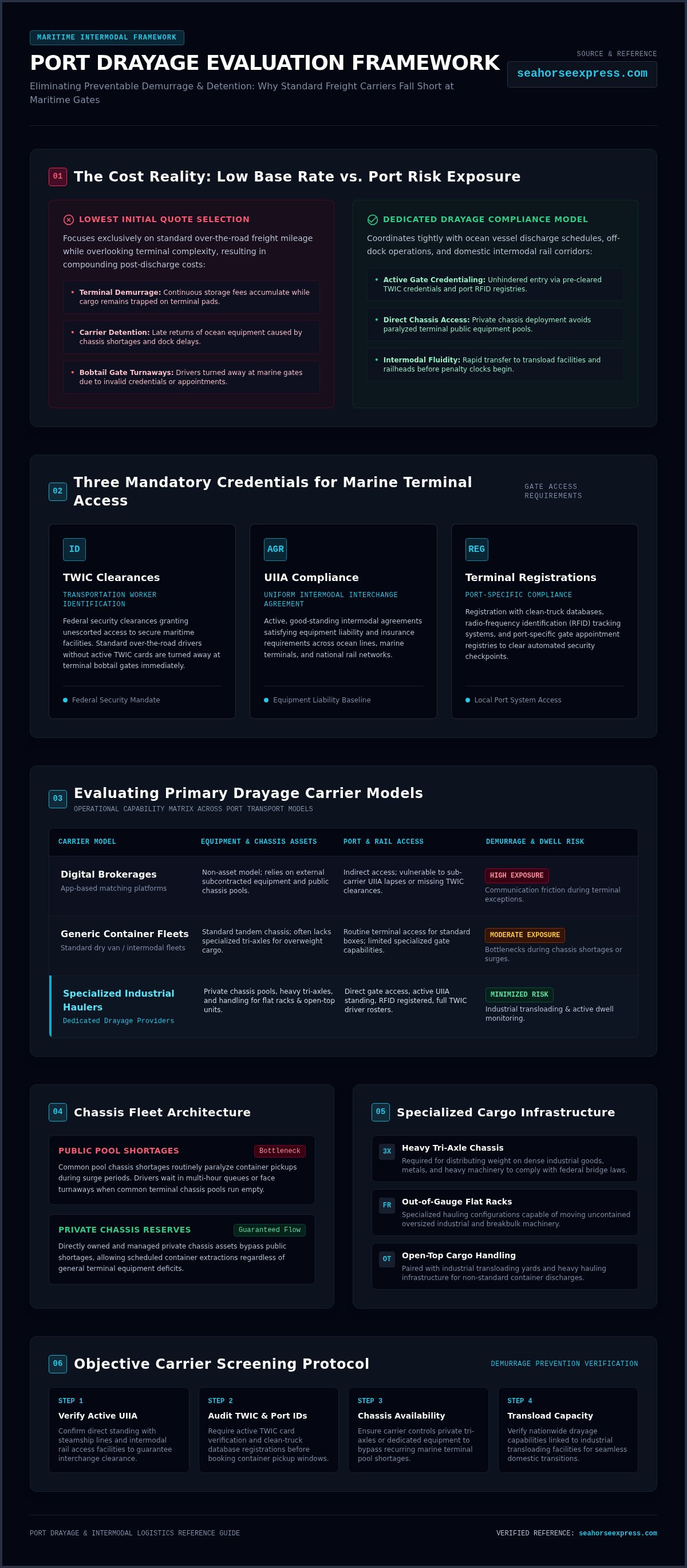
Preventing port storage penalties requires a systematic screening process before tendering your first bill of lading. Demurrage and detention fees quickly erase shipment margins when operational handoffs fail. To protect your freight schedules, evaluate prospective drayage companies against a strict five-step vetting protocol:
- Verify Active UIIA Standing: Confirm the carrier maintains current insurance filings and active interchange contracts with all ocean shipping lines calling your discharge terminals.
- Confirm Direct Driver Credentialing: Ensure the carrier's driver roster holds valid security credentials and clean-truck terminal registrations across targeted seaport facilities.
- Audit Free-Time Tracking Systems: Review how dispatchers monitor container vessel discharge milestones and calculate allowable terminal free time.
- Review Accessorial Schedules: Examine how the provider bills for chassis splits, pre-pulls, driver wait time, and off-dock staging.
- Inspect Transload and Yard Capabilities: Assess the carrier's private facilities for intermediate container storage and cargo stripping.
Deciphering Free Time Rules, Demurrage, and Per Diem Charges
Understanding port penalties begins with separating terminal demurrage from equipment detention. Demurrage applies when an import container sits inside the marine terminal past assigned free time. In contrast, detention or per diem accrues when a container remains outside the terminal beyond the shipping line's allotted equipment window.
Terminal free-time clocks begin ticking as soon as a container touches the wharf, regardless of terminal congestion. Proactive drayage companies pull freight within standard free time, moving boxes to private yards before expensive terminal storage rates take effect.
Validating Transload Capabilities and Secure Off-Dock Container Storage
Port-adjacent transloading offers the most effective safeguard against mounting per diem fees. By pulling an import container to an off-dock facility, unloading the cargo, and returning the empty box to the marine gate immediately, carriers stop per diem accruals at once. High-capacity cross-docking then transfers freight directly into domestic flatbeds, step-decks, or dry vans for inland transport.
Secure off-dock container yards require continuous perimeter fencing, high-definition camera coverage, and controlled gate access. This staging capability gives cargo owners the flexibility to store imports safely until destination facilities are ready for delivery. To protect your industrial supply chain from preventable port storage charges, contact Seahorse Express to coordinate your port drayage.
Partnering with Seahorse Express for Comprehensive Port Drayage and Industrial Transloading
Managing heavy industrial imports through maritime ports demands far more than basic container transport. Most drayage companies operate purely as curb-to-curb carriers, leaving cargo owners to source separate riggers, crating providers, and heavy-haul carriers once a box leaves the wharf. Seahorse Express operates as a nationwide specialist, bridging maritime terminals directly to inland industrial sites through coordinated port drayage, heavy container transloading, and specialized domestic transport.
Nationwide Seaport Coverage for Flat Rack and Open-Top Containers
Clearing out-of-gauge machinery and industrial equipment requires specialized interchange authority and purpose-built running gear. Seahorse Express maintains active terminal agreements across every major seaport in the United States. Whether handling over-dimensional flat racks or over-height open-top containers, our operations ensure prompt extraction from terminal docks before storage penalties take hold. Engineered equipment configurations properly distribute weight across commercial corridors, keeping over-dimensional freight fully compliant while transiting from marine piers to inland destinations.
Integrated Logistics: Heavy Haul, Rigging, and Turnkey Cargo Relocation
Fragmented handoffs between multiple independent vendors create costly scheduling delays and administrative friction. Seahorse Express eliminates these vulnerabilities by integrating port drayage with industrial transloading, machinery dismantling and rigging, custom crating, and secure warehousing under a single operational umbrella.
- Port Drayage and Stripping: Direct terminal retrieval of flat racks and open tops, followed by immediate cargo deconsolidation.
- Machinery Rigging and Crating: Professional dismantling, precision rigging, and custom crating designed to protect delicate industrial components during inland transit.
- Domestic Heavy Hauling: Seamless transfer onto heavy-haul, flatbed, or specialized trailers for full-truckload (FTL) and partial-truckload (PTL) distribution nationwide.
- Commercial Warehousing: Secure off-dock yard staging and facility storage for shipments awaiting site readiness.
Rather than managing detached communication across multiple vendors, shippers gain single-source accountability. This bundled approach eliminates middle-tier broker markups, prevents demurrage accruals, and delivers true end-to-end control over your high-stakes industrial cargo.
Secure Your Port Logistics and Eliminate Terminal Risk
Protecting freight margins requires moving beyond low base rates to evaluate operational readiness. Top drayage companies distinguish themselves through active interchange agreements, private chassis pools, and proactive terminal appointment management. When carriers possess the administrative credentials to enter port gates promptly and the equipment to handle dense or oversized cargo, costly demurrage and detention fees disappear.
Managing specialized containerized cargo doesn't have to strain your operations. Seahorse Express provides fully credentialed, compliant fleet operations across every major seaport nationwide. By integrating port drayage for flat racks and open tops with heavy hauling, machinery rigging, and secure warehousing, we eliminate third-party delays and keep your industrial project moving seamlessly. Take control of your maritime container strategy today and request a specialized port drayage and transloading quote from Seahorse Express.
Frequently Asked Questions
What is the primary difference between a drayage company and a long-haul trucking carrier?
Drayage focuses on short-distance moves connecting maritime terminals, rail yards, and nearby industrial facilities, whereas long-haul carriers manage point-to-point interstate transit. Draymen navigate complex terminal appointment registries, gate queue protocols, and marine container chassis interchange systems. Standard over-the-road freight carriers rarely hold the federal port security badges or ocean interchange contracts required to pass through commercial maritime terminal gates.
How do drayage companies help shippers avoid expensive port demurrage and detention charges?
Experienced drayage companies monitor vessel discharges, track allowable free time, and secure early terminal gate appointments before cargo lands. When terminal space tightens or receiver docks back up, they pull import containers to private off-dock yards. This pre-pull strategy stops terminal demurrage clocks immediately and enables rapid empty box returns to avoid shipping line equipment detention fees.
What credentials must a drayage company possess to enter major maritime port terminals?
Drivers must possess active Transportation Worker Identification Credentials (TWIC) for unescorted access to federally regulated port facilities. The motor carrier must also maintain active standing in the Uniform Intermodal Interchange and Facilities Access Agreement (UIIA), satisfying equipment liability and insurance terms with ocean shipping lines. Port-specific registrations, including clean-truck database enrollment and radio-frequency identification tags, are mandatory for gate entry.
Can all standard drayage companies haul open-top and flat-rack ocean containers?
No, standard container haulers usually transport enclosed dry containers and lack the equipment or permits for non-standard equipment. Moving open-top and flat-rack cargo requires heavy-duty multi-axle trailers, specialized tie-down equipment, and engineered load-distribution planning. Transporting oversized industrial machinery safely requires specialized carriers equipped for over-dimensional project cargo and non-standard container configurations across commercial highway networks.
What is container transloading, and why should it be integrated with port drayage services?
Container transloading is the process of stripping cargo from ocean containers and reloading it onto domestic transport equipment, such as flatbeds or dry vans. Integrating transload operations with port drayage allows shippers to return empty ocean containers to the terminal quickly, eliminating container per diem charges. It also facilitates custom crating, cargo consolidation, and efficient long-distance over-the-road freight distribution across the country.
How do chassis shortages impact drayage timelines, and how do top providers solve this issue?
Terminal chassis pool deficits force drivers to wait in prolonged inspection lines or abandon container pickups altogether, leading to missed appointments and storage penalties. Leading providers overcome common pool shortages by maintaining dedicated private chassis fleets, including specialized tri-axle running gear for overweight cargo. Controlling private chassis assets guarantees equipment availability so shipments move immediately upon terminal release.
What accessorial fees should shippers expect when contracting drayage companies?
Drayage billing commonly includes fuel surcharges, terminal gate wait time charges, chassis daily use fees, and split fees when picking up chassis from separate off-dock yards. Shippers may also incur pre-pull charges for early container retrieval or staging fees for interim yard storage. Clarifying these accessorial terms upfront ensures predictable freight accounting and eliminates billing surprises.


