
If you treat a 200,000 pound load as just another shipment, you're planning for a failure that starts long before the wheels turn. In 2026, specialized transport is a feat of engineering rather than a simple delivery service. You understand that moving oversized equipment across state lines is an exercise in high-stakes precision. A single permit error at a state border can result in expensive delays; meanwhile, improper equipment choices put your most valuable assets at risk. It's natural to feel concerned about the complexity of coordinating multi-state regulations and finding reliable heavy haul trucking companies that possess the technical expertise your project demands.
This guide offers a clear roadmap for mastering these complexities. You'll learn how to vet carriers for specific capabilities, such as 13-axle RGN capacity, and how to navigate the latest FMCSA oversized load requirements. We'll provide a step-by-step process for securing permits and coordinating the dismantling, rigging, and transport of your cargo. By the end of this article, you'll have the knowledge necessary to ensure your oversized loads move safely and arrive on schedule. We've designed this resource to help you act as a steady hand in your company's supply chain.
Key Takeaways
- Identify the specific technical distinctions between oversized and overweight cargo to determine the necessary equipment and routing.
- Apply a rigorous vetting process for heavy haul trucking companies by analyzing FMCSA safety data and carrier-specific capacity.
- Master multi-state permit requirements to avoid administrative bottlenecks and ensure your cargo remains on schedule across borders.
- Select trailer configurations like Removable Gooseneck (RGN) or extendable decks based on precise weight and dimension calculations.
- Consolidate your supply chain by partnering with experts who manage everything from machinery dismantling to final delivery.
Defining the Scope of Heavy Haul Trucking
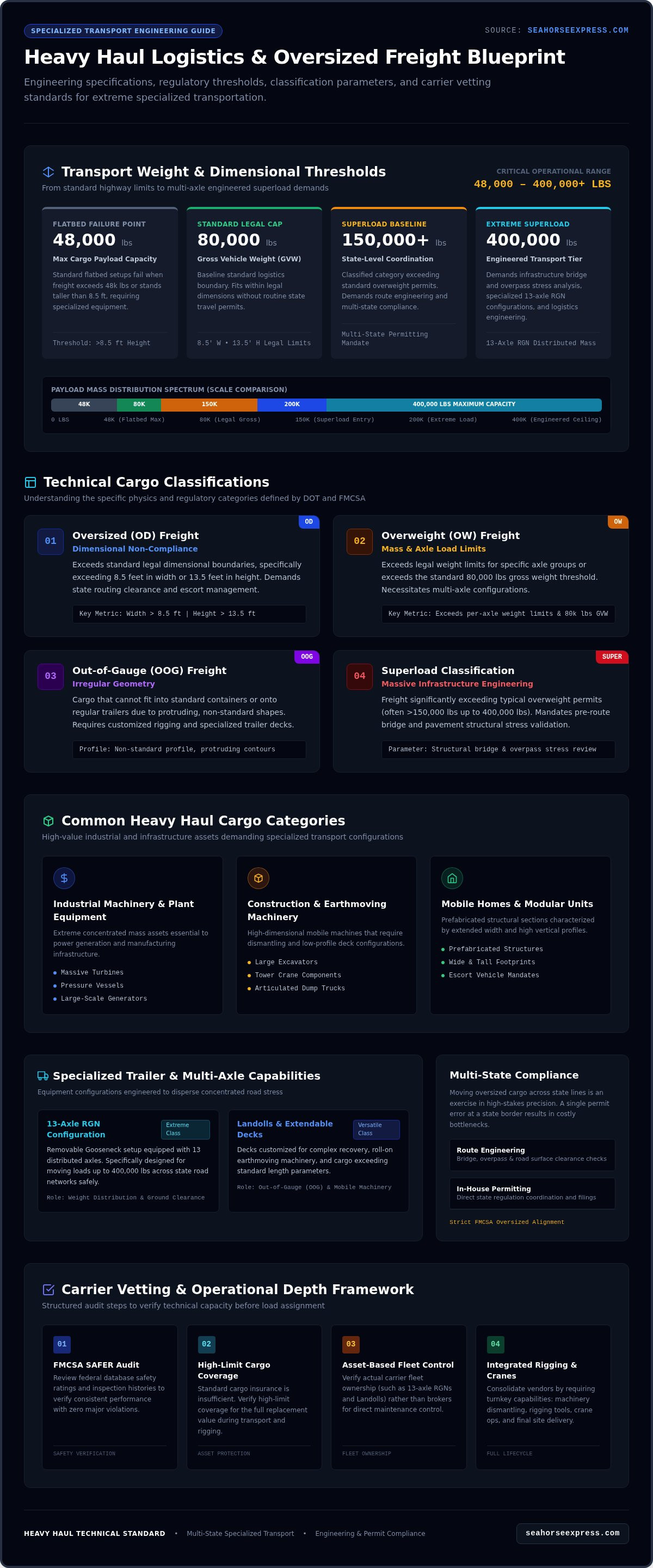
Standard logistics involves freight that fits within legal dimensions: 8.5 feet wide, 13.5 feet high, and 80,000 pounds gross weight. Heavy haul begins where these limits end. Shippers must understand that heavy haul trucking companies don't just move boxes; they manage massive engineering challenges. Moving a piece of equipment that exceeds these standards requires more than a standard tractor-trailer; it demands a calculated approach to physics and road safety.
The industry distinguishes between oversized (OD) and overweight (OW) cargo. OD freight exceeds legal dimensions, such as width or height, while OW freight exceeds legal weight limits for specific axle groups. Often, a single load is both. For comprehensive details on legal limits and how they impact routing, you can refer to oversize and overweight load specifications. Understanding these definitions is the first step in avoiding costly regulatory delays.
In 2026, we also see more "Out-of-Gauge" (OOG) and "Superload" classifications. OOG refers to cargo that cannot fit in standard containers or on standard trailers due to its protruding shape. A Superload is a specialized category for freight that significantly exceeds standard overweight permits. For loads reaching 400,000 lbs, specialized logistics engineering is no longer optional. It's a requirement to ensure that every bridge, overpass, and road surface on the route can support the concentrated mass without failure.
Common Heavy Haul Cargo Categories
Specialized transport usually involves high-value assets that are essential to industrial and infrastructure projects. These categories include:
- Industrial machinery and plant equipment transport: This includes massive turbines, pressure vessels, and large-scale generators for power plants.
- Construction and earthmoving machinery: Large excavators, tower crane components, and articulated dump trucks often require specialized trailers.
- Mobile homes and modular building units: These prefabricated structures are typically wide and tall, requiring careful route planning and escort vehicles.
The Threshold for Specialized Transport
Standard flatbeds generally fail when a load exceeds 48,000 pounds or stands taller than 8.5 feet. Once you hit these limits, you must transition to specialized equipment. A Superload is typically defined as a load exceeding 150,000 pounds, requiring intensive state-level coordination. Handling these massive weights requires multi-axle configurations, such as 13-axle RGNs, to distribute weight safely across the pavement. Experienced heavy haul trucking companies use these tools to maintain the integrity of both your cargo and the national highway system.
How to Vet Specialized Heavy Haul Carriers
Selecting from a pool of heavy haul trucking companies involves more than comparing quotes. It requires a rigorous audit of their operational depth. Shippers must look for a steady hand that understands the nuances of weight distribution and regulatory compliance. A failure in the vetting stage often leads to permit delays or equipment malfunctions that can derail a multi-million dollar project. Use a structured 5-step framework to ensure your carrier is capable of the task.
Your first priority is verifying the carrier's safety record and legal standing. Access the FMCSA SAFER database to review their safety ratings and inspection history. Look for carriers with consistent performance and no major safety violations. After confirming their safety data, verify their insurance coverage. Standard cargo insurance is often insufficient for industrial machinery or turbines. Ensure the carrier carries high-limit policies that specifically cover the full replacement value of your cargo during transport and rigging operations.
Step 1: Verify Equipment and Capacity
Asset-based heavy haul trucking companies offer a level of reliability that brokers cannot match. When a company owns its fleet, it has direct control over maintenance standards and driver training. Ask specifically if they own specialized trailers like 13-axle RGNs or Landolls. These configurations are essential for distributing loads up to 400,000 lbs safely. Additionally, check if they provide integrated services such as on-site cranes and rigging tools. This integration reduces the number of vendors you must manage, which simplifies the coordination of complex moves.
Step 2: Audit Logistics and Permit Expertise
Technical expertise must extend into the office. Ask the carrier about their in-house route planning and permit departments. A carrier with its own permit team can respond faster to state-level changes than one that outsources this work. Reliable carriers provide 24/7 expert support to handle any issues that arise during active shipments. If your project involves moving cargo between the US and Canada, verify their specific experience with cross-border regulations and customs procedures. Choosing a partner with a proven track record in national heavy hauling ensures your shipment remains in expert hands from start to finish.
Managing the Permit Maze and Multi-State Compliance
Crossing state lines introduces a fresh layer of bureaucracy for every mile traveled. Each state department of transportation (DOT) maintains its own set of rules for oversized loads. East Coast states often have stricter height and width limitations due to older bridges and narrower urban corridors. In contrast, Midwest states might allow larger dimensions but have specific requirements regarding Federal Bridge Formula weight limits to protect infrastructure from excessive axle pressure. Experienced heavy haul trucking companies anticipate these regional differences during the planning phase to prevent cargo from being stranded at a state border.
When a shipment enters "Superload" territory, the administrative burden increases. These permits aren't issued overnight. Shippers should expect a timeline of 30 to 90 days for approval, as multiple departments must review the proposed route. This review often includes structural engineers checking bridge capacities and utility companies verifying overhead clearance. Attempting to rush this process usually leads to rejection. It's better to build this lead time into your project schedule from the beginning to maintain a steady flow of operations.
Permit Types and State-Level Nuances
You'll encounter two primary permit types: single-trip and annual. Annual permits work well for smaller OD loads that move frequently. Massive industrial equipment almost always requires a single-trip permit tailored to a specific route. These permits often come with "curfews" that prohibit travel during rush hours, holidays, or after sunset. A Route Survey is a physical pre-run of the entire path where a technician uses a high-clearance pole to identify every low-hanging wire, tree limb, or bridge that could obstruct the load. This step is mandatory for any cargo exceeding certain height thresholds.
Escort Vehicles and Pilot Car Coordination
State laws dictate when you must employ escort vehicles, also known as pilot cars. A "Lead" car travels ahead to warn oncoming traffic and check clearances, while a "Chase" car follows to prevent vehicles from passing in dangerous zones. For Superloads, civilian pilot cars may not be enough. Some jurisdictions require police escorts to manage traffic flow or close entire highway segments. Professional heavy haul trucking companies ensure all pilot car drivers are certified and carry the necessary insurance to operate in every state on the route. This coordination is vital for maintaining safety and legal compliance throughout the journey.
Selecting the Right Equipment for Oversized Loads
Physical equipment is the foundation of every successful specialized move. It requires a precise understanding of weight distribution and center of gravity. Choosing the wrong trailer leads to more than just permit delays; it creates genuine safety risks on the road. Leading heavy haul trucking companies maintain a diverse fleet to ensure they never force a load onto a sub-optimal configuration. Whether your cargo requires a Landoll for easy loading or a double drop trailer to clear low bridges, the choice must be data-driven to ensure a steady and safe delivery.
The configuration of the trailer must match the specific mass of the cargo. For example, a load that is concentrated in a small area requires a trailer with more axles to prevent road damage and meet statutory requirements. In 2026, the complexity of these configurations has only increased as infrastructure regulations tighten. Shippers who understand the mechanical capabilities of their carrier's fleet are better positioned to avoid the common pitfalls of improper equipment selection.
RGN vs. Step Deck: A Comparison
The Removable Gooseneck (RGN) trailer is the industry standard for drivable heavy machinery. Its design allows the front of the trailer to detach, creating a ramp for equipment to be driven directly onto the deck. While a standard step deck is useful for cargo that is slightly tall, it often lacks the weight-bearing capacity for massive industrial loads. For projects reaching the 400,000 lb threshold, a 13-axle RGN is necessary to distribute weight according to bridge laws. You can learn more about Choosing the Right RGN Trailer to see which configuration fits your specific machinery.
Rigging, Dismantling, and Custom Crating
Strategic logistics often involves more than just driving. In many cases, mechanical disassembly is more cost-effective than securing "Superload" permits for an intact machine. By reducing the dimensions of the load, you can often simplify the permit process and reduce escort requirements. This approach requires integrated rigging and dismantling services to be performed by seasoned experts. Utilizing 200,000 lb cranes ensures that heavy industrial assets are loaded with precision and care, maintaining the integrity of the equipment at every stage.
Once dismantled, custom crating provides the necessary protection for sensitive components during multi-state transit. This added layer of security is vital for high-value industrial assets that cannot risk exposure to the elements or road debris. Working with heavy haul trucking companies that offer end-to-end management ensures that every piece of your equipment is accounted for, from the initial rigging to the final delivery, providing you with a single point of contact for the entire operation.
Partnering for Success: The Seahorse Express Approach
Seahorse Express serves as a steady hand for shippers managing high-stakes industrial projects. Unlike many heavy haul trucking companies that only provide transport, we offer a comprehensive logistics solution that covers the entire lifecycle of a move. We handle everything from the initial dismantling of industrial machinery to the final rigging and delivery. This integrated approach removes the friction of managing multiple vendors and ensures that safety standards remain consistent across every phase of the operation.
Our commitment to precision is reflected in our project-based pricing and 24/7 expert support. We understand that in specialized logistics, a single point of contact is vital for maintaining clear communication and accountability. By consolidating dismantling, custom crating, and heavy hauling under one roof, we provide a sense of security through our mastery of the field. You don't have to worry about coordination gaps between different service providers; we manage the entire sequence with professional authority.
End-to-End Logistics Engineering
Our capabilities extend across North America, providing a seamless chain of custody for oversized cargo. We integrate specialized services like port drayage and warehousing to support complex project timelines. For instance, our storage facilities near major ports allow you to stage equipment until the final site is ready for installation. We've successfully engineered moves for cargo up to 400,000 lbs, demonstrating our ability to solve the most demanding technical challenges in the industry. This end-to-end management ensures that your supply chain remains moving and efficient.
Requesting a Heavy Haul Quote in 2026
Precision planning begins with accurate data. When you request a quote, we require detailed dimensions, gross weight, and your specific delivery windows. Our team then conducts a safety-first review to determine the optimal trailer configuration, such as a 13-axle RGN, and the necessary route surveys. This methodical process ensures that we account for every permit requirement and infrastructure constraint before the wheels turn. We provide transparent quotes that reflect the full scope of work, including all necessary escorts and regulatory compliance fees.
Selecting from various heavy haul trucking companies requires trust in their execution and safety record. We maintain constant communication to keep you informed as your cargo moves across state lines and through complex regulatory zones. Our focus remains on the successful delivery of your assets on schedule and without incident. You can get a specialized heavy haul quote today to begin planning your next industrial move with a partner that understands the weight of your success.
Securing Your Specialized Logistics Strategy for 2026
Successful heavy hauling requires a transition from simple transport to detailed logistics engineering. You've seen that qualifying heavy haul trucking companies involves auditing their physical assets, such as 13-axle RGNs, and their internal permit expertise. Managing multi-state compliance and selecting the right trailer configuration are the primary pillars of a safe, on-schedule delivery. By integrating dismantling and rigging into your transport plan, you reduce the risk of structural delays and administrative bottlenecks at state lines.
Seahorse Express provides the steady hand you need for complex projects across the US and Canada. Our specialized fleet handles loads up to 400,000 lbs with precision and safety. Whether you're moving industrial machinery or massive construction equipment, we manage every detail from the first permit to the final site installation. When your project demands national coverage and technical mastery, request a heavy haul quote from Seahorse Express to secure your next industrial move. We're ready to help you navigate the complexities of 2026 logistics with absolute confidence.
Frequently Asked Questions
What is the maximum weight for a heavy haul load without a superload permit?
A superload classification typically begins when a shipment exceeds 150,000 pounds, though this threshold varies by state. Standard overweight permits cover loads between 80,000 and 150,000 pounds. Once you cross into superload territory, the permit process becomes more rigorous and requires structural engineering reviews of bridges and road surfaces. It's essential to consult with experts who understand these specific state-level weight limits to ensure compliance and avoid unexpected delays.
How much do oversized load permits cost for multi-state transport?
Permit costs are determined by each state's Department of Transportation based on the load's specific weight and dimensions. Factors such as the number of states crossed, the duration of the trip, and the need for police escorts all influence the final price. Because these fees are subject to regulatory changes and vary significantly between the East Coast and the Midwest, shippers should request a comprehensive quote that includes all administrative and infrastructure impact fees for their specific route.
Can heavy haul trucking companies move cargo into Canada?
Yes, specialized heavy haul trucking companies possess the authority and equipment to move oversized cargo between the United States and Canada. This process involves coordinating with both U.S. federal agencies and Canadian provincial authorities to ensure all permits are valid in both jurisdictions. Shippers must also account for customs documentation and specific provincial weight regulations, which can differ from U.S. federal standards. A carrier with cross-border experience simplifies this complex international coordination.
What is the difference between an RGN and a lowboy trailer?
The main distinction lies in how the trailer is loaded and its capacity for heavy machinery. A Removable Gooseneck (RGN) trailer allows the front to detach, creating a ramp so equipment can be driven directly onto the deck. A standard lowboy trailer often has a fixed neck, which might require loading from the rear or using external cranes. RGNs are generally preferred for drivable industrial equipment because they offer greater stability and ease of loading for heavy assets.
How long does it take to get permits for an oversized load?
The timeline for securing permits depends on the complexity of the load and the states involved. Standard oversized load permits usually take between three and seven business days to process through state agencies. If your shipment qualifies as a superload, the timeline extends significantly to between 30 and 90 days. This longer period allows state engineers to conduct route surveys and verify that every bridge and overpass can safely support the concentrated weight of the cargo.
Do I need a separate rigging company if I hire a heavy haul carrier?
You don't need a separate vendor if you choose a carrier that offers end-to-end logistics solutions. Many heavy haul trucking companies provide integrated machinery dismantling and rigging services as part of their transport package. This integration reduces the risk of communication errors between different contractors and ensures that the team loading the equipment is the same one responsible for its safe transit. Consolidating these services often leads to a more efficient project timeline and lower overall costs.
What happens if my oversized load is delayed by weather or curfews?
When delays occur, the carrier must adhere to the specific travel windows outlined in the state permits. Most oversized load permits are only valid for a specific set of dates and daylight hours. If weather or curfews prevent movement, the driver must secure the load in a safe, designated area until travel is legally permitted again. In some cases, the carrier may need to apply for a permit extension if the delay pushes the trip outside the original window.
Are pilot cars required for all oversized loads?
Pilot cars are not mandatory for every oversized load but are required once cargo exceeds specific width or height thresholds. These requirements vary by state; for example, a load over 12 feet wide typically requires at least one escort vehicle. For superloads, you may need multiple pilot cars, including both lead and chase vehicles, to manage traffic and check for overhead obstructions. Your carrier will determine the legal requirements based on your cargo's final dimensions and route.


