
A machinery move can lose time before the truck reaches the road if lifting, dismantling, cargo preparation, and transport are planned as separate tasks. Machinery moving and rigging contractors help coordinate these connected stages, but the plan still depends on a clear scope, accurate equipment information, and a workable sequence.
It’s reasonable to be concerned about damage, operational disruption, or missed milestones when a move involves several handoffs. Rigging focuses on preparing and carrying out the lift; dismantling prepares equipment for relocation; and heavy haul transport moves it over public roads. Decisions at each stage affect what needs to happen next.
This guide explains how those roles fit together and what to prepare before equipment moves between facilities. You’ll learn which project details help shape the plan, how to sequence handling, cargo preparation, and transportation, and why coordinating them from the outset can make the relocation easier to manage. Seahorse Express connects machinery dismantling and rigging with heavy hauling, over-dimensional transportation, custom crating, and related logistics, bringing equipment handling and freight planning into one coordinated approach.
Key Takeaways
- Understand how rigging, dismantling, and transportation serve different roles in an industrial equipment move.
- See how equipment details and site conditions help shape the project scope and sequence.
- Learn what to compare when evaluating machinery moving and rigging contractors, from handling coordination to freight and storage needs.
- Use a preparation checklist to organize equipment information, access details, scheduling, and destination readiness.
- Explore how machinery rigging can connect with heavy hauling, crating, storage, and over-dimensional transport planning.
What Machinery Moving and Rigging Contractors Do for Industrial Equipment
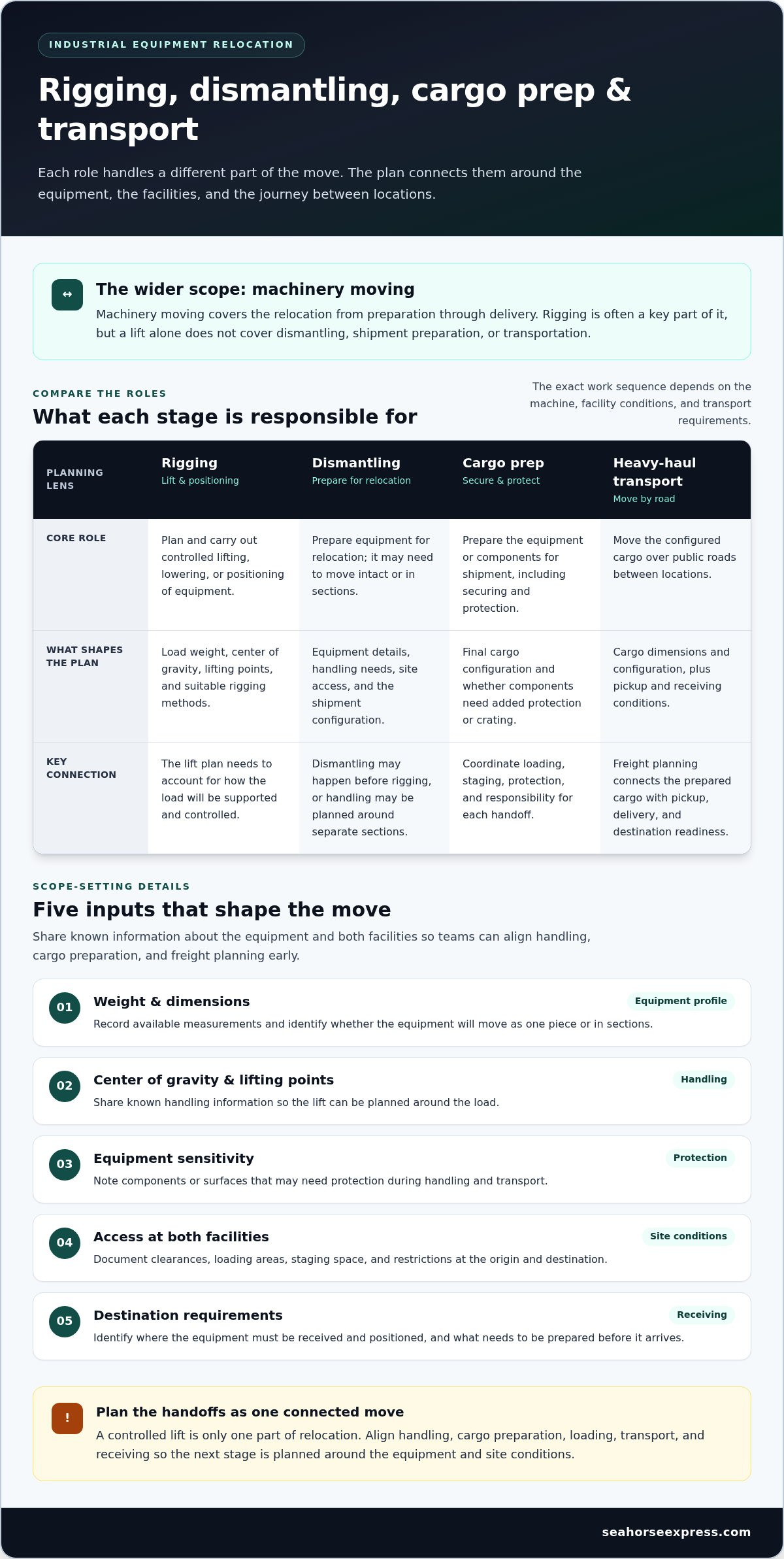
Rigging positions and handles machinery; machinery moving covers the broader relocation, from preparation through delivery. The distinction matters because a controlled lift is only one part of a move. Equipment may need to be dismantled, lifted, secured, packaged, and transported, with each step coordinated with the next. Machinery moving and rigging contractors help define how these connected tasks fit the equipment and the route between locations.
Machinery rigging is the planned, controlled handling of equipment during lifting, lowering, or positioning, using suitable rigging equipment and methods for the load. The term can refer to both the equipment and the work involved, as described in Rigging (material handling).
How rigging differs from machinery moving
Rigging focuses on the lift or positioning operation: how the load will be supported, controlled, and moved into place. Machinery moving may include rigging, but also covers the wider relocation plan, such as dismantling equipment, preparing it for shipment, and coordinating transportation. The terms overlap because rigging is often a key part of a move, but they describe different scopes. A rigging-only task may end once machinery is positioned; a facility relocation continues through transport and delivery.
When an industrial machinery move needs specialized coordination
Specialized coordination is useful when equipment is large, heavy, sensitive, or central to production. A machine’s weight and dimensions affect handling and transportation planning, while its center of gravity and lifting points influence how it can be supported and moved. Sensitivity to movement or contact can also shape dismantling, securing, and packaging decisions. Consider these details together rather than treating them as separate questions.
Access adds another layer. Narrow aisles, low clearances, limited staging space, or difficult loading areas can affect the order of work and the handling approach. A move between facilities also requires coordination between the departure site, transport, and destination so equipment can be released, loaded, received, and positioned in a workable sequence. For a closer look at preparing this type of relocation, consult the machinery removal planning guide.
Before defining the scope, gather what’s known about the equipment and both sites. Useful planning details include:
- Weight and dimensions: Record available measurements and identify whether the equipment will move as one piece or in sections.
- Center of gravity and lifting points: Share known handling information so the lift can be planned around the load.
- Equipment sensitivity: Note components or surfaces that may need protection during handling and transport.
- Access conditions: Document clearances, loading areas, staging space, and any restrictions at either facility.
- Destination requirements: Identify where equipment must be received and positioned, and what needs to be prepared before it arrives.
With these details in view, teams can align rigging, cargo preparation, and freight planning early. This helps clarify handoffs and build a move sequence around the equipment and facility conditions.
How Machinery Rigging and Moving Projects Progress from Scope to Transport
A well-coordinated move develops in stages, but the order of physical work depends on the equipment, facility conditions, and transport requirements. Machinery moving and rigging contractors use early project information to connect the handling plan with the cargo configuration and the journey ahead. The sequence below is a planning framework, not a fixed procedure for every machine.
- Collect equipment and cargo details. Assemble equipment descriptions, available dimensions and weights, known lifting points, handling notes, and information about sensitive components. Identify whether the machine can travel intact or may need to be dismantled. Clear documentation helps the project team identify missing details before work is scheduled.
- Review origin and destination conditions. Consider access routes within both facilities, door and ceiling clearances, loading areas, staging space, and operational constraints. The destination must also be ready to receive the equipment and support its next handling step. Conditions at either site can affect the scope and order of activities.
- Develop the handling and dismantling scope. Use the equipment information and site review to determine how preparation, lifting, and positioning relate to one another. Dismantling may occur before rigging, or handling may be planned around sections prepared for separate shipment. The appropriate approach depends on the machine and project conditions, not a universal sequence.
- Align cargo preparation with transport. The transport configuration influences how equipment is secured, protected, and loaded. Packaging or crating may be relevant for components that need added protection; the industrial equipment crating guide offers more context. Make loading, staging, and responsibility for each handoff clear in the project plan.
- Coordinate freight and delivery readiness. Plan transportation around the cargo’s final dimensions and configuration, as well as pickup and receiving conditions. Over-dimensional cargo may require route planning, permits, and escort logistics. Confirm that the destination can receive the shipment in the planned sequence, rather than treating delivery as separate from the move.
Transport planning should inform machinery preparation early because dismantling and packaging decisions can change the shipment’s dimensions, handling needs, and loading requirements. A late change to the cargo configuration can affect freight arrangements or site access. Connect these decisions as the scope takes shape.
Coordinate handling, preparation, and transport handoffs
Before work begins, map who is responsible for preparing the machine, protecting components, staging cargo, loading it, and coordinating transportation. The exact sequence can vary: some equipment may require crating before shipment, while other moves call for different preparation. For rigging work related to construction, consult the OSHA Rigging Equipment Standards for relevant equipment requirements. Seahorse Express connects machinery dismantling and rigging with heavy hauling and cargo preparation, supporting a coordinated approach to industrial relocation. Learn more about Seahorse Express machinery logistics.
How to Evaluate Machinery Moving and Rigging Contractor Capabilities
Compare the work your move requires, not just a list of equipment or services. A rigging-only scope may cover lifting and positioning machinery at a facility. A connected handling-and-freight scope can also include dismantling, cargo protection, transportation, and storage. The right scope depends on the move. Defining each task, handoff, and responsibility makes the project easier to coordinate.
Compare contractor scope with the actual move
Map the project’s needs against the work being coordinated. For example, machinery leaving a facility in sections may require dismantling and rigging, while a long-distance relocation may also involve crating, heavy hauling, or storage between move stages. Aligning the scope makes clear who prepares cargo, who manages each handoff, and how the work connects to transport. An equipment list alone won’t show whether those interfaces are covered.
| Capability area | What to align with the move |
|---|---|
| Scope | Identify whether dismantling, rigging, or both are needed, and define where each task begins and ends. |
| Handling coordination | Establish how equipment moves from its operating position to staging and loading, including responsibility at each transition. |
| Cargo preparation | Determine whether components need securing or custom crating, and how preparation relates to the planned shipment configuration. |
| Transportation | Match the freight plan to the cargo and route. Over-dimensional loads may require route planning, permits, and escort logistics. |
| Storage and port needs | Consider whether warehousing, storage, port drayage, or transloading fits the shipment’s route and schedule. |
Assess transport and cargo-protection coordination
Transport choices affect how machinery is prepared, secured, and handed off. If the final cargo configuration is over-dimensional, route planning, permitting, and escort logistics may form part of the move. If equipment needs protection or temporary holding, custom crating and warehousing can connect cargo preparation with freight planning. Port-connected shipments may also call for drayage or transloading; the professional drayage services guide explains how these services fit into freight movement.
For a rigging-only scope, define the endpoint for transportation, such as when machinery is ready for loading and who coordinates that transition. A connected scope can align dismantling and rigging with crating, storage, and freight planning. Seahorse Express provides machinery dismantling and rigging, heavy hauling, over-dimensional transportation, custom crating, warehousing, storage, and port drayage and transloading. The Specialized Carriers & Rigging Association also offers industry information relevant to specialized transportation and rigging.
Use the comparison to identify gaps before the move plan is finalized. Assess machinery moving and rigging contractors against the full chain of work, from equipment handling through cargo preparation and transportation, rather than by any single capability in isolation.
Machinery Move Preparation Checklist for Project Teams
Good preparation gives the project team and machinery moving and rigging contractors a shared, practical picture of the move. Start by collecting what’s known, then label estimates and open questions rather than treating them as confirmed facts. Site requirements vary, so use this checklist to organize planning without assuming every machine needs the same preparation.
Prepare equipment and site information
Gather equipment records and review the origin and destination conditions with people who understand each facility. Photos, drawings, and notes can reveal constraints that may be missed in a general description.
- Equipment identification: Record the machine name or asset number, make and model if available, and any relevant drawings or handling notes.
- Dimensions and weight: Document known measurements and weight data, marking whether each value is confirmed, estimated, or still being verified. Note protruding components or parts that may be removed.
- Handling requirements: Include known lifting points, sensitive parts, and any instructions for disconnection, dismantling, or reassembly already identified by the project team. Don’t assume an unknown handling detail.
- Access and site conditions: Record the proposed path through each facility, including doorways, turns, overhead restrictions, floor conditions, loading areas, and staging space. Note access limitations that could affect equipment handling.
Align timing, cargo protection, and destination readiness
Scheduling is part of the move plan, not an administrative detail to resolve at the end. Production schedules, shutdown windows, and competing work at either facility can affect when equipment is available, where it can be staged, and how the move fits around other operations.
- Dates and operating constraints: Set out target dates, required shutdown periods, production dependencies, and activities that must happen before or after the machinery move. Mark fixed commitments separately from preferred dates.
- Staging and cargo protection: Identify space for temporary staging and whether equipment or components may need custom crating, warehousing, or storage. Record known protection needs without deciding on a packaging method before the cargo is assessed.
- Receiving conditions: Note where the equipment will be received, whether the destination area will be ready, and what access or staging arrangements apply there. Include any identified positioning or reassembly requirements in the project scope.
- Transport coordination: Connect the cargo’s expected final configuration with loading and transportation planning. If dimensions or other details remain estimates, flag them so planning accounts for the uncertainty instead of relying on an unverified assumption.
Keep the checklist as a working project record. Update it as information is verified, and assign an owner to each unresolved item so site, handling, and transport decisions stay aligned. For support connecting machinery handling with cargo preparation and freight planning, plan your machinery move with Seahorse Express.
Seahorse Express Connects Machinery Rigging with Industrial Logistics
A machinery relocation may call for more than lifting equipment out of a facility. Dismantling, cargo protection, storage, and freight planning can all affect how the move is organized. Seahorse Express connects machinery dismantling and rigging with industrial transportation and cargo preparation, helping project teams plan related requirements as parts of one logistics scope.
Connect machinery handling to nationwide transportation
Seahorse Express provides machinery dismantling and rigging alongside heavy hauling and over-dimensional transportation. Planning these needs together helps align how machinery is prepared and handled with the configuration required for its journey. For example, a machine dismantled into sections may have different cargo preparation and transportation needs than equipment shipped intact. The appropriate plan depends on the equipment and project conditions.
For over-dimensional cargo, Seahorse Express coordinates nationwide route planning, permitting, and escort logistics when the shipment requires them. These transport considerations can inform handling and preparation decisions, rather than being left until machinery is ready to ship. The move can also include custom crating to prepare cargo for transit, or warehousing and storage when project timing calls for a place to hold equipment between stages.
Plan a coordinated industrial move with Seahorse Express
The services that fit a move depend on its route and cargo requirements. A project may connect machinery dismantling and rigging with heavy hauling, custom crating, or storage. Freight needs can also include domestic transport, import and export logistics, or port-connected services. Seahorse Express provides flat-rack and open-top container drayage and transloading across every major U.S. seaport, supporting applicable industrial shipments moving through ports.
To help shape a useful project scope, organize the information your team already has: equipment description, known dimensions and weight, origin and destination, access or handling requirements, and target timing. Include destination conditions and any known need for crating, storage, or port handling. These details help connect equipment preparation with freight planning and clarify the relevant handoffs.
For a coordinated machinery move, share your equipment details, origin and destination, and project timing with Seahorse Express.
Set the Move in Motion with a Clear Project Brief
Turn what your team knows into a practical starting brief. Bring together the equipment information, site constraints, timing priorities, and destination needs, and distinguish confirmed details from estimates. This gives machinery moving and rigging contractors a clearer basis for shaping the project scope and identifying decisions that still need attention.
A move doesn’t need every detail resolved before planning can begin. An organized brief helps surface dependencies early, so your team can coordinate internal schedules and prepare for key handoffs. Keep the project record current as information changes, and make sure the people responsible for site access, equipment preparation, and receiving arrangements are working from the same plan.
Share your machinery move requirements with Seahorse Express to start discussing a coordinated approach. Share your machinery move requirements with Seahorse Express.
With a clear starting point and a connected plan, your team can move forward with greater confidence.
Frequently Asked Questions
What is the difference between machinery moving and rigging?
Rigging addresses the controlled lifting or positioning of machinery, while machinery moving refers to the wider relocation project. A task might involve rigging a press to remove it from a production line, then preparing it for shipment to another facility. The move can include activities beyond the lift. Defining the scope this way helps teams understand whether they need support for a specific handling phase or a broader relocation.
Can machinery moving contractors handle dismantling and transportation?
Yes. The work can include both dismantling and transportation when those services are part of the project scope. Seahorse Express provides machinery dismantling and rigging alongside heavy hauling and domestic freight transport. For a production line with connected sections, teams can identify which components must be separated, how each will be prepared for shipment, and how transportation fits the project schedule. Clear task boundaries help reduce uncertainty at handoffs.
What information should I provide for a machinery moving plan?
Provide the equipment’s identification, known dimensions and weight, available drawings, handling notes, and clear photos if available. Include the planned pickup and delivery locations, access constraints, loading conditions, target dates, and any production or shutdown dependencies. Flag details that are estimates rather than verified measurements. This gives the planning team a useful starting picture and helps identify which equipment or site information needs follow-up before the scope is finalized.
Does every industrial machinery move require rigging?
No. The handling method depends on the equipment and site conditions. Some moves may use rigging for lifting or positioning; others may involve a different approach based on the machine, its location, and the route through the facility. For example, equipment already accessible at a loading area may have different handling needs than machinery in a confined production space. The project scope should reflect the actual move.
Can machinery be crated before it is transported?
Yes. Crating can be included when the equipment or its components need added protection during shipment. The preparation plan should account for the machine’s configuration after dismantling, any sensitive parts, and how the cargo will be handled and transported. Seahorse Express provides custom crating for industrial cargo. Teams can note which components need protection and coordinate crating with staging and loading arrangements as the shipment plan develops.
How are oversized machinery moves planned across state lines?
Planning starts with the shipment’s final dimensions and weight, since dismantling or packaging can change the cargo configuration. The route, pickup and delivery access, and transport requirements then inform the move plan. For over-dimensional cargo, Seahorse Express coordinates nationwide route planning, permitting, and escort logistics when required. Sharing accurate cargo details early helps connect preparation at the facility with transportation planning across state lines.
Can a machinery move include temporary storage?
Yes. Temporary storage can be incorporated when equipment needs to wait between removal and delivery, or when project activities at the receiving facility aren’t aligned with shipment timing. Planning should identify what cargo will be stored, when it is expected to move onward, and how storage fits the broader freight sequence. Seahorse Express provides warehousing and storage for industrial logistics, helping teams include this stage in the move scope.


